




10 Inspiring Muslim Startup Founders Making a Global Impact

The startup world thrives on stories ; the late-night pivots, the restless curiosity, the stubborn refusal to accept “that’s just how it is.” In that landscape, Muslim startup founders have been building companies that change how people learn, move, eat, buy, and even feel. This post highlights ten inspiring founders ; from education and AI to food and e-commerce ; whose ideas turned into global businesses and whose leadership continues to shape industries.
What “impact” means in this context
For this list, founders were included based on the following criteria:
- They built companies with global reach or significant industry influence.
- They demonstrated sustained leadership in founder, co-founder, or CEO roles.
- They created measurable social, economic, or technological impact.
Each profile shows who the founder is, what problem they set out to solve, why their journey is important, and the impact they’ve made. The descriptions are short and easy to read but still give you a good sense of their achievements.
Sal Khan ; Khan Academy (Education)
The founder
Salman “Sal” Khan turned a few math videos into one of the world’s most-used free learning platforms.
What they built
Khan Academy offers thousands of video lessons, practice exercises, and tools for teachers, all used by students and schools around the world. Its goal is to make quality education free and easy for everyone to access.
Why it’s inspiring
Sal’s story is classic startup-by-helpfulness: tutoring his cousins remotely grew into a nonprofit used by millions. Khan Academy re-imagined how asynchronous learning scales and set a blueprint for mission-driven edtech.
Mustafa Suleyman ; DeepMind & Inflection (Artificial Intelligence)
The founder
Mustafa Suleyman co-founded DeepMind, one of the world’s most famous AI labs, and later co-founded Inflection ; shaping how AI products and ethics combine.
What they built
DeepMind produced breakthroughs like AlphaGo and AlphaFold (protein folding). Suleyman later focused on applied AI, AI governance, and consumer AI products.
Why it’s inspiring
He’s both a technical ecosystem builder and a public voice on responsible AI , arguing that AI’s power must be matched with ethics and institutional thoughtfulness. His career shows how a founder can move from research to real-world productization while keeping ethics on the agenda.
Hamdi Ulukaya ; Chobani (Food & Social Impact)
The founder
Hamdi Ulukaya founded Chobani, turning a small yogurt factory purchase into a global brand and a major U.S. food company.
What they built
Chobani disrupted the yogurt aisle with strained yogurt and a brand positioned around quality and better-for-you choices. Ulukaya is also a prominent philanthropist focused on refugees and humane company practices.
Why it’s inspiring
Hamdi combines founder grit with large-scale social giving: Chobani pledged profit-sharing programs and significant charitable commitments. His trajectory is a reminder that consumer products can carry deep social purpose.
Mudassir Sheikha ; Careem (Ride-hailing & Regional Scale)
The founder
Mudassir Sheikha co-founded Careem, the Dubai-based ride-hailing app that re-shaped mobility across the Middle East, North Africa and Pakistan.
What they built
Careem localized ride-hailing for regional needs (cash payments, local regulations, service types) and scaled across dozens of cities before being acquired by a global leader.
Why it’s inspiring
Careem is a case study in taking a global idea and making it hyper-relevant locally. Mudassir’s leadership shows how founders from the region can create category winners that compete with global giants.
Omar Hamoui , AdMob (Mobile advertising)
The founder
Omar Hamoui founded AdMob, an early mobile advertising network that became a vital part of mobile app monetization.
What they built
AdMob helped publishers and app developers monetize mobile traffic and was acquired by Google, shaping the foundations of mobile ads we still use today.
Why it’s inspiring
Omar’s work demonstrates the entrepreneurial pattern of solving an emerging platform problem (mobile monetization) early, scaling quickly, and influencing an entire industry after acquisition.
Fadi Ghandour ; Aramex & Wamda (Logistics & Ecosystem Building)
The founder
Fadi Ghandour co-founded Aramex (a pioneering regional logistics company) and later built platforms that support entrepreneurship across the MENA region.
What they built
Aramex became a logistics leader in a region where cross-border shipping was hard. Through Wamda and related initiatives, Ghandour has invested in ecosystem development, funding and mentoring startups across the Middle East and North Africa.
Why it’s inspiring
He shows that founders can lift entire ecosystems , not just build companies , by creating capital, knowledge networks, and platforms for the next generation of founders.
Nadiem Makarim ; Gojek (Super-app & Platform Transformation)
The founder
Nadiem Makarim founded Gojek in Indonesia and built a multi-service super-app that started as motorbike rides and became payments, delivery, and more.
What they built
Gojek transformed informal gig work into a digital earning platform for millions of drivers and small merchants, reshaping Southeast Asian digital services.
Why it’s inspiring
Nadiem’s model , turning an on-demand transport solution into an ecosystem , influenced many regional “super-app” plays and modern gig economies. It’s a lesson in modular scaling and platform thinking.
Huda Kattan ; Huda Beauty (Beauty & Creator Economy)
The founder
Huda Kattan launched Huda Beauty from a blog and Instagram presence into one of the world’s best-known beauty brands.
What they built
Huda Beauty started with false eyelashes and scaled into make-up lines sold globally, leveraging content, creator-first marketing, and community feedback.
Why it’s inspiring
Huda’s growth shows how founders can flip the old ad-driven model: build audience trust first, then product. She is among the highest-profile female Muslim founders in beauty and lifestyle. (Note: like any public figure, she’s also been in the spotlight for controversies; founder stories are rarely only wins.)
Tariq Farid ; Edible Arrangements (Franchise & Retail Innovation)
The founder
Tariq Farid founded Edible Arrangements, a franchise brand that reinvented fruit baskets as designed edible bouquets.
What they built
What started as a single store expanded via franchising into over 1,000 locations across many countries, combining in-store retail, logistics, and seasonal gifting.
Why it’s inspiring
Tariq’s path , immigrant roots, small business innovation, and franchising , is a practical blueprint for founders who want to scale service concepts globally. He’s also widely recognized for mentoring and supporting small business entrepreneurship.
Rana el Kaliouby ; Affectiva (Emotion AI & Ethical Tech)
The founder
Rana el Kaliouby co-founded Affectiva to build technology that can read and respond to human emotional signals.
What they built
Affectiva created emotion-recognition software used in research, automotive safety, and media measurement. The company focused on combining AI with rigorous emotion science.
Why it’s inspiring
Rana’s journey is important for two reasons: she’s a highly visible Muslim woman leader in AI, and she pushed the debate on how sensitive AI applications should be built and governed. Her work highlights the role of empathy and ethics in product design.
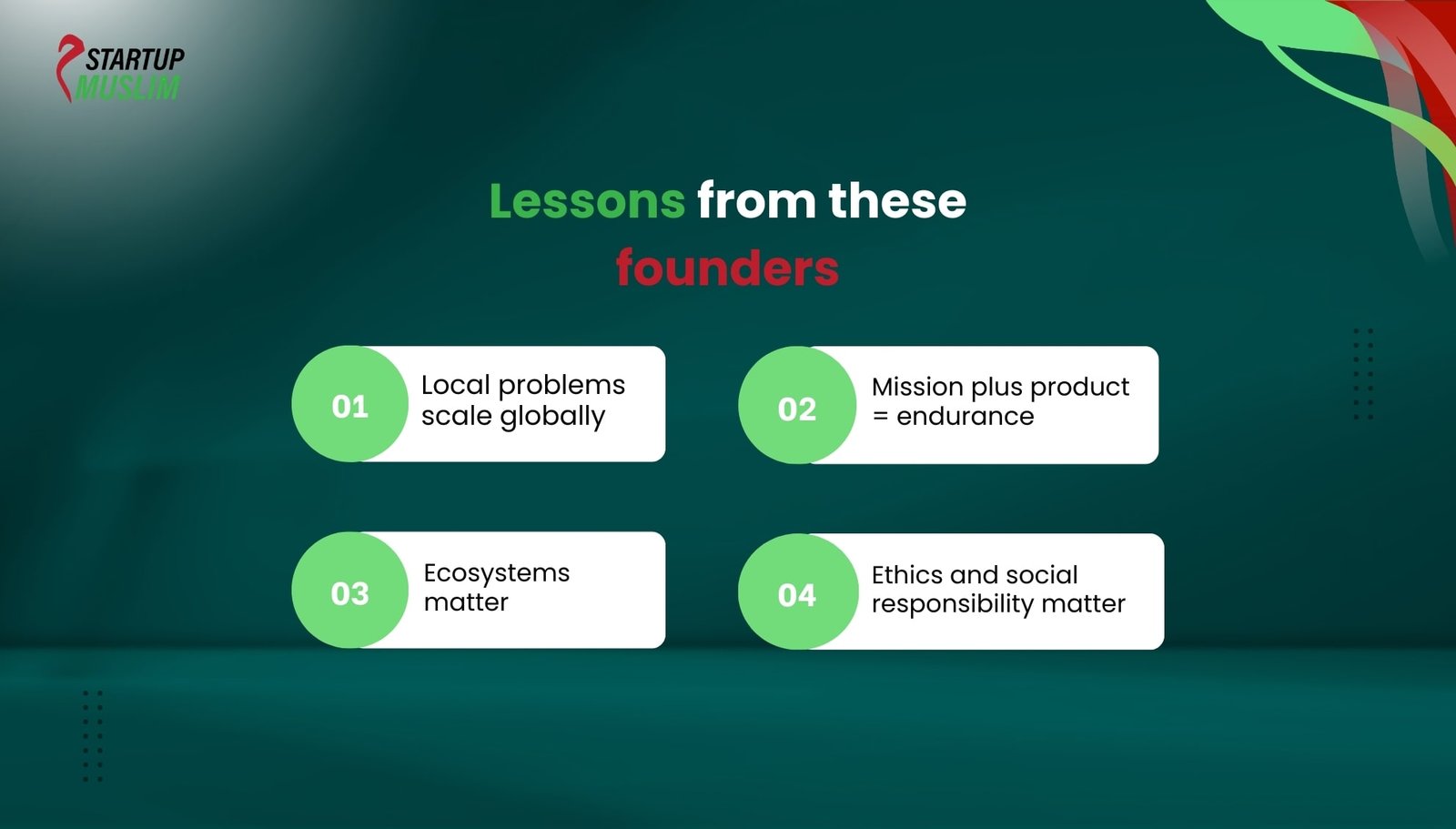
Lessons from these founders
1. Local problems scale globally
Many of the founders above started by solving region-specific problems , Careem for MENA transit, Gojek for Jakarta’s motorbike culture , and then generalized their solutions. Start locally; think globally.
2. Mission plus product = endurance
Whether it’s free education, better food, or safer AI, a clear mission helps attract users, talent, and partners. Mission-driven companies often weather the messy growth years better.
3. Ecosystems matter
Founders like Fadi Ghandour show that building capital, mentorship programs, and infrastructure accelerates more founders , multiplying impact beyond one company.
4. Ethics and social responsibility matter
From Mustafa Suleyman’s public focus on AI ethics to Hamdi Ulukaya’s refugee philanthropy, these leaders remind us that influence comes with responsibility.
How to support the next wave of Muslim innovators
- Celebrate diverse role models: share founder stories in classrooms and local meetups.
- Invest locally: seed funds and angel investors in underrepresented regions multiply opportunities.
- Mentor and teach: founders pay forward learning by opening doors to interns and early hires.
- Advocate for policy that removes barriers: infrastructure, payments, and logistics matter to scaling.
Closing Thoughts
It is not just these ten leaders but many more who are making a difference in this world.
What makes them different is, they didn’t just see a problem as just a problem, they saw it as an opportunity to not only solve it but also as an opportunity to create something meaningful and impactful that would last decades. Be it tech, education or food, they got into every field.
These stories are proof that passion combined with purpose makes waves. They have set a fine example for coming Muslim Founders that Muslim Startups belong to gloabl stage. The journey they have undertaken to reach their destinations is a beacon of light for generations of Muslims to come.
👉🏻Any Muslim-owned business, any industry.!!!
Share your story on Startup Muslim, build credibility, and attract new opportunities. Apply today!
Frequently Asked Questions (FAQs)
1) What is the purpose of Startup Muslim?
Startup Muslim highlights Muslim-owned businesses, shares success stories, offers tips, and supports founders.
2) Who are the founders featured?
It features Muslim founders, creators, and CEOs from all industries; tech, fashion, food, finance, education, and more; both established and new.
3) How does Startup Muslim decide who to feature?
Founders are selected for creativity, impact, ethics, community work, and strong leadership.
4) Can Muslim entrepreneurs submit their businesses?
Yes. Entrepreneurs can submit via the website, and the team features entries that align with the mission.
5) Does Startup Muslim offer resources for entrepreneurs?
Yes. It provides articles, interviews, and tips on fundraising, branding, marketing, and scaling to help founders grow.