





The Former Actuary Who Walked Away from a Prestigious Career to Build a Fairer Financial System
Success often arrives disguised as certainty. A prestigious profession, a stable career, and a clear path to financial security are the milestones many aspire to achieve. For Raza Ullah, those milestones came early. As a qualified actuary, he built an impressive career working with some of the UK’s most respected financial institutions, including PwC, Lloyd’s of London, and the Bank of England’s Prudential Regulation Authority. From the outside, he had everything a finance professional could hope for.
Yet beneath the professional success, a different question was beginning to emerge. Was he simply becoming another participant in a financial system, or could he use his knowledge to build something that genuinely benefited people?


That question would eventually lead him to leave the City of London and build Pfida, an ethical fintech company that is challenging one of the most deeply rooted assumptions in modern finance—that debt is the only path to homeownership.
A Question That Changed Everything
Raza’s journey into entrepreneurship did not begin with a startup idea or a desire to build the next unicorn. Instead, it began with an unexpected conversation.
At the time, he was discussing his personal financial ambitions with a colleague. Like many professionals, he was saving to buy property and had begun considering rental investments as a route to financial independence. His colleague responded with a question that would remain with him long after the conversation ended.
“With your skills,” the colleague asked, “should you really be adding to the housing problem—or using those same skills to help solve it?”
The question forced Raza to rethink not only his career but also the purpose behind it. If he understood how financial systems worked, perhaps he also had a responsibility to improve them.
That feeling became even stronger later that year during his pilgrimage to Makkah. Standing on the plains of Arafah during Hajj, he found himself reflecting not on career progression or financial success, but on accountability.
“Ya Allah, You have given me everything… so what will I say to You on that Day when You ask what I did with it all?”
For Raza, that moment became the defining turning point of his life.
“It wasn’t simply about changing careers,” he recalls. “It was about recognising that the knowledge I’d been given came with responsibility.”
In 2016, he walked away from his corporate career and began building what would become Pfida—not simply another fintech startup, but an attempt to rethink how finance itself could work.
Challenging the Foundations of Modern Finance
Having spent years inside some of the world’s most sophisticated financial institutions, Raza understood both the strengths and limitations of conventional finance.
One issue stood out above all others. Homeownership had become inseparable from debt. For Muslims, that created an immediate dilemma because traditional mortgages rely on interest-based lending. While Islamic finance products existed, Raza believed many simply recreated conventional lending structures using different contractual terminology.
“I didn’t want to build a Shariah-labelled version of conventional finance,” he explains. “I wanted to build something fundamentally different.”
That meant replacing the relationship between lender and borrower with one based on partnership. Instead of financing homes through debt, Pfida would purchase properties alongside customers through a shared ownership model. Customers would gradually increase their ownership over time while paying rent on the portion owned by Pfida, creating a structure based on real assets rather than financial leverage. The distinction may appear subtle, but Raza believes it changes the entire relationship.
Debt transfers risk almost entirely to the borrower. Partnership shares both responsibility and reward. That principle became the foundation upon which Pfida was built.
Reinventing Homeownership
Today, Pfida describes itself as an ethical fintech helping people save, invest, and achieve homeownership without relying on interest or debt.
Its flagship product, OwnTogether, allows customers and Pfida to jointly purchase a property. Customers pay rent only on the portion they do not yet own and have complete flexibility regarding when—and how much—additional equity they choose to purchase.
Unlike traditional mortgages, there is no interest-bearing loan. Unlike many existing Islamic finance products, there is no contractual obligation forcing customers to buy Pfida’s share within a predetermined timeframe.
The company has also deliberately separated rental pricing from interest-rate movements, introduced annual caps on rent reviews, created rental discounts for customers, and even established equity buffers designed to support homeowners during periods of financial hardship.
For Raza, these features are not simply product innovations. They represent a different philosophy of finance.
“We wanted to create something based on partnership, flexibility and genuine risk-sharing—not simply another way of packaging debt,” he says.

Building Trust Before Scale
Launching a financial institution is significantly more complex than launching a conventional technology startup.
Trust must be earned from regulators, investors, customers, scholars, and partners simultaneously. For Pfida, that meant spending years refining its legal structures, developing technology, strengthening governance, and engaging carefully with regulators before fully entering the market.
Raza resisted the temptation to pursue rapid growth. Instead, he focused on building the right foundations first.
“We didn’t have endless capital or a huge marketing budget,” he explains. “A lot of our early momentum came from people who believed in the vision and helped us grow organically.”
That patience has gradually paid off. Since launching its home finance product in 2019, Pfida has financed more than £56 million worth of homes while attracting over £78 million in customer savings—all without relying on bank funding or institutional debt markets. Instead, the business operates through what Raza describes as a community-powered funding model inspired by prophetic tradition, where savers collectively help finance the homeownership journeys of others.
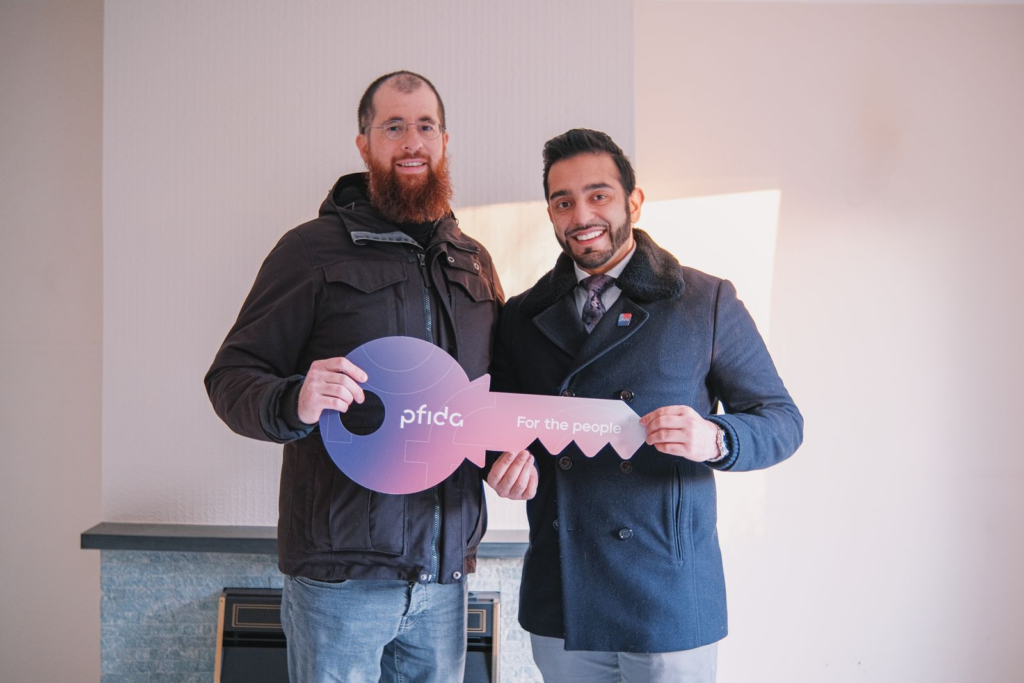
The milestone he values most, however, has little to do with capital deployed. He remembers speaking with Pfida’s 100th homeowner, who had spent a lifetime renting and believed buying a home would never be possible until discovering the platform.
“Those are the moments that matter,” Raza says. “That’s how Pfida changes lives.”
A Business Model Rooted in Real Assets
While many fintech companies generate revenue by extending credit, charging transaction fees, or leveraging customer deposits, Pfida’s model is intentionally different.
Revenue comes from ownership of real assets. When Pfida purchases part of a property alongside a customer, it earns rental income on its ownership share while customers gradually increase their equity over time. Likewise, customer savings are deployed to finance real homes, with returns linked to rental income and underlying property performance rather than interest payments.
“The way we earn matters just as much as how much we earn,” Raza explains. “We only want revenue that is connected to genuine value creation—not hardship.”
That philosophy extends beyond product design into leadership itself.
“My faith reminds me that business is an amanah—a trust,” he says. “Customers trust us with their savings, their homes and their aspirations. That’s an enormous responsibility.”
For Raza, commercial success and faith are not competing priorities. One strengthens the other.
Building a Camel, Not a Unicorn
While much of the startup ecosystem celebrates unicorn valuations and hypergrowth, Raza deliberately uses a different metaphor.
“I don’t want to build a unicorn,” he says. “I want to build a camel.”
The distinction reflects his philosophy of resilience over hype. Camels survive harsh environments because they are built for endurance rather than speed. Likewise, Pfida is being built around sustainable income, community capital, and long-term value instead of excessive leverage or growth at any cost.
Over the coming years, the company plans to expand its community-powered savings platform, improve its digital customer experience, strengthen partnerships, and explore how technologies such as artificial intelligence can improve transparency while simplifying ethical financial services.
More importantly, Raza hopes Pfida proves something much larger than one successful company. He wants to demonstrate that partnership-based finance can compete with debt-based banking on commercial terms while remaining firmly rooted in ethical principles.
Redefining the Future of Finance
Looking ahead, Raza’s ambition extends far beyond home finance. He envisions Pfida becoming a trusted ethical alternative to conventional banking—a place where customers can save, invest, purchase homes, and manage their financial lives without compromising their values.
More importantly, he hopes the company leaves behind a lasting legacy. “I don’t want Pfida to be remembered simply as a successful fintech,” he says. “I want it to be remembered as one of the businesses that proved finance could be built differently.”
For too long, he believes, society has accepted debt as the inevitable foundation of economic progress. Pfida exists to challenge that assumption by showing that partnership, shared ownership, community capital, and real asset-backed finance can create a system that is not only commercially viable but also fairer, more resilient, and more humane.
If that vision succeeds, Pfida’s greatest achievement will not be the number of homes it finances or the assets it manages. It will be restoring confidence that faith and financial progress do not have to exist in tension—that ethical principles can serve not as constraints on innovation, but as the very foundation upon which a better financial system is built.


