


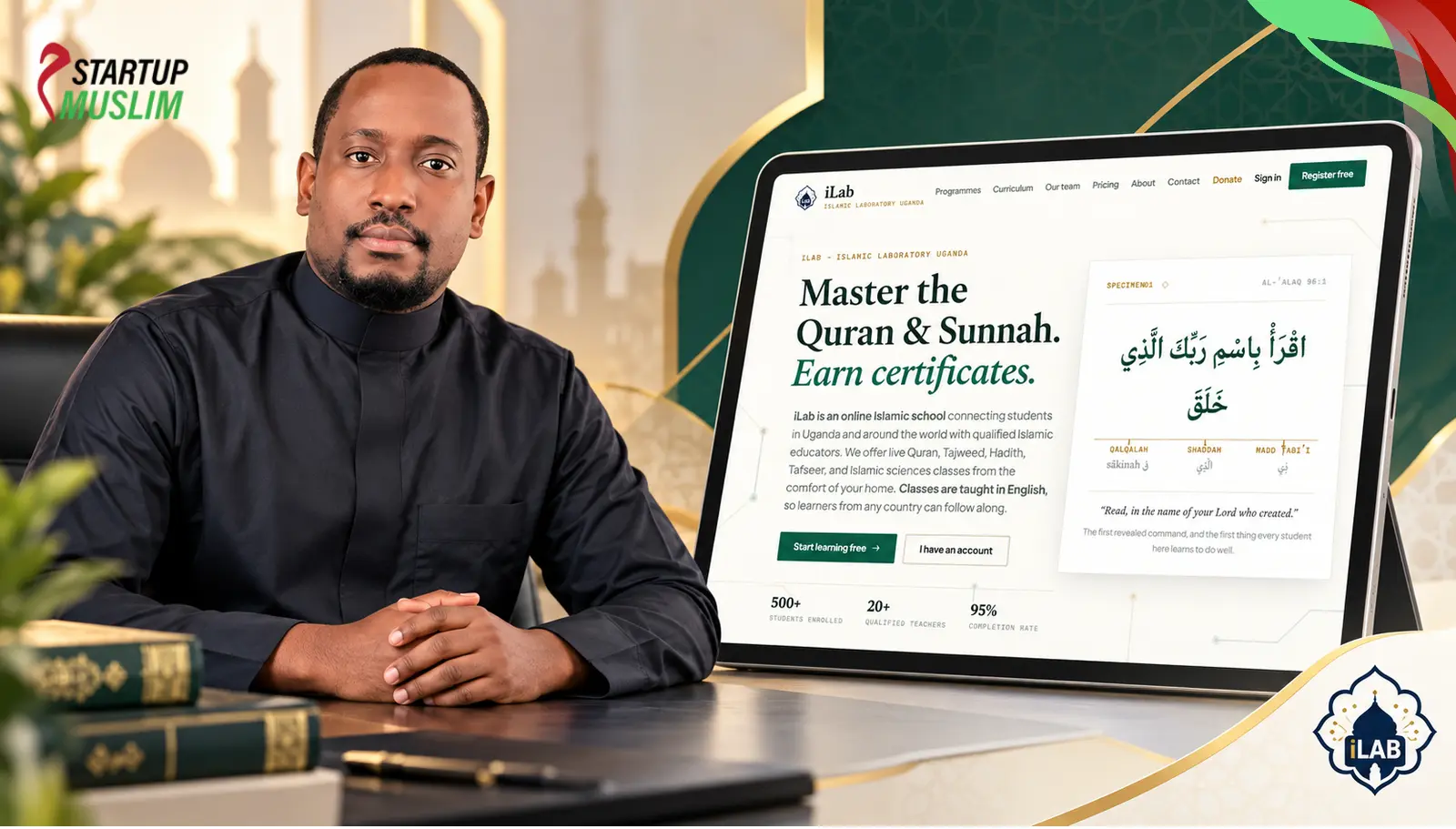
For many Muslims, the desire to deepen their understanding of Islam is not the problem. Finding the time, a qualified teacher and a structured learning programme that fits around the demands of everyday life can be much harder. For families balancing work, school and other responsibilities, regular Islamic education often requires a level of coordination that is difficult to sustain.
In Uganda, Huzaifah Lutaaya Idris and his co-founders saw an opportunity to address that challenge through technology. Their venture, iLab, combines live, teacher-led lessons with structured learning pathways and digital progress tracking, allowing students to learn remotely without losing the guidance of a teacher.
The ambition is straightforward but consequential. Rather than treating online Islamic education as a collection of disconnected lessons, iLab aims to make it a consistent learning experience, with clear stages, appropriate teaching and a way for students to understand their progress.
For Idris, a software engineer whose career has included roles at Andela, Retro Rabbit and New Vision, the opportunity lies at the intersection of technology, education and community needs. The challenge is to build a platform that can expand access while remaining affordable, academically grounded and financially sustainable.
1. Solving the Access Problem in Islamic Education
Idris co-founded iLab with Kiberu Faiswal Salim and Nabil Matovu, bringing together complementary expertise in technology, Islamic scholarship and business development. As Founder and Chief Executive, Idris leads the platform’s technology and overall development. Salim, who holds a BA in Sharia from the Islamic University of Madinah, has an ijāzah in the Qur’an with the complete Qirāʾāt and is pursuing a master’s degree in Sharia at the Islamic University in Uganda, leads the academy’s curriculum, teaching standards and student assessments.

Kiberu Faiswal Salim

Nabil Matovu
Matovu, an entrepreneur, halal events manager and business advocate, oversees development and marketing. The founding team’s combination of technical capability, religious scholarship and outreach reflects the problem they set out to solve. Making Islamic education accessible requires more than a functioning website; it also requires credible teachers, an appropriate curriculum and a way to reach learners who can benefit from the service.
The founders did not identify a shortage of dedicated teachers or Islamic knowledge. Instead, they saw that many people struggled to find regular classes that accommodated their work, studies, family commitments or distance from a suitable teacher. iLab was created to connect learners with qualified educators and provide a clearer path through their studies.
That distinction shapes the platform’s approach. Technology is intended to remove logistical barriers, not replace the teacher or the relationship between a student and an educator.
2. Applying a Software Engineer’s Mindset to Learning
Idris’s professional background has influenced how he approaches the platform. His experience at Andela, Retro Rabbit and New Vision, followed by roles with technology companies in Germany, taught him to examine how systems work as a whole rather than focus exclusively on individual features. For iLab, that means considering the entire learner journey, from discovering a class and choosing a schedule to progressing through a level and receiving feedback.
A platform can make lessons available online and still leave students without a clear sense of direction. Idris wants iLab to provide structure around the learning experience, helping students understand where they begin, what they need to learn next and how their progress is being assessed. Digital systems can also help teachers manage attendance and monitor students more consistently.
This approach reflects a broader lesson from educational technology projects across Africa. Connectivity, affordability, language, device access and local habits all influence whether a digital product becomes useful in practice. A technically sophisticated system is not necessarily an effective educational one if it fails to accommodate the realities of its intended users.
Idris’s experience includes work on audience measurement for Ubongo, an educational media organisation, as well as other educational technology projects. These experiences reinforced his belief that technology must be designed around the people using it and the outcomes they need, rather than the technology itself.
3. Combining Live Teaching With Structured Learning Paths
iLab’s core offering brings together live lessons, defined learning levels and digital progress tracking. In Qur’an studies, students can progress from foundational reading to Tilāwah, memorisation and more advanced study. Their starting point is determined by their current ability, helping the learning experience reflect their individual needs rather than forcing every student through the same sequence.
Students can select class schedules that suit their circumstances, while teachers monitor attendance and progress. The model aims to combine the convenience of online learning with the regular interaction and guidance associated with teacher-led instruction. It also gives the platform a clearer educational framework than a library of recordings alone.
The distinction matters because learning a subject such as Qur’an recitation involves more than consuming information. Students need appropriate instruction and feedback as their abilities develop. A structured programme can help establish continuity, although its effectiveness ultimately depends on teaching quality, student engagement and consistent participation.
iLab’s model is still developing, and the company is working to strengthen the way it measures retention and course completion. Idris has chosen not to publish percentages until the underlying figures can be measured consistently. That restraint is important for an early-stage education company, where enrolment alone cannot establish whether students are learning effectively or remaining engaged over time.
4. Early Traction and the Economics of Accessible Learning
As of 1 October 2026, iLab had reached 100 paying students, up from six at the end of July. The company has also received free registrations and enquiries, although Idris is reconciling those figures with active learners before reporting a total. The early increase in paying students provides an initial indication of demand, but sustained growth will depend on the company’s ability to attract students and keep them engaged.
The company offers subscription packages starting at UGX 23,500 per week and UGX 95,000 per month. The pricing strategy must balance two objectives that can be difficult to reconcile: keeping Islamic education affordable for families while generating enough revenue to support teachers, technology and continued product development.
That challenge is central to iLab’s long-term prospects. If subscriptions are priced beyond what many prospective learners can afford, the platform risks limiting its reach. If prices are too low to cover the cost of delivering quality instruction, the company may struggle to maintain the service as enrolment grows.
Partnerships could help bridge that gap. Idris sees opportunities to work with organisations that can sponsor access or provide learning devices for students and teachers who need support. Such partnerships could broaden access while creating additional routes to sustainability, although their impact will depend on the funding and delivery models iLab develops.
5. Reaching Learners Beyond Reliable Connectivity
Expanding digital education beyond well-connected communities presents a different set of challenges. iLab’s current classes are delivered through its website and mobile applications and require an internet connection. For learners in rural areas with unreliable electricity or limited connectivity, that requirement can restrict access even when the educational content is relevant.
The company has identified teacher devices and offline access as important needs and is exploring what a solar-supported learning model might look like. However, solar-powered tablets have not yet been deployed at scale. Any rollout would need to account for charging, device maintenance, connectivity, content access and the ongoing support required by teachers and students.
The opportunity is significant, but the execution will matter. Providing devices alone does not guarantee that students can participate in regular classes or receive the support they need. A viable model would have to connect the hardware to a dependable educational service, with practical arrangements for maintaining devices and supporting learners over time.
For Idris, the wider lesson is that digital inclusion requires an understanding of local conditions. The most useful solution may not be the most technically ambitious one, but the one that reliably enables a student to learn despite the constraints around them.
6. Building an Education Mission That Can Last
Alongside iLab, Idris balances his work with Dar Al Maswadir Islamic Foundation, which addresses broader community needs. He sees the two initiatives as connected through a wider commitment to education and community development, even though their day-to-day responsibilities differ. Both require careful planning, trusted local relationships and accountability to the people they serve.
That responsibility also shapes how he thinks about professional setbacks. Building a new service with limited resources means continuously learning what students and teachers need, adjusting assumptions and improving the product. Idris says his faith, his sense of responsibility to the community and his belief in education’s ability to change lives help him remain patient through those challenges.
The next stage for iLab involves broadening its course offerings and strengthening its teacher network. In 2027, the company hopes to introduce planned Ibtidā’ primary classes and I‘dād classes for adults who missed those stages, combining live instruction with recorded lessons. Over the longer term, Idris wants iLab to serve Muslim learners across Africa and eventually beyond the continent.
That ambition will require more than adding courses or expanding the platform’s reach. The company will need to demonstrate consistent educational quality, measure student outcomes more reliably and establish a sustainable operating model. Its plans for offline and solar-supported access will also need to move from exploration to practical implementation if they are to reach communities facing the greatest barriers.
7. A Broader Vision for Islamic Learning
iLab’s story reflects a growing opportunity to apply digital tools to longstanding educational needs without losing sight of the human relationships that make learning meaningful. Its founders are attempting to bring together qualified scholarship, structured instruction and technology in a format that can accommodate the realities of modern life.
The early enrolment figures provide a starting point, not a verdict on the business. The next test is whether iLab can convert initial demand into sustained participation, demonstrate the value of its teaching model and expand access without compromising quality or financial stability.
For Idris, the larger goal remains clear: to make structured Islamic learning easier to access, whether a student lives near an established teacher or faces practical barriers to attending regular classes. If iLab can build a dependable and sustainable service around that mission, it could help more learners pursue their education on a schedule that works for them.
The measure of success will not simply be how many people sign up, but how many are able to continue learning.
