


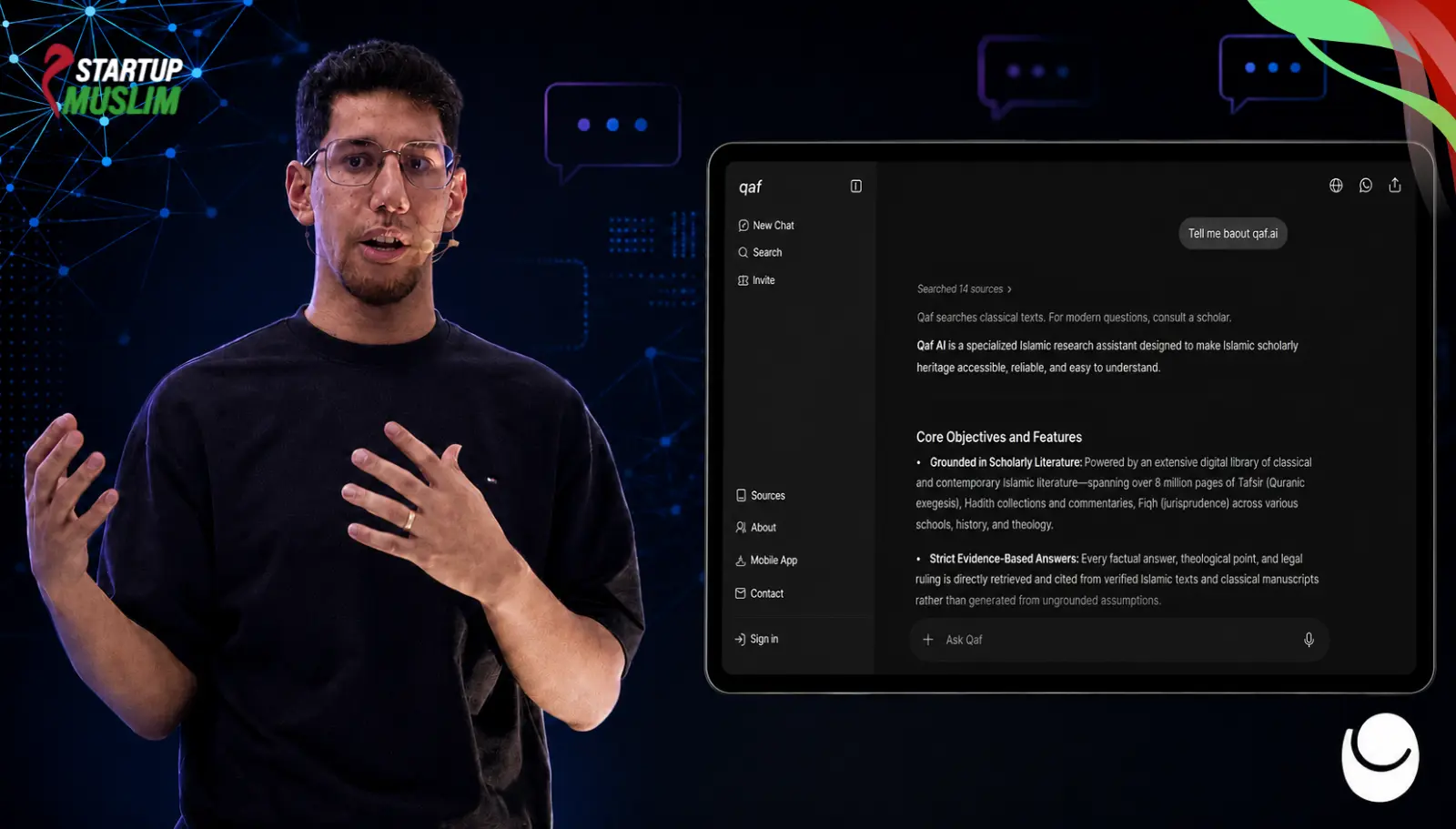
Qaf Islamic AI has crossed 25,000 users as Abdellatif Abdelfattah and his team attempt something far more difficult than building another chatbot: making thousands of Islamic books searchable through artificial intelligence without allowing the technology to present itself as a replacement for scholars.
Artificial intelligence has made it possible to ask increasingly complex questions and receive polished answers within seconds. For most technology companies, the challenge is making those answers faster, more accurate and less expensive to generate. But when AI is applied to Islamic knowledge, the stakes become considerably higher. A fabricated hadith, an incorrectly attributed statement, or a religious opinion presented without its scholarly context is not simply a poor search result. It can shape how a person understands and practices their faith.
That tension sits at the center of Qaf, an Islamic AI platform that extensively searches more than 8,000 Islamic books and provides source-backed answers to users researching Islamic questions. The platform recently crossed 25,000 users, marking an early milestone for a product being built by Abdellatif Abdelfattah, CEO of Agentset and Qaf and one of the builders behind Tarteel.
For Abdelfattah, however, Qaf is not simply a product created because generative AI happens to be the technology industry’s latest wave. He sees it as part of a much longer history in which each major computing platform has changed the way Muslims access Islamic knowledge.
“With every wave of technology there’s a new group of Islamic applications,” Abdelfattah told Startup Muslim. “With desktops there was Quran player CDs and a Windows application to read the Quran. With the internet there was Quran.com and Islamic lectures on YouTube. With mobile phones there were Quran, Qibla, and prayer time apps. And now with AI there’s a new wave of products that we can build for Muslims.”
The question for his team was therefore not whether Muslims would eventually use artificial intelligence. It was how the technology could be built deliberately around their needs.
“The question we started with was how can we use AI to better serve Muslims,” he said. “We as engineers were using Claude Code and other AI coding tools all the time. Can we apply the same technology for Islamic knowledge? And that’s what started the idea.”
Qaf Islamic AI Is Trying to Preserve Scholarly Complexity, Not Eliminate It
Applying artificial intelligence to Islamic scholarship creates a problem that many conventional AI applications do not have to address. Islamic knowledge is not a single database of uncontested answers. It encompasses more than fourteen centuries of Quranic commentary, hadith, jurisprudence, theology, biography, history and scholarly interpretation. Within that tradition, respected scholars can examine the same sources and reach different conclusions because they apply different methodologies or belong to different schools of jurisprudence.
Generative AI, by contrast, is exceptionally good at taking complexity and turning it into a clean, confident response. That can make technology easier to use, but in Islamic scholarship it can also erase precisely the context the user needs to understand.
An AI system could take several recognized scholarly opinions and compress them into a single answer that appears to represent “the Islamic position.” The response might sound authoritative while obscuring centuries of legitimate disagreement.
Abdelfattah says Qaf is intentionally designed not to behave that way.
“Qaf does not present a particular view as the correct one,” he explained. “Instead it showcases the different opinions and highlights if one holds a strong majority.”
That design decision is important because it shifts the objective of the product. Qaf is not attempting to manufacture certainty where the underlying tradition contains disagreement. It is trying to make the disagreement itself understandable. If multiple recognized positions exist, users should be able to see that. If one view represents a substantial scholarly majority, Qaf can provide that context without pretending that minority positions never existed.
For an AI product, this requires resisting the temptation to optimize entirely for simplicity. The easiest answer for the user is not always the most intellectually responsible answer. Sometimes accuracy requires telling someone that respected scholars disagreed, explaining the differences between those positions and allowing the user to explore the sources behind them.
The broader opportunity is significant. Much of the Islamic scholarly corpus remains difficult for ordinary Muslims to navigate. A person may not know which book contains the answer they are looking for, which terminology scholars use to discuss the subject or where disagreement exists. Artificial intelligence can dramatically reduce those barriers. But for Abdelfattah, accessibility cannot come at the expense of representing the tradition accurately.
In Islamic AI, Hallucination Is More Than a Technical Failure
Hallucination remains one of the most persistent problems in modern generative AI. A language model can produce information that is incorrect, invent references or connect facts in ways that sound plausible even when they are unsupported.
In many applications, the consequences are limited. A chatbot may provide the wrong date, summarize a document badly or recommend something that does not exist.
In an Islamic AI platform, the same failure mechanism can have a much greater impact.
A model could fabricate a hadith and present it in language convincing enough for a user to assume it is authentic. It could incorrectly attribute a position to a scholar. It could remove qualifications from a legal opinion or combine separate scholarly arguments into a conclusion that no recognized scholar actually made.
For Abdelfattah, that means the core product cannot simply be a general-purpose language model trained to sound knowledgeable about Islam.
“The core of Qaf is that users can trust the output — that it’s actually coming from an underlying Islamic text,” he said.
Qaf’s system is instructed to use sources retrieved from the Islamic material available to it rather than allowing the model to freely generate religious claims. Abdelfattah says the system also performs a check when the model fails to remain grounded in those sources.
Quranic verses and hadith presented through the platform are clickable, providing users with another layer of verification and allowing them to inspect additional information rather than simply accepting the generated paragraph in front of them.
This reflects a different philosophy from the one underlying many conversational AI products. The goal is not for the user to trust the machine because the machine sounds convincing. The goal is to make the path from the machine-generated answer back to the underlying Islamic text visible.
In that model, the AI is not the source of authority. It is an interface for navigating sources that already exist.
That principle may become increasingly important as artificial intelligence improves. The more fluent and sophisticated an AI system becomes, the easier it is for users to confuse confidence with authority. A platform dealing with religious knowledge therefore has to solve not only the technical problem of producing good answers, but also the behavioral problem of teaching users how those answers should be understood.
From Agentset to Qaf: The Infrastructure Behind the Product
Qaf’s technical foundations are closely connected to another company Abdelfattah is building: Agentset.
Agentset provides retrieval infrastructure for AI applications, helping companies search and reason across large collections of proprietary or specialized information. Qaf applies those capabilities to a particularly demanding body of knowledge where citation quality, retrieval accuracy and the representation of competing viewpoints matter enormously.
“Qaf is an embodiment of what Agentset can do,” Abdelfattah said. “We further tuned the outputs to better fit Islamic knowledge.”
The relationship between the two companies also gives Abdelfattah a firsthand view of two very different business models emerging in artificial intelligence.
Agentset is primarily a B2B product. Enterprise customers can be difficult to acquire, but once secured, the economics can be attractive.
“B2B enterprise products like Agentset are really good for generating revenue,” he explained. “A single contract can be in the six or seven digits. The challenge however is that getting these enterprise customers are quite difficult and usually takes many months of conversations.”
Qaf operates on the opposite side of the market. It is a consumer product, where distribution and user growth can happen much more quickly, particularly when a product solves a clear problem for a global community.
Abdelfattah has already experienced that type of growth through Tarteel, which has reached more than 10 million users. But consumer scale introduces a different problem.
“B2C products like Tarteel and Qaf are very easy to grow and get users. But monetization is a big challenge,” he said.
For a consumer AI company, that monetization challenge is intensified because every user interaction carries an underlying compute cost. Traditional content products can often serve an additional reader at almost no marginal cost. AI systems consume tokens and computing resources every time a user asks a new question.
For Qaf, those numbers became substantial very quickly.
Abdelfattah said that only recently the platform’s daily token costs had reached approximately $8,000 per day. Through optimization, the team was able to reduce that expenditure to roughly $1,500 per day.
That reduction is an important part of the Qaf story because it exposes a challenge often hidden behind impressive user-growth numbers in consumer AI. A company can acquire tens of thousands of users and still have an unsustainable business if serving those users costs too much.
“You’re often fighting to break even or get to profitability,” Abdelfattah said. “It’s a different problem to solve.”
For Qaf, the engineering problem therefore extends beyond making the AI more capable. The company has to determine how to deliver useful, reliable answers at a cost that allows the platform to remain accessible to Muslims around the world.
That constraint can shape everything from model selection and retrieval architecture to how much information the system processes before generating an answer. In consumer AI, intelligence and economics are becoming inseparable product decisions.
Qaf Is Not Trying to Turn AI Into a Scholar
The most difficult question surrounding Qaf Islamic AI may ultimately have little to do with retrieval infrastructure or token economics.
It is what happens when technology becomes good enough that users begin assigning it authority.
Islamic scholarship has historically been transmitted through scholars and teachers who do considerably more than retrieve information. They provide context, understand the methodologies behind different opinions, account for individual circumstances and know when a question cannot be answered responsibly without more information.
An AI system can search thousands of books faster than any individual human being. But retrieval speed is not equivalent to scholarship.
Abdelfattah draws a clear boundary between the two.
“I don’t think Qaf replaces human scholarship,” he said. “Qaf is good for retrieving specific information.”
He compares the role of Qaf to the way people increasingly use ChatGPT and other AI products before speaking with a doctor. A patient might use AI to understand medical terminology, explore possible explanations for a symptom or prepare more informed questions before an appointment. The technology has not turned that person into a physician. It may simply allow them to use their time with the physician more effectively.
Abdelfattah believes a similar dynamic can exist between Muslims, Qaf and Islamic scholars.
A user may begin by researching a question on Qaf, discovering the relevant terminology, identifying major scholarly positions and reading the sources behind them. That person can then approach a qualified scholar with substantially more context than they had before.
In this model, AI does not eliminate the scholar. It improves the research that can happen before the conversation with the scholar begins.
That distinction could become increasingly important for Islamic technology companies. Much of Silicon Valley’s history has been built around removing intermediaries and automating tasks once performed by humans. The most responsible use of AI in religious knowledge may require resisting that instinct.
The value of Qaf may not lie in removing scholars from the process. It may lie in dramatically reducing the friction between ordinary Muslims and the enormous body of scholarship those scholars represent.
Bringing Silicon Valley Product Thinking to Muslim Technology
Abdelfattah’s approach to building products for Muslims has also been shaped by his own international journey.
While he has sometimes been associated with Norway, he says he actually grew up in Egypt and Abu Dhabi before attending university in San Jose, California, placing him in close proximity to Silicon Valley.
That environment had a profound influence on how he learned to think about startups and product development.
“You’re surrounded by the smartest minds in tech and learn so much by being in proximity with other startup founders,” he said.
For Abdelfattah, the opportunity now is to take the quality of engineering and product thinking he encountered in Silicon Valley and apply it to technology designed specifically for Muslims.
“What we’re trying to do is bring the highest quality products from our learnings in Silicon Valley and make it accessible to Muslims worldwide.”
That ambition connects much of the work he has been involved with.
Tarteel applied artificial intelligence to Quran engagement and grew to more than 10 million users. Agentset operates deeper in the technology stack, providing infrastructure for companies building sophisticated AI products. Qaf brings those technological capabilities back into a direct-to-consumer application centered on Islamic knowledge.
Together, those products represent a broader argument about the future of Muslim technology: products designed for Muslims should not have to be simplified or delayed versions of innovations created elsewhere.
Muslim founders can participate directly at the technological frontier and simultaneously ask questions that mainstream technology companies may never prioritize: how should AI handle religious disagreement? How should an application communicate the limits of its authority? How can sophisticated technology serve Muslims globally without sacrificing accessibility or becoming economically unsustainable?
These are not merely questions about localization. They are questions about product philosophy.
What Happens if Qaf Becomes a Primary Gateway to Islamic Knowledge?
Qaf’s milestone of 25,000 users is still early compared with the scale of the largest consumer platforms. But growth creates a different kind of question for a product dealing with religious knowledge.
What happens if Qaf eventually reaches hundreds of thousands or millions of Muslims?
If a generation becomes accustomed to asking an AI system about Islamic history, worship, family matters, theology or jurisprudence before consulting other sources, the company operating that system will hold a responsibility extending well beyond conventional product management.
Its design choices could influence which scholarly opinions users encounter first, how disagreement is framed, which sources receive visibility and when a user concludes that a question requires a human scholar.
Abdelfattah recognizes that the governance of the product would have to evolve alongside its reach.
“As Qaf grows, and the responsibility gets larger, we’d aim to have a scholarly board shaping what Qaf should do and how to properly govern AI outputs,” he said.
A scholarly board could potentially provide a layer of oversight that technical teams alone cannot offer. The challenge is not merely determining whether a retrieved passage is accurate. It is determining whether the AI is representing Islamic knowledge responsibly, communicating uncertainty appropriately and recognizing when a particular type of question should not be reduced to an automated answer.
There is also one outcome Abdelfattah says he explicitly wants to avoid. “We would never want Qaf to be a fatwa bot or a replacement to scholars — and we work actively on the product such that it educates users around it.” That line may become harder to preserve as the technology improves.
The more intelligent and persuasive AI becomes, the easier it will be for users to treat a generated response as a final judgment rather than the beginning of an investigation. Qaf therefore faces an unusual product-design challenge: becoming highly useful without encouraging people to assign the system more authority than its founders believe it should have.
That requires restraint, something technology companies are not always incentivized to build into their products.
The Larger Opportunity for Islamic AI
The opportunity behind Qaf is nevertheless substantial. Islamic civilization has produced an immense body of literature, much of which remains inaccessible to ordinary Muslims because of language barriers, lack of familiarity with classical terminology, limited access to specialized libraries or simply the difficulty of knowing where to begin.
AI can change that relationship dramatically. Instead of needing to know the title of a particular book or the Arabic terminology scholars use for a subject, a user can begin with an ordinary question. The technology can search across thousands of texts, identify relevant material and guide the person toward sources that might previously have taken hours or days to find.
That is where Qaf Islamic AI could ultimately create the greatest value. Not by compressing Islamic scholarship into a machine-generated opinion, but by making the scholarship itself more discoverable.
The distinction is central to Abdelfattah’s vision. Qaf is useful precisely because a machine can search an enormous body of text at extraordinary speed. But the product becomes more responsible when that capability is paired with clear acknowledgment that retrieval and synthesis are not substitutes for religious authority.
At 25,000 users, Qaf is still at an early stage. Its long-term success will depend on much more than how quickly the user count grows. The company will have to maintain trust as usage expands, continue lowering the economics of AI inference, preserve scholarly disagreement without overwhelming users, improve source verification and eventually develop governance structures capable of matching the responsibility that comes with greater influence.
If it succeeds, Qaf could demonstrate something important for the broader Muslim technology ecosystem: the latest technological frontier does not have to be adopted uncritically, nor does Muslim technology have to remain several years behind it.
Artificial intelligence can be adapted around the intellectual traditions, ethical concerns and practical needs of Muslim communities.
Abdelfattah’s challenge is making sure that as Qaf becomes more capable, it never forgets the boundary that gave the product its purpose in the first place. The machine can help Muslims find the knowledge. It should not pretend to become the scholar.
