





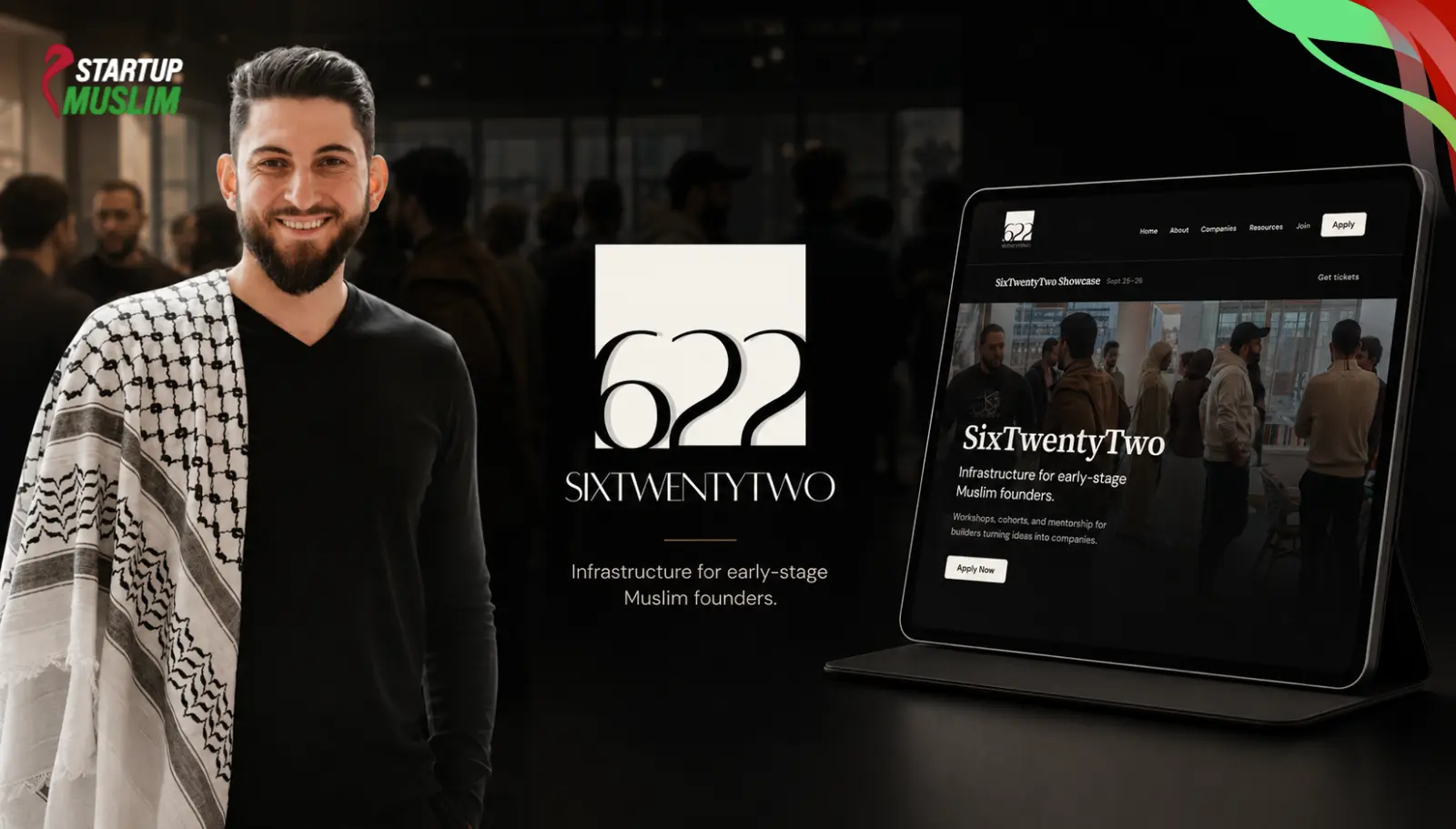
Every successful entrepreneur has a story about failure. Some speak about products that never found customers. Others recall investors who walked away, partnerships that collapsed, or markets that simply weren’t ready. Yet very few founders willingly admit they built four companies before finally discovering what they were truly meant to create.
For Ehab Mustapha, failure wasn’t a detour—it was preparation.
Long before founding SixTwentyTwo (622), Canada’s first Muslim-focused technology accelerator, Ehab launched four different startups. None of them survived. One secured funding but never evolved into a sustainable business. Another was derailed by the global disruption caused by COVID-19. A third ended after disagreements between partners, while another built a product that simply never found product-market fit. On the surface, the failures looked unrelated, but together they revealed something far more valuable than success ever could.
Each failure taught him that startups rarely collapse because of one catastrophic decision. More often, they fail because founders lack the systems, support, and discipline needed to adapt when reality refuses to match their original assumptions. Instead of walking away from entrepreneurship, Ehab chose to immerse himself even deeper into it. He transitioned into advisory work, helping startups, scaleups, and innovation ecosystems navigate the very challenges he had experienced firsthand. Ironically, stepping away from building companies allowed him to better understand why some founders consistently succeeded while others repeatedly struggled. Yet during those years another realization began to take shape. The problem wasn’t simply that founders needed better advice. Many of them needed an entirely different ecosystem.
The Ecosystem That Didn’t Exist
Canada has one of the world’s most developed startup ecosystems. Founders have access to accelerators, incubators, government grants, university innovation programs, and countless networking opportunities. Yet despite living in one of Canada’s largest Muslim communities, Ehab noticed something surprisingly absent. There was no dedicated place where Muslim founders could consistently come together to build companies while remaining fully aligned with their values. The entrepreneurial ambition certainly existed.
Across the community were talented engineers, physicians, scientists, lawyers, consultants, designers, and corporate professionals capable of building remarkable businesses. But many of them shared the same frustration. Existing startup programs rarely addressed the unique realities they faced. Entrepreneurs who wanted to avoid questionable funding, unethical partnerships, or business models that conflicted with their beliefs often found themselves navigating an ecosystem that assumed compromise was simply part of entrepreneurship.
For months, Ehab thought about how such a community could be created. The breakthrough came not from an investor or a mentor, but from his wife. She encouraged him to stop thinking about the perfect accelerator and simply build a proof of concept. Instead of spending months designing frameworks, she suggested gathering a handful of founders into one room and seeing what happened. Almost as an afterthought, Ehab published a short LinkedIn post. The response was immediate. Eighty-one founders applied.
What had begun as a small experiment suddenly became proof that an entire community had been waiting for exactly this kind of initiative. SixTwentyTwo wasn’t born from market research or business planning. It emerged because founders had been searching for a place to belong.
Why the Name Matters
Most accelerators choose names associated with speed, disruption, or innovation. SixTwentyTwo chose history. The accelerator is named after the Hijrah of 622 CE, one of the most transformative moments in Islamic civilization. Yet for Ehab, the significance extends beyond migration itself.The Hijrah was not simply about leaving one place for another. It represented the deliberate creation of new institutions—a society, economy, and community built upon enduring principles rather than temporary convenience. That idea sits at the heart of SixTwentyTwo.
The accelerator is not designed merely to help founders launch startups or raise venture capital. It exists to help entrepreneurs build organizations capable of creating lasting value—companies that outlive their founders and contribute meaningfully to society. As Ehab often explains, the migration was never the destination. Building what came afterward was.
Teaching Entrepreneurship Through Execution
One of the first things visitors notice about SixTwentyTwo is how different it feels from a traditional accelerator. There are no lengthy lecture series. No endless PowerPoint presentations. No theoretical frameworks detached from reality. Instead, the entire program revolves around one simple principle “The market is the only source of truth”.
SixTwentyTwo operates through intensive 12-week cohorts designed to move founders from idea to genuine market validation. Every participant progresses through five practical learning pods—Discovery, Access, Demand, Build-to-Retain, and Close-the-Yes—each focused on mastering one repeatable entrepreneurial skill.
Discovery teaches founders to replace assumptions with customer evidence. Access helps entrepreneurs reach real decision-makers instead of conversations that go nowhere. Demand focuses on building an audience before attempting to scale. Build-to-Retain transforms curiosity into active users, while Close-the-Yes develops the discipline required to convert genuine interest into paying customers. Every stage follows the same rhythm “Run. Drill. Ship”. Founders are expected to speak with customers, test assumptions, collect evidence, and iterate continuously. Weaknesses emerge naturally through action rather than theoretical diagnosis. Instead of telling founders where their strategy is flawed, the market reveals those answers itself.
Closing Both the Skills Gap and the Values Gap
Ehab believes Muslim entrepreneurs face two distinct challenges that are rarely addressed together. The first is a values gap. Modern startup culture often assumes founders will pursue every available opportunity to accelerate growth. Saying no to certain investors, partnerships, or business practices is frequently viewed as unnecessary friction. Entrepreneurs who choose to build according to their ethical convictions are often left navigating an ecosystem that was never designed around those choices.
The second challenge is a skills gap. Throughout his advisory work, Ehab repeatedly encountered brilliant professionals who had mastered engineering, medicine, law, or science but had never learned how to build companies. They understood technology but struggled with customer acquisition. They knew how to solve technical problems but lacked experience in sales, pricing, positioning, or lean execution. SixTwentyTwo exists to solve both problems simultaneously. It teaches founders how to become world-class entrepreneurs without asking them to compromise the principles that define them.
Building Better Founders Before Better Companies
When selecting entrepreneurs for the accelerator, Ehab rarely begins by evaluating business ideas. He looks first at the founder. Talent matters. Technical ability matters. But neither is enough. Instead, he searches for qualities that become increasingly important as companies grow: grit, resilience, sabr, coachability, and clarity of purpose.
He wants founders who are willing to be wrong. Founders who can receive difficult feedback without becoming defensive. Founders who see setbacks as opportunities to improve rather than excuses to quit. Most importantly, he wants entrepreneurs who understand why they are building in the first place. Everyone wants financial success. Far fewer genuinely aspire to create institutions that continue benefiting others long after they themselves are gone. For Ehab, intention remains the ultimate filter.
A Quiet Movement Begins to Grow
Although SixTwentyTwo has existed for less than a year, its growth suggests that the demand Ehab identified was very real. Without a major launch campaign or expensive marketing effort, the accelerator has organically grown into a community of more than 140 builders, over 40 mentors, and more than 15 investors.
Its inaugural cohort welcomed 11 founders, each deliberately choosing what Ehab describes as “Hard Mode”—building companies without compromising ethics, accepting questionable funding, or pursuing partnerships that conflicted with their values. Together, these founders have already completed more than 200 customer interviews, generated tens of thousands of dollars in early revenue, signed contracts with paying customers, and navigated difficult—but ultimately productive—pivots toward genuine product-market fit. Today, SixTwentyTwo is physically based within Sheridan College’s EDGE program, giving Canada’s first Muslim-focused accelerator a permanent home while continuing to refine its model for future cohorts.
Building the Infrastructure for the Next Generation
While much of today’s startup conversation revolves around artificial intelligence, venture capital, and rapid scaling, Ehab believes the future belongs to founders who build enduring infrastructure rather than simply fast-growing companies. He sees AI dramatically reducing the cost of building software, allowing smaller teams to accomplish what previously required entire organizations. But he also warns against using these technologies merely to recreate products that already exist.
Instead, Muslim entrepreneurs should focus on building new infrastructure—new standards, new institutions, and new technologies capable of solving problems that remain largely untouched. That philosophy extends beyond SixTwentyTwo itself. Ehab does not measure success by the number of startups graduating from each cohort. His long-term vision is much larger. He hopes to help establish a global network of institutions that support Muslim entrepreneurs throughout every stage of their journey—from education and funding to governance, ethical investing, technology standards, and international collaboration. He imagines an ecosystem where entrepreneurs no longer need to choose between commercial success and ethical integrity because both become fundamental design principles from the very beginning.
He often describes this vision through a simple image. Someone plants a tree fully aware they may never live long enough to enjoy its shade. That, he believes, is the true work of entrepreneurship. The greatest founders are not remembered simply because they built successful companies. They are remembered because they built institutions that continued creating opportunities long after they were gone. If SixTwentyTwo succeeds, its greatest legacy will not be the businesses it accelerates today. It will be the entrepreneurial infrastructure it leaves behind for generations of Muslim founders who have yet to write the first chapter of their own stories.


