





There is a tendency to associate great technology companies with great technology ecosystems. Silicon Valley gave birth to Apple and Google. Shenzhen became synonymous with hardware innovation. Geography, we often assume, shapes entrepreneurship.
Haroon Azizi’s story challenges that assumption.
From Afghanistan—a country more frequently associated with conflict than innovation—Haroon has quietly built a portfolio of technology products serving learners, creators, freelancers, and businesses. His companies may not yet be household names globally, but they represent something much larger than individual startups. They demonstrate that innovation is not determined by geography, infrastructure, or even access to capital. It begins with a way of thinking.
For Haroon, that mindset started long before he ever called himself an entrepreneur.
A Childhood Defined by Curiosity
As a child, Haroon wasn’t satisfied with simply playing with remote-controlled cars. He wanted to know how they worked. He would carefully dismantle them, examine every component, and then reassemble them piece by piece. Looking back, those childhood experiments revealed the instincts that would later shape his career: curiosity, persistence, and an unwillingness to accept that something should remain a mystery simply because no one had explained it.
That curiosity naturally led him toward computer science. He imagined a career where technology solved meaningful problems and created entirely new possibilities. Instead, as he entered the software industry, he discovered that many companies were focused on building routine management systems and client projects. While those businesses served an important purpose, Haroon felt they weren’t pushing the boundaries of what technology could achieve.
He had ideas for products that could genuinely improve people’s lives, but convincing others to pursue those ideas proved difficult. Eventually, he stopped waiting for permission.
“If no one is willing to build them,” he thought, “I’ll build them myself.”
That decision marked the beginning of a journey that would reshape not only his own career but also contribute to Afghanistan’s emerging technology ecosystem.
Building Products, Not Just Software
Haroon’s first major venture was Hadaf, an educational platform created for Afghan learners around the world. Developed with two friends over three to four months, Hadaf combined live language courses, computer science education, and professional development into a single web and mobile platform. More importantly, it simplified online learning by making technology and digital payments easier for users who often faced significant barriers to accessing quality education.
For Haroon, Hadaf represented more than an online academy. It was proof that Afghan entrepreneurs could build original products rather than simply deliver outsourced software services. It also taught him one of entrepreneurship’s earliest lessons: building something valuable requires patience.
Reaching the platform’s first 500 users took 32 weeks. Growth was slow, resources were limited, and like many first-time founders, there were moments when the progress seemed almost invisible. Yet every new learner reinforced his belief that meaningful products solve meaningful problems, even if the market takes time to recognize them.
Instead of becoming discouraged, Haroon became more determined. Hadaf gave him confidence that Afghanistan’s technology sector could create products designed for users—not just clients.
Listening More Than Building
Many entrepreneurs fall in love with their ideas. Haroon prefers falling in love with his users’ problems.
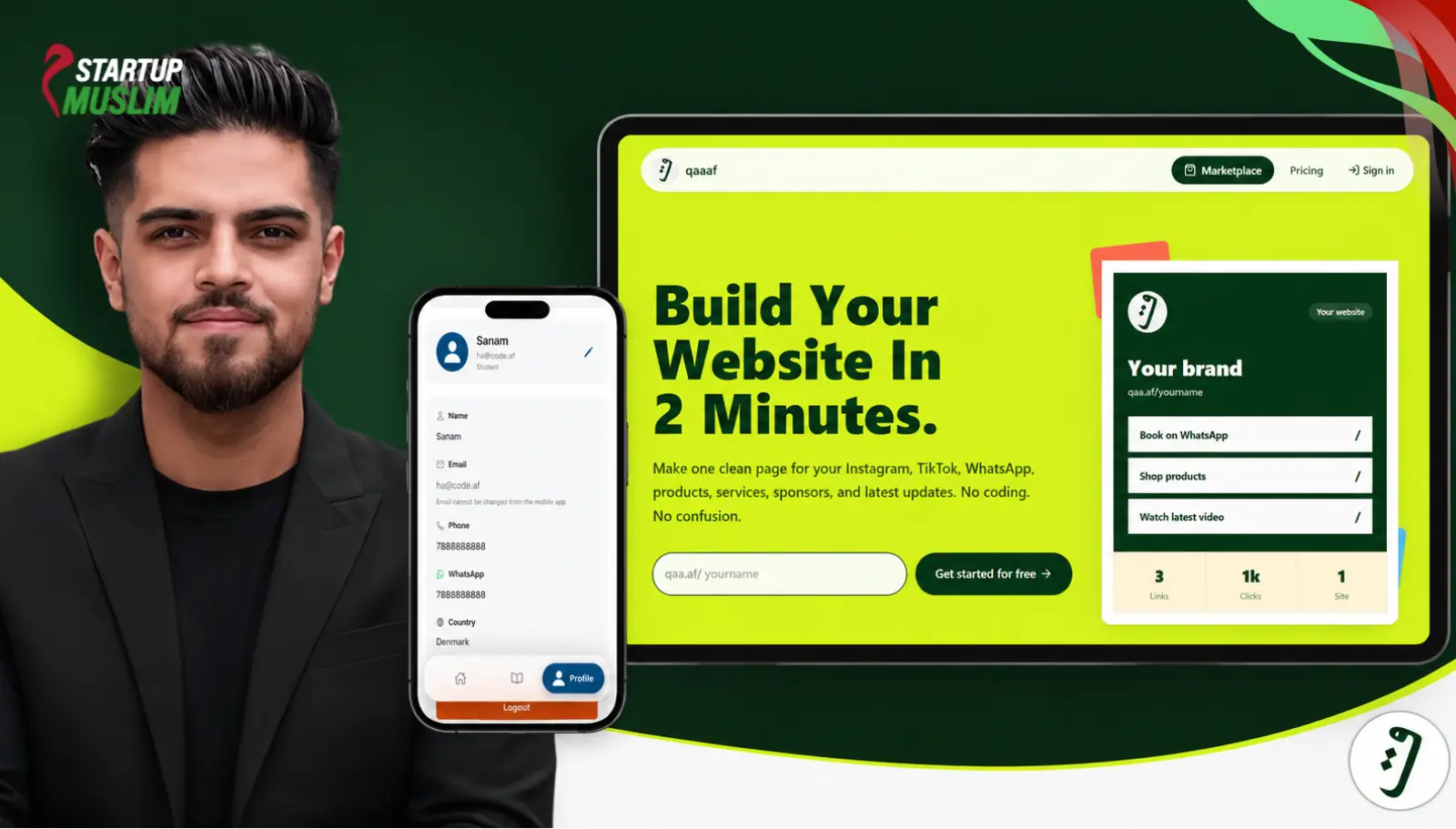
That philosophy became the foundation of his second startup, Qaaaf. Initially envisioned as a simple link-in-bio platform for Afghan creators and freelancers, the product appeared relatively straightforward. But during testing, Haroon noticed something unexpected. Users weren’t merely asking for a page to organize their links; they wanted tools that helped them build their businesses online.
Rather than launching quickly, he paused and expanded the platform’s vision. Qaaaf evolved into an ecosystem that allowed users to create personal websites, publish blogs, access analytics, build digital marketplaces, and eventually receive international payments through Qaaaf Receive. Each feature emerged directly from conversations with users rather than assumptions made inside a meeting room.
The difference was immediate.
While Hadaf needed eight months to reach its first 500 users, Qaaaf achieved the same milestone in just one week. The platform also became profitable in its first month, generating revenue through premium subscriptions, APIs, and payment services. For Haroon, the experience reinforced a simple principle that continues to guide his work today: the best product roadmap is often written by the community itself.
Building Against the Odds
Launching startups is difficult in any country. Building them in Afghanistan introduces challenges that founders elsewhere rarely encounter.
Limited banking infrastructure, unreliable electricity, inconsistent internet access, and international sanctions create obstacles at almost every stage of product development. Even publishing software can become unexpectedly complicated. Haroon recalls that Hadaf’s iOS application had to be released under his uncle’s name in Germany because restrictions prevented him from publishing it under his own identity.
“It feels really bad when I don’t see my name under my own app,” he says.
Yet those experiences never convinced him that success was impossible. Instead, they reshaped how he approached entrepreneurship. Whenever he encountered a barrier, his instinct was no longer to search for an existing solution. It was to create one.
When freelancers struggled to receive international payments, he built Qaaaf Receive. When developers needed a publishing platform, he created Qaaaf Blogs. When entrepreneurs wanted an easier way to sell online, he launched Qaaaf Marketplace. Each product emerged from the same conviction that has become his personal philosophy.
“If there isn’t a way, I should be the one to build it.”
That mindset reflects something larger than entrepreneurship. It represents a belief that founders in emerging markets often have to build not only products, but pieces of the ecosystem itself.
Creating an Ecosystem Alongside His Companies
Long before Haroon became known for his startups, he became known for helping people.
He entered university during one of Afghanistan’s most uncertain periods, when many professors had left, institutional systems were under pressure, and new students struggled to find guidance. Remembering how isolated he had felt during his own first semester, Haroon proposed orientation sessions for incoming students, created WhatsApp groups, and built communities where aspiring developers could support one another. What began as a single presentation gradually evolved into an expanding network of students, engineers, and entrepreneurs connected by a shared passion for technology.
That same community later became one of his greatest strengths as a founder. Users openly shared ideas, reported problems, and suggested new features that shaped the evolution of Qaaaf. Haroon believes one of his greatest advantages has never been having all the answers. It has been remaining open to changing direction whenever users reveal a better one.
Today, that community continues to motivate him through the inevitable highs and lows of entrepreneurship.
“The only reason I haven’t given up,” he says, “is the people who’ve followed my work and believed in me.”
Building With Faith, Purpose, and Vision
Ask Haroon what drives him to spend long days building products, and he rarely mentions revenue or growth metrics. Instead, he talks about seeing people use something he created and knowing it genuinely improved their lives. Whether it’s a student completing a course on Hadaf or a freelancer successfully receiving payment through Qaaaf, those moments provide the motivation to keep building.
Faith also plays a central role in how he evaluates new ideas. Before starting any project, he asks himself a simple question: “How will this help other people?” That philosophy runs consistently across all of his ventures. Hadaf shares knowledge. Qaaaf empowers creators and freelancers. Code.af transforms business ideas into digital products. For Haroon, entrepreneurship is ultimately an act of service.
Looking ahead, his ambitions extend far beyond Afghanistan. Over the next five years, he hopes Hadaf will evolve into a multinational education technology company, Qaaaf will serve hundreds of thousands—perhaps millions—of users worldwide, and Code.af will become one of the region’s leading software development firms. He also plans to grow his team from 10 people to 100, creating more opportunities for Afghan engineers while continuing to strengthen the country’s technology ecosystem.
Despite those global ambitions, his commitment to Afghanistan remains unchanged.
“The only reason I started from Afghanistan first,” he says, “is because I want the tech market to grow here.”
Curiosity as a Competitive Advantage
Haroon Azizi’s story is not simply about building startups in a difficult environment. It is about refusing to let that environment define what is possible.
His journey began with a child taking apart remote-controlled cars to understand how they worked. Today, that same curiosity drives him to solve far more complex problems—making education more accessible, helping creators build sustainable businesses, strengthening Afghanistan’s technology ecosystem, and proving that innovation can emerge from places the world often overlooks.
The tools have changed. The challenges have grown. But the mindset has remained remarkably consistent. Great entrepreneurs are rarely the ones who have all the answers. They are the ones who never stop asking better questions—and who possess the courage to build the answers themselves.


