





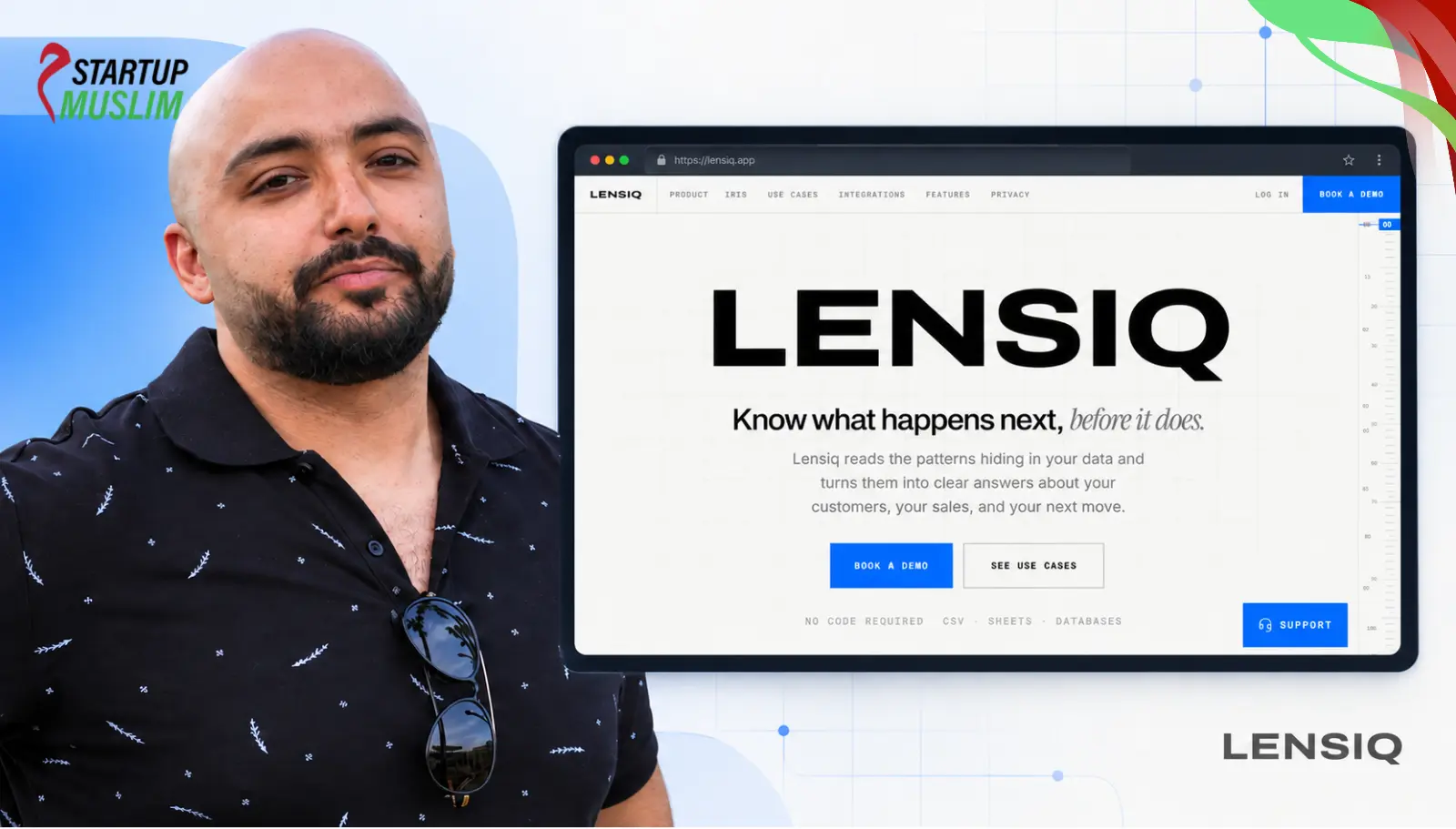
Most businesses have plenty of data. They can track sales, monitor operations and review reports to understand what went right or wrong. The harder question is whether that information can help them see a problem coming and do something about it before it affects the business. Ahmad Hijazi, co-founder of Lensiq, believes this is where the next major shift in business technology will happen.
Lensiq is developing a predictive intelligence platform that combines historical data with real-time information to help companies anticipate outcomes and make better decisions. Its first area of focus is logistics, where delivery delays, route disruptions and changing operating conditions can quickly increase costs. The company is still at an early stage, with active pilots and plans to turn its technology into a commercial product, but its ambition is much larger than building another analytics tool.
Hijazi’s interest in this problem comes from years of experience across different businesses, including e-commerce, advertising, technology and finance. Along the way, he has seen promising ventures struggle, lost control of a company and watched a political crisis wipe out a large volume of business contracts almost overnight. Those experiences shaped his view of risk and eventually helped him identify the problem he wants Lensiq to solve.
A Founder Shaped by Experience, Not Just Success
Hijazi began his entrepreneurial journey in 2016 after spending a couple of years working in construction in Saudi Arabia. He decided to return to Lebanon and start a business of his own, launching a curated e-commerce platform with an old friend. The idea had potential, but the company closed after nearly two years, teaching him that a promising concept is only the beginning of building a business.
His next venture was a boutique advertising agency, backed by an initial investment of $500,000. Hijazi eventually left after experiencing significant dilution and losing control of the business, an experience that changed how he thinks about ownership and fundraising. He later joined another startup, helping its founder build the company and raise pre-seed and seed funding, before launching a programmatic audio advertising business.
That business brought a different kind of lesson. Following a political crisis between Lebanon and Saudi Arabia, the company lost $1 million in contracts in a single day. It was a sharp reminder that even a business with a solid foundation can be exposed to events beyond its control.
“It’s not enough to ask what happens if everything goes according to plan. You also have to understand what happens when it doesn’t.”
From Trading Data to a New Business Idea
After his experience in technology, Hijazi stepped away from the sector for a period and launched a small private fund with a close circle of investors. He managed capital over several years and found the financial results rewarding, but he eventually realised that investment returns alone did not give him what he wanted from his work. He wanted to build something tangible that could have a lasting role in how businesses operate.
The idea behind Lensiq began with his own trading history. Hijazi had years of historical data and wanted to do more than study past performance, looking instead for patterns that could help him make better decisions in the future. As he explored the idea with his cousin and co-founder, they recognised that the same challenge existed in businesses across many industries.
Companies collect large amounts of information, and business intelligence tools help them understand past performance and monitor current operations. But knowing what happened is not the same as knowing what is likely to happen next, or what action could change the result. Lensiq emerged from the effort to close that gap by connecting historical patterns with real-time conditions.
The aim is to give businesses a clearer view of what may lie ahead, rather than leaving them to respond only after a problem becomes visible.
Why Logistics Became the Starting Point
Logistics is the first market Lensiq is targeting because small changes in operating conditions can have immediate financial consequences. A delivery may be delayed by traffic, a route may become disrupted, or an estimated arrival time may no longer reflect what is happening on the ground. If a business learns about the problem too late, it may have fewer options to prevent extra costs or missed commitments.
Many logistics companies already use transportation management systems, business intelligence tools and other software to manage their operations. These systems can help coordinate deliveries and report performance, but Hijazi believes there is room for a layer that identifies which deliveries are at risk and updates those predictions as conditions change. Lensiq aims to help teams act earlier, while there is still an opportunity to influence the outcome.
The company is building its technology around a specific workflow. It uses historical data to learn patterns, incorporates relevant real-time context, predicts likely outcomes and explains what may be driving them, with recommendations to support decisions. Rather than asking customers to replace their existing systems, Lensiq intends to work above their current data infrastructure and operational tools.
For an early-stage company, proving that approach in real operating environments will be critical. Lensiq is running pilots to test its capabilities against practical business challenges and exploring reseller opportunities in Saudi Arabia and Türkiye to support its route to market.
Beyond Dashboards and Traditional Analytics
Hijazi sees Lensiq as part of a broader change in how companies use technology. Business intelligence has helped organisations understand performance through reports and dashboards, while operational systems manage the day-to-day work. Predictive intelligence, as he defines it, adds the ability to anticipate likely outcomes and help people decide what to do before those outcomes occur.
“We don’t believe companies need another dashboard or another system that simply produces insights. They need intelligence that connects data to decisions and decisions to action.”
Making this work is not just a matter of building a machine learning model. Business data is often spread across different systems, recorded in inconsistent formats or missing important details. Before predictions can be useful, the team must understand the data, identify the factors that matter and connect them to a clear business outcome.
Real-time context creates another challenge. A prediction based only on past patterns may quickly become outdated when conditions change. Lensiq’s goal is to combine historical learning with current information and make the results useful to people responsible for business operations, without requiring them to become machine learning experts.
For Hijazi, accessibility means doing the hard technical work behind the scenes so that customers can focus on decisions. That will require not only reliable technology but also clear use cases and evidence that the platform can improve the way a business works.
Earning Trust in a New Technology Category
Introducing predictive intelligence presents a commercial challenge as well as a technical one. Most businesses already understand analytics, reports and dashboards, but they may not immediately see how a system that predicts future outcomes fits into their existing operations. Hijazi says companies need to understand the problem differently before they can see the value of a new category of technology.
Data readiness is another hurdle. Having years of operational records does not necessarily mean a company can use them effectively, particularly when information is scattered across systems or disconnected from the decisions the business wants to improve. Privacy concerns can also slow adoption, even when a product has been designed with security in mind.
These lessons have shaped Lensiq’s approach to finding customers. Instead of pitching a broad vision of artificial intelligence, the team starts with a specific operational problem, reviews the available data and tests whether predictive intelligence can support a better decision. Pilots allow both sides to assess the technology in a real setting before moving towards wider deployment.
The company is also taking a measured approach to funding. Hijazi says Lensiq is not actively raising capital at this stage, choosing instead to strengthen the product, advance pilots towards commercial use and build traction before seeking outside investment. Reseller partnerships in Saudi Arabia and Türkiye could help the business reach customers through established local relationships.
Building the Infrastructure for Predictive Intelligence
Hijazi’s ambition extends beyond solving individual problems in logistics. He wants Lensiq to become part of the underlying infrastructure businesses use to anticipate demand, identify risks and make decisions using both historical data and real-time information. The longer-term plan is to create a platform that connects data, predictive models, recommendations and execution, allowing other developers and technology companies to build new applications on top of it.
He sees this as the next step in a longer history of business technology. Spreadsheets changed how companies work with numbers, while business intelligence changed how they understand performance. Predictive intelligence, he believes, could help businesses move from studying what has happened to acting while they can still influence what happens next.
“Our long-term vision is for predictive intelligence to become as fundamental to running a business as spreadsheets are today.”
Whether Lensiq can reach that point will depend on proving its value in real operations, building customer trust and turning early pilots into repeatable commercial deployments. Its current focus remains on establishing that foundation, starting with logistics and expanding as the technology and business model develop. For Hijazi, the opportunity is to help companies make better decisions before uncertainty turns into a costly problem.


