


From the Pentagon and Google to a 5 A.M. Cessna
At five o’clock in the morning, standing beside a Cessna and preparing for a flight, Almeena Shaikh found herself doing what many general aviation pilots have learned to accept as routine. She was moving between multiple apps, checking weather, regulations, aircraft information and other pieces of data required before taking off. The problem was not a shortage of information. The problem was that none of those tools appeared to understand the person making the decision.
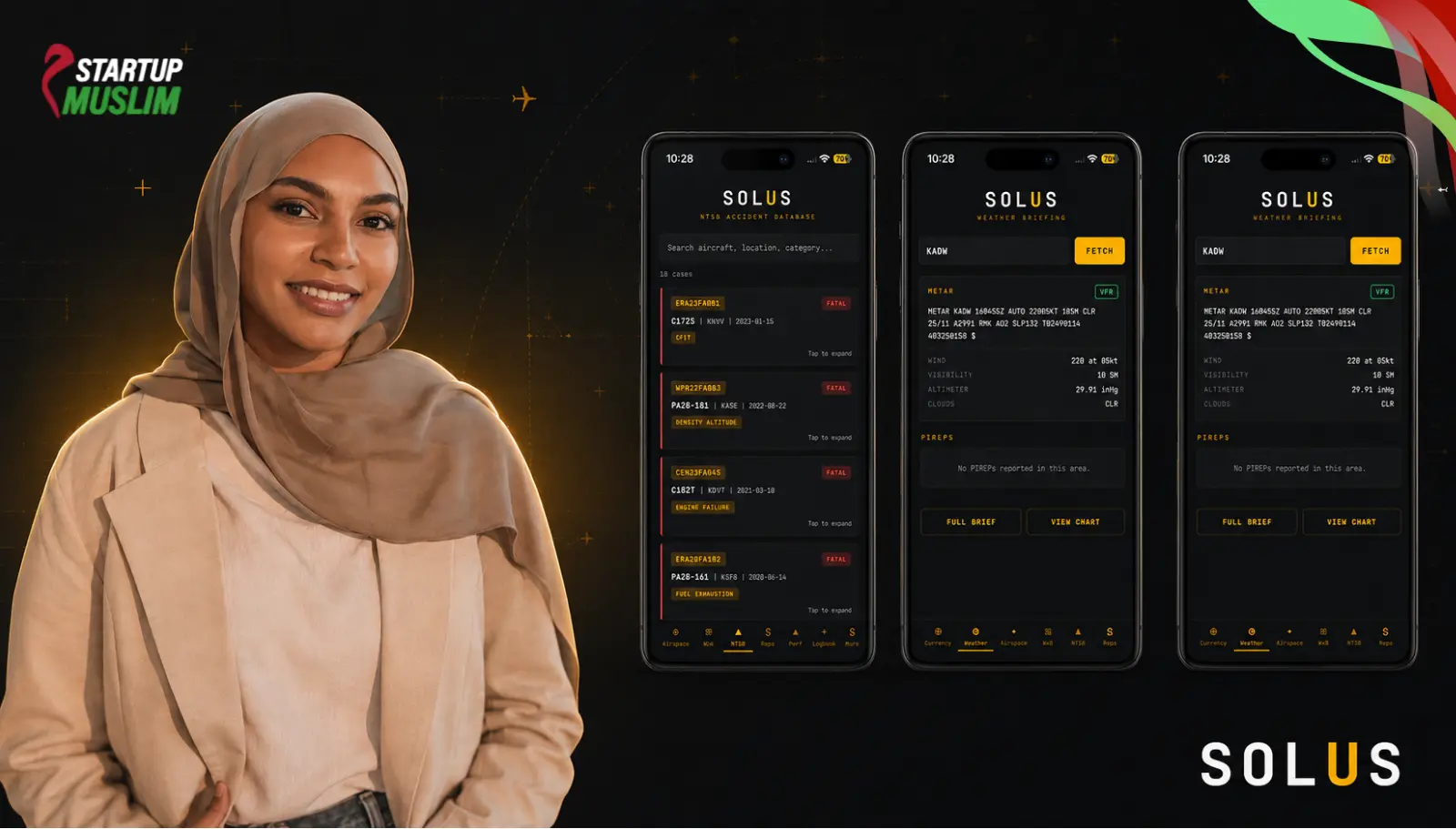
None of them knew her recency as a pilot, the aircraft she was flying, her experience, her tendencies or the limits she had set for herself. For Shaikh, a private pilot whose career had already taken her through the U.S. Air Force, the Pentagon, NASA and Google’s AI teams, the moment exposed a gap she could no longer stop thinking about. General aviation had plenty of data and increasingly sophisticated software, but pilots still had to perform the difficult work of turning fragmented information into judgment. That realization would eventually lead her to build SOLUS Copilot, an AI-powered decision-support platform designed to give general aviation pilots what she describes as a second set of eyes.
A Pattern of Betting on Herself
Shaikh’s journey into entrepreneurship did not begin with a conventional startup career. As the eldest daughter in an immigrant household, she says discipline, high agency and the habit of constantly challenging herself became part of her character early in life. Those qualities would later shape a career defined by repeatedly stepping into unfamiliar territory. The U.S. Air Force gave that instinct a more formal foundation in leadership. While serving on active duty, Shaikh taught herself how to code and earned her private pilot license. Two pursuits that were not required by her role but reflected her desire to keep expanding her capabilities. She also began digitizing processes within the squadron supporting the Vice President and the Secretary of Defense, an experience that connected technology with the practical realities of complex operations.
That work helped open the next chapters of her career, taking her to the Pentagon, NASA and eventually Google’s AI teams. Yet, despite the prestige associated with those institutions, Shaikh says her confidence to leave a successful career and become a founder came from something more personal: a pattern she had come to trust in herself. Every time she had chosen to pursue something she could not stop thinking about, she says, the decision to bet on herself had paid off. SOLUS became the next and perhaps most consequential version of that bet.
The Problem Was Not Information
The idea for SOLUS emerged from Shaikh’s own experience as a pilot. On that early morning beside the Cessna, she was juggling five different applications, each offering valuable information but none bringing it together in a way that reflected her individual circumstances. The tools could show her the weather, regulations and other flight data, but they could not help her answer the more complicated question: Given everything happening today, what should I do?
That distinction between data and judgment sits at the center of SOLUS. Shaikh points to a statistic that shaped her thinking: 74% of fatal general aviation accidents involve pilot decision errors. The issue, in her view, is not simply that pilots lack weather information or that they are unaware of mechanical risks. The challenge is that decision-making often happens under pressure, with incomplete attention and multiple variables competing for consideration.
Commercial aviation developed a structural answer to that problem decades ago through crew resource management and multi-pilot operations. A pilot does not have to carry every judgment alone when another trained professional is sitting beside them, checking assumptions, asking questions and providing another perspective. General aviation pilots often do.
Building a Second Set of Eyes
SOLUS is not intended to take control away from the pilot. Shaikh is clear that the pilot in command always retains final authority. Instead, the company is attempting to build an intelligence layer that can synthesize the information surrounding a flight and present it as a personalized risk assessment.
The platform brings together inputs including FAA weather information, FAR currency tracking, aircraft maintenance, weight and balance, and decades of NTSB accident reports. But the system’s architecture is designed around an important distinction: some calculations must be deterministic, while other forms of intelligence can benefit from AI synthesis.
Weight and balance, currency and performance calculations, for example, are handled through verified code rather than being generated by a language model. Regulatory claims must be grounded in actual FAR or AIM sources. The AI is then used for what Shaikh believes it does best: synthesizing weather, NOTAMs, the pilot’s own currency and history, and patterns from comparable accidents into a brief that can be understood quickly. The ambition is not to create another app filled with more information. It is to help pilots see what the information means for them.
The Human Problem Behind Aviation Risk
Shaikh’s research into hundreds of NTSB accident reports reinforced another conviction behind the product. What surprised her most, she says, was how rarely the story was simply about ignorance. In many cases, pilots already knew the rules or understood the risks involved.
The recurring problem was something more human: self-exemption. A warning may be recognized as valid in general but dismissed as applying to somebody else. Then pressure enters the equation. A passenger is waiting, weather is beginning to close in, the destination is almost within reach, or a pilot has invested time and effort into getting the flight underway. Each factor can make it easier to reinterpret risk in a more convenient way.
That insight changed how Shaikh thinks about warnings. The goal, she says, is not simply to make alerts louder or create another stream of notifications that pilots can learn to ignore. A warning becomes more difficult to dismiss when it is tied directly to the pilot’s own hours, aircraft, route and circumstances on that specific day. In other words, the system is designed to make risk feel personal because, in aviation, it often is.
From AI Expertise to Aviation Purpose
Shaikh incorporated SOLUS and moved quickly from concept to product. The platform went live on the App Store in July 2026, roughly four months after incorporation, and she says it was built entirely by her as a solo founder. Around 250 pilots have signed up for early access, including pilots from United Airlines, the U.S. Coast Guard and the Air Force Reserve.
The company has also secured a retained paying customer and is working with several flight schools through design partnerships. Rather than pursuing rapid onboarding from the beginning, Shaikh says SOLUS is deliberately bringing users in slowly and by hand, using early interactions to refine a product where trust may ultimately matter as much as technological capability.
That approach reflects the unusual responsibility of building AI for a safety-critical environment. In many software categories, a bad recommendation may create inconvenience. In aviation, judgment can carry far greater consequences.
For Shaikh, that makes the mission deeply personal. SOLUS is not simply the latest chapter in a résumé that has moved from military service to the Pentagon, NASA, Google and entrepreneurship. It brings together the two worlds she has spent years navigating: artificial intelligence and aviation. And it began with a deceptively simple realization beside a Cessna before sunrise. Pilots had the data. What they needed was help turning it into judgment.
The Data Behind Better Judgment
The most important technology inside SOLUS Copilot may not be its AI interface. It may be the discipline behind deciding what AI should—and should not—be allowed to do. Almeena Shaikh is building for an industry in which a convincing but incorrect answer can carry consequences far beyond a bad customer experience. That has shaped the architecture of SOLUS from the beginning. The company separates calculations and claims that require certainty from the broader task of synthesizing complex information into a personalized assessment.
That distinction sits at the heart of what SOLUS is trying to become: not another chatbot for pilots, but an intelligence layer designed around better judgment. SOLUS says it combines pilot currency, aircraft information, live FAA data and historical NTSB accident patterns into a single pre-departure risk brief.
Where AI Must Stop and Verified Systems Begin
Shaikh describes the product’s architecture through two principles. The first is “deterministic where it must be.” Weight and balance, currency tracking and performance calculations are handled through verified code rather than generated by a language model. The second principle is “grounded or rejected.” Every regulatory claim in a SOLUS brief must be traceable to an actual FAR or AIM source, rather than relying on an AI model to improvise an answer. This is a crucial design decision for a founder building in a safety-critical category, where sounding correct is not remotely the same as being correct.
On top of those constraints, AI performs the work for which Shaikh believes it is genuinely useful. It can synthesize multiple inputs—weather, NOTAMs, pilot history, recency and accident patterns—into a personalized brief that a pilot can absorb quickly. The product’s purpose is therefore not to generate authority, but to organize intelligence around a decision the human pilot must ultimately make. The pilot in command, Shaikh emphasizes, always retains final authority.
Turning 847 Accident Reports Into a Product Philosophy
The second major layer of SOLUS comes from Shaikh’s research into hundreds of NTSB accident reports. She says she has personally analyzed more than 847 cases, looking beyond the final cause of an accident and asking a different question: what information existed before the pilot made the decision?
What surprised her was how often the problem was not ignorance. Many pilots, she says, already knew the rule they were breaking or understood the danger in front of them. The harder problem was self-exemption—the human tendency to believe that a warning applies to everyone else but not necessarily to oneself. Then comes pressure. A passenger is waiting. The weather is deteriorating. The trip is almost complete. The pilot has already invested time and effort into the flight. Risk can begin to look different when a person has reasons to want a particular outcome. That insight changed how Shaikh thinks about safety alerts. SOLUS is not trying to create louder warnings or simply add another notification to an already crowded cockpit workflow. The objective is to surface warnings that are difficult to dismiss because they are tied directly to your currency, your aircraft, your route and the conditions of your flight.
From Historical Accidents to Personalized Risk
SOLUS’s approach to accident data is built around relevance rather than simply displaying a database of historical crashes. The company says its system can match accident patterns against a pilot’s current flight profile, considering factors such as aircraft type, route, weather, time of day and pilot currency.
In Shaikh’s view, the NTSB database contains something more valuable than a record of past failures. It contains patterns that can potentially help a pilot recognize risk before becoming part of a similar story. In her analysis, she found that many accident chains began well before the moment of impact, often with information that existed but was never synthesized into a complete picture. This is where the distinction between information and intelligence becomes central again. A pilot may have access to weather data, a logbook, maintenance records and aviation charts. But if each source remains isolated, the responsibility for connecting every signal still falls on one person, often under time pressure.
SOLUS is being built around the idea that synthesis itself is a safety function. The information may already exist. The question is whether it reaches the pilot in a form that can change a decision.
The Subscription May Not Be the Real Asset
For Shaikh, however, the long-term opportunity extends beyond a subscription business. Every pre-flight decision made through SOLUS can potentially create structured behavioral data about how pilots assess risk. Over time, that could reveal patterns around weather conservatism, fuel planning, risk tolerance, proficiency decay after time away from flying and other dimensions of pilot decision-making.
Shaikh believes such a dataset does not currently exist in a comprehensive form across general aviation. Insurers, she argues, have historically relied heavily on aggregate statistics because they have limited visibility into how an individual pilot actually makes decisions from flight to flight. A structured behavioral dataset could eventually create a more granular understanding of operational risk.
SOLUS’s own public materials similarly frame the company’s long-term thesis around a data flywheel, in which more pilots and more pre-flight activity could improve the intelligence available across the network. The company has also identified insurance integration as a potential future application for per-flight risk data. (Solus Copilot)
A Dataset for the Future of Flight
Shaikh sees another potential application in advanced air mobility. As the aviation industry moves toward increasingly autonomous and AI-assisted systems, she believes there will be value in understanding how experienced human pilots make judgments in complex and changing environments.
The question is not merely what decision a pilot made. It is what conditions existed, what risks were visible, what information was available and how that pilot ultimately responded.
That could make behavioral flight data strategically significant for insurers, researchers and companies building future aviation systems. Shaikh’s thesis is ambitious: the immediate product is a decision-support tool, but the durable asset underneath it could be the intelligence generated through repeated real-world use.
In one of her public descriptions of SOLUS’s longer-term vision, she summarized the progression in stark terms: first, a pre-flight brief for general aviation pilots; later, a behavioral flight dataset for insurers; and eventually, operational intelligence for a more autonomous aviation future.
Building Trust Before Scale—and an Aviation Future Beyond the Cockpit
For a technology founder, the conventional instinct is often to move quickly: acquire users, automate onboarding and scale distribution before competitors catch up. Almeena Shaikh is taking a more deliberate approach with SOLUS Copilot. In a product designed to sit alongside safety-critical aviation decisions, she believes trust has to come before scale. SOLUS went live on the App Store in July 2026, roughly four months after the company was incorporated. Shaikh built the initial product entirely by herself, an unusually compressed journey for a founder attempting to combine aviation regulations, flight data, AI and personalized risk intelligence into a single product.
Around 250 pilots have already signed up for early access, including pilots from United Airlines, the U.S. Coast Guard and the Air Force Reserve. The company also has a retained paying customer, several flight school design partnerships and has submitted its first NSF SBIR pitch to support the research dimension of the business. But Shaikh is not treating those early numbers as a signal to open the floodgates.
Why Trust Comes Before Growth
SOLUS is deliberately onboarding users slowly and by hand. The objective is to understand how pilots respond to the product, where they place their trust and how the underlying intelligence can be improved before the company attempts to scale more aggressively. That decision reflects the nature of what Shaikh is building. A social media platform can launch new features, observe engagement and rapidly iterate. An aviation decision-support product operates under a different set of expectations. If a system is asking a pilot to pay attention to a risk they may otherwise overlook, the quality of that interaction matters.
Shaikh’s approach is therefore to tune the model around trust before pursuing volume. Early users are not simply customers; they are helping shape how SOLUS communicates risk, what information deserves priority and how a personalized flight brief should fit into a pilot’s existing workflow. The company is still early, but the philosophy is clear. Before SOLUS can become a large-scale intelligence layer, pilots must believe it deserves a place in their decision-making process.
The Flight School Wedge
Shaikh is equally clear that SOLUS is not trying to replace established aviation software. Pilots already have tools they trust for maps, flight planning and data, and she sees little value in asking them to abandon systems that already perform those functions well. Instead, SOLUS is positioning itself as the intelligence layer between pilots and those tools. The platform’s job is to know more about the individual pilot and help turn a fragmented collection of information into a personalized judgment. That positioning has shaped the company’s go-to-market strategy, with flight schools emerging as the initial wedge. Shaikh believes training environments are where decision-making habits are formed, making them a natural place to introduce a tool built around risk assessment and pilot judgment.
For instructors, the proposition is also different from traditional flight planning software. Shaikh argues that instructors often have limited visibility into how students make go-or-no-go decisions between lessons. SOLUS could potentially give them a clearer view into that decision-making process while giving students individualized briefs before they fly. The strategy also creates what early-stage startups value most: density and trust. Rather than trying to reach every pilot individually, SOLUS can work within environments where pilots, instructors and training organizations already interact regularly.
Building in Public as Product Development
Shaikh has also chosen to build SOLUS in public, openly sharing everything from App Store rejections to customer feedback and product iterations. For her, transparency has become more than a marketing strategy. She describes it as a form of quality control. Early users have directly influenced the roadmap. An airline pilot pushed her to make weight and balance a first-class go-or-no-go consideration. A veteran flight instructor challenged the company with what Shaikh describes as one of the hardest questions in the category. Another aviation founder pointed out a simpler but equally important reality: an older pilot demographic needed larger fonts and touch targets. These details illustrate why building in public can be particularly useful for a founder operating in a specialized industry. The product may be built with advanced AI and complex data systems, but the people using it still experience it through practical questions: Can I read this easily? Does this warning make sense? Does the system understand how I actually fly?
For Shaikh, publicly sharing the process has also helped establish credibility with a community she describes as having a long memory. Aviation, she says, can recognize the difference between someone moving carefully and someone merely moving fast.
From the United States to the World’s Training Hubs
The United States is SOLUS’s immediate market, but Shaikh sees a much larger opportunity beyond American general aviation. The Middle East, in particular, is high on her list of future markets. Her reasoning begins with flight training. Gulf countries are investing heavily in aviation, with flight academies training future generations of pilots at scale. Those markets combine ambitious aviation growth with safety cultures shaped by some of the world’s leading airlines, making them potentially strong environments for a product built around better decision-making.
Shaikh’s international strategy mirrors the company’s U.S. playbook. Rather than entering new markets as a generic consumer application, SOLUS would seek partnerships with flight training programs first, reaching pilots where habits are formed and then growing with them through their aviation careers. Today, the product is grounded in the FAA ecosystem. But Shaikh says ICAO-aligned regulatory grounding is on the roadmap as the company prepares for international opportunities. For a platform built around judgment, that expansion thesis has a certain logic: go where the next generation of pilots is being trained.
A Muslim Founder’s Approach to Responsibility
Shaikh’s identity as a Muslim woman also shapes the way she thinks about building SOLUS. She describes the Islamic concept of amanah—a trust for which a person is accountable—as inseparable from her approach to product responsibility. Building software that sits close to life-and-death decisions, she says, is precisely that kind of trust.
It is why she has drawn clear boundaries around what SOLUS can and cannot automate. There should be no critical number produced by a model that might hallucinate. No regulatory claim should appear without a verified source. And no design decision should quietly transfer final authority away from the pilot. The pilot remains the pilot in command. Shaikh also says faith gives her a particular steadiness as a founder. Her responsibility is to do the disciplined work, make careful decisions and build with integrity, without becoming consumed by outcomes beyond her control. That philosophy also informs her decision to build visibly.
Opening the Door for Those Who Follow
Shaikh has spent her career moving through institutions and industries where she has repeatedly chosen to enter new rooms: the military, the Pentagon, NASA, Google’s AI teams, aviation and now entrepreneurship. Building SOLUS is, in many ways, another version of that pattern.
But she is conscious of who might be watching. As a Muslim woman building AI for aviation, Shaikh wants other aspiring founders to see that the door can open. Representation alone is not the mission of SOLUS, but visibility is part of the responsibility she feels as she builds in public. The company now faces the difficult work ahead: refining its intelligence, earning deeper trust from pilots, proving its flight school model and demonstrating that personalized decision support can become a meaningful part of general aviation.
Yet the larger ambition reaches beyond a single application. SOLUS is built around the belief that as aviation becomes more complex—and eventually more autonomous—the industry will need better ways to understand how humans make decisions before, during and around a flight. And for Almeena Shaikh, the journey began with a simple question beside a Cessna at 5 a.m.: if pilots have access to all this information, why are they still left alone to make sense of it? That question became SOLUS Copilot. Now, Shaikh is betting that the future of safer aviation may not be about giving pilots more data. It may be about giving them a better second set of eyes.
