


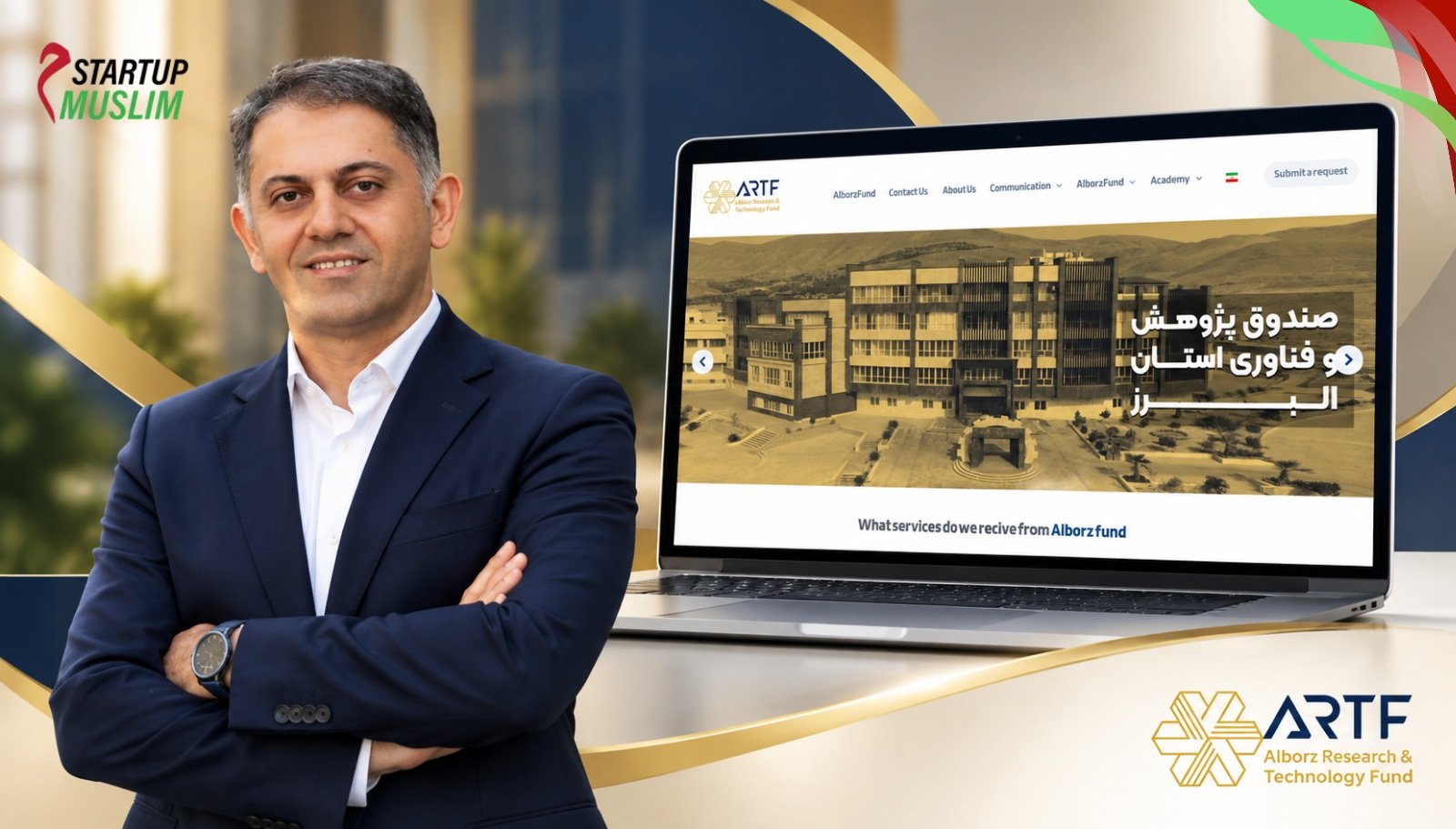
For Dr. Alireza Babakhan, venture capital was never supposed to be a departure from engineering. It was an extension of it.
His career moved from industrial engineering and technology management into a PhD in Science, Technology and Innovation Policy, then into the world of entrepreneurs, technology companies and investment. Along the way, he kept encountering the same problem: technically strong companies often failed to reach their potential not because their technology was weak, but because something around the technology was missing, whether capital, customers, manufacturing capacity, management expertise or the right strategic partner.
Today, as CEO of Alborz Research and Technology Fund, Babakhan is building an investment model designed around that observation. Alborz has supported more than 850 knowledge-based and technology projects, with assets under management and financial capacity exceeding $60 million and cumulative investment activity of approximately $13.4 million.
But Babakhan does not want Alborz to be defined simply by how much money it manages.
He wants it to become a platform that connects capital, technology, industry and experience.
He Didn’t Leave Engineering. He Started Engineering Companies
Babakhan’s journey into venture capital began with a question that emerged during his engineering career: why do some technologies become valuable businesses while others remain trapped inside laboratories or early-stage companies?
His academic work gave him one part of the answer. Research into university-industry relationships and technology commercialization showed him that commercialization is rarely just a technology problem. A company may have an excellent product and still fail because it cannot find customers, finance production, build the right team or create a viable business model.
Working directly with entrepreneurs made the lesson more concrete. Babakhan saw founders who needed financing, but he also saw companies where another round of capital would not solve the real problem. Sometimes what they needed was a major customer, a manufacturing partner, better financial discipline or a different financing structure.
That experience changed how he viewed the investor’s role. Capital was no longer the destination. It was one of several tools for engineering the conditions in which a company could grow.
The Alborz Model: Capital Should Follow the Problem
That philosophy sits at the heart of Alborz.
The fund’s registered capital is approximately $6 million, but its assets under management and financial capacity exceed $60 million. It has supported more than 850 technology and knowledge-based projects, while its financing architecture extends beyond conventional equity to include guarantees, debt financing, crowdfunding, leasing, supply-chain finance, structured financing and tokenization.
The distinction matters because Babakhan believes different companies require different forms of capital.
A startup developing an uncertain technology may genuinely need equity. A manufacturer with confirmed purchase orders might instead need working capital. Another company may have the product and production capacity but lack a major customer, making an industrial partnership more valuable than another financing round. Alborz’s objective is therefore to identify the bottleneck and deploy the resource that actually removes it.
Babakhan calls this “smart capital.”
The philosophy turns Alborz from a conventional investment portfolio into what he describes as a value-creation portfolio, where the question is not simply where capital was deployed but what became different because the investor was involved.
What Happens After the Investment Matters More
One of Alborz’s strongest examples comes from a technology company manufacturing BLDC motors.
When Alborz became involved, the business was essentially a two-person company with strong technical capabilities but limited financial capacity. Rather than relying exclusively on equity, Alborz helped the company access guarantees and banking facilities, allowing it to finance production and pursue larger orders. In less than three years, the company grew from two employees to approximately 35, while sales increased more than 70 times.
Another example came from solar energy. The company had the technology and execution capabilities to participate in large projects, but long payment cycles created significant cash-flow pressure. Instead of simply injecting more capital, Alborz connected the company with a larger EPC partner that brought stronger financial capacity and market access.
A third investment demonstrates the model in healthcare. Alborz supported an AI-based medical-imaging company using AI to analyse CT scans and assist radiologists. According to the company’s results, its technology can reduce diagnostic errors by up to 70%, and it is now operating through supplementary health-insurance partnerships within a healthcare ecosystem covering more than 30 million people in Iran.
For Babakhan, these companies illustrate a common principle: venture capital creates the most value when it removes the constraint preventing a company from reaching its next stage.
Iran’s Bigger Problem Isn’t Talent. It’s Commercialization.
Babakhan sees Iran’s technology ecosystem as a paradox.
The country has universities, engineers, scientists and technically capable founders. Years of operating under constraints have also produced resilience, forcing entrepreneurs to localize technologies, redesign processes and find alternatives when conventional routes are unavailable. Yet much of that technical capability remains disconnected from the mechanisms required to commercialize it.
The problem, in his view, is partly one of translation.
Researchers speak about technical performance and scientific novelty. Industrial customers ask whether a technology will lower costs, improve quality, increase capacity or reduce energy consumption. Investors ask about markets, margins, governance and returns. Between those questions sits a commercialization gap that requires people capable of translating scientific capability into customer problems, business models and investable companies.
That gap becomes even more consequential because Iranian companies operate under significant constraints around international markets, capital, payment infrastructure and later-stage financing. Babakhan argues that the answer is not simply to replicate Silicon Valley, but to develop an innovation model around Iran’s own capabilities while building stronger connections to international markets and industries.
The Lessons Hidden Inside Failed Investments
Babakhan is equally interested in what goes wrong.
One Alborz investment in agricultural biotechnology demonstrated the unpredictability of scientific risk. The underlying proposition was promising, but when the technology moved into real-world implementation, the resulting potatoes did not achieve the expected characteristics in size and texture, undermining the commercial assumptions behind the project.
A completely different investment in home-appliance manufacturing exposed another problem: economics. The company could technically manufacture its product, but production costs pushed the final price beyond what could compete effectively with foreign alternatives. Technical feasibility, Babakhan learned, does not automatically translate into commercial viability.
Those experiences have pushed Alborz toward a stage-gated approach in which additional capital follows evidence: technical validation, market validation, customer traction, competitive unit economics and predefined milestones. Just as importantly, Babakhan believes investors must be willing to admit when an original assumption was wrong rather than continuing to fund a company simply because they have already invested in it.
AI, Industry and the Next Generation of Iranian Technology
AI is another area where Babakhan sees substantial opportunity, but not necessarily in the race to build another foundation model.
His interest lies in applying AI to industries where Iran already has substantial expertise, including manufacturing, energy, healthcare, pharmaceuticals, agriculture and materials. Predictive maintenance, computer-vision quality control, energy optimization, production planning and supply-chain optimization can all produce measurable economic value when they solve problems customers are already willing to pay to fix.
That philosophy is reflected in Alborz’s AI commercialization initiatives. The fund is currently engaging with more than 20 AI teams, including young researchers with international Olympiad medals, with the objective of helping technically strong teams develop product-market fit, business models, intellectual-property strategies and commercial capabilities.
The same thinking extends to the fund’s School of Experience, which seeks to connect technical talent with experienced entrepreneurs, investors, industry experts, customers and real commercial problems. In one international biotechnology initiative, the programme attracted approximately 2,500 proposals from 32 countries, suggesting that Alborz’s ambitions are already beginning to extend beyond domestic deal flow.
From Iranian Fund to International Innovation Network
Babakhan’s long-term ambition is not simply to make Alborz bigger.
Over the next five to ten years, he wants at least 2,000 high-quality technology companies within Alborz’s financing and service ecosystem. Some may receive equity; others may use guarantees, debt, leasing, crowdfunding or supply-chain finance. For others, the most valuable intervention could be an industrial partner, experienced executive, customer or international connection.
The international component is equally important. Babakhan sees opportunities to connect Iranian technology companies with the Middle East, Central Asia, South Asia, Africa and the broader Muslim world, while also bringing international technologies and teams into Alborz’s network. His vision is built around two-way innovation corridors rather than a one-directional export model.
That could ultimately produce a different kind of venture institution: one where a technology can originate in one country, find an industrial partner in another, receive capital from a third and reach its strongest market somewhere else.
For Babakhan, that is the bigger opportunity behind Alborz. Venture capital, in his view, is not ultimately about deploying money. It is about bringing together the people, knowledge, institutions, industries and markets required to turn technological possibility into economic value.
And that may be the most important lesson of his journey from engineer to investor: innovation becomes powerful not when technology exists, but when an ecosystem learns how to make that technology matter.
