


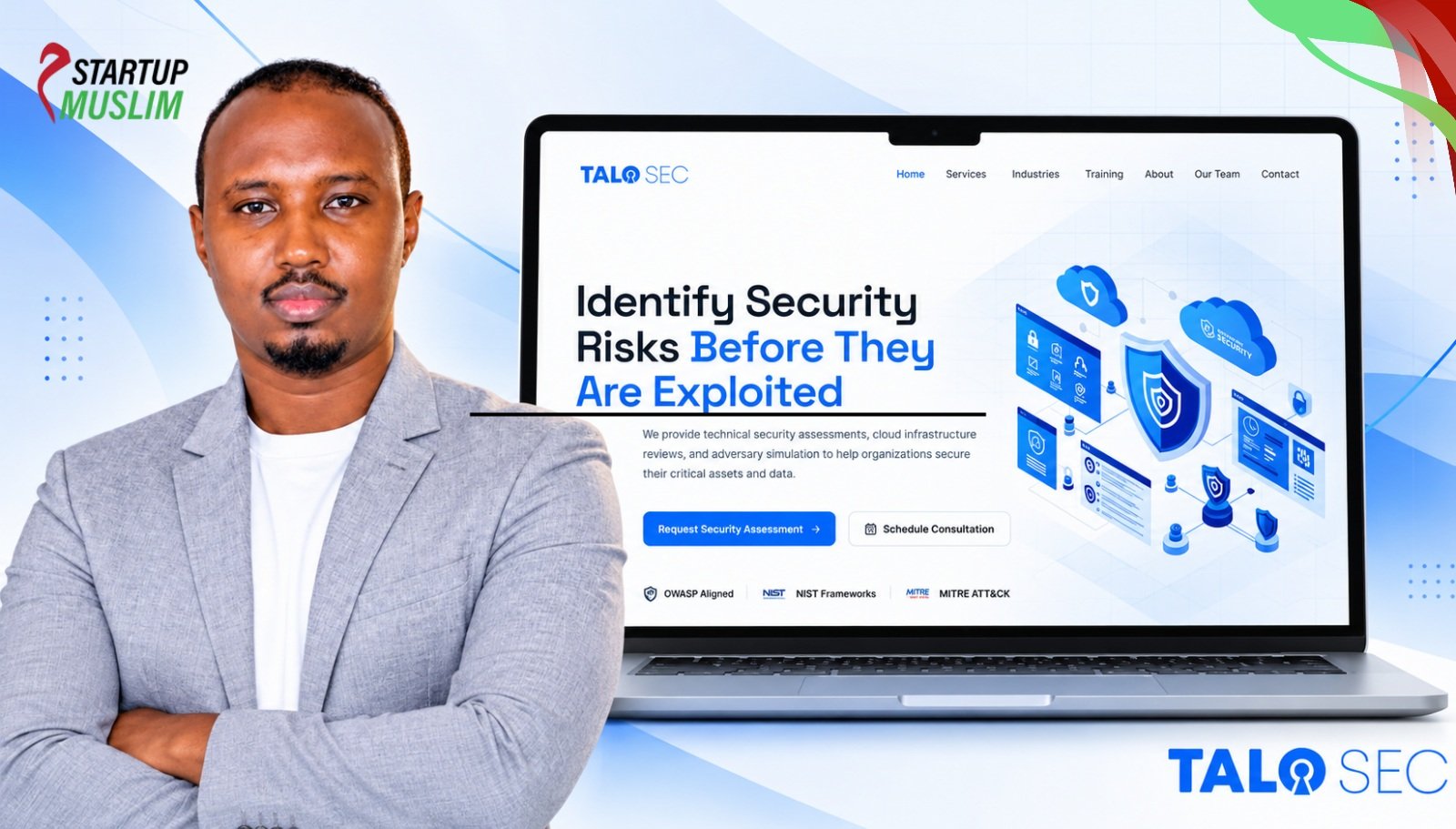
The founder of Talosec wants to turn cybersecurity expertise into a lasting African capability, combining technical security services, threat intelligence and professional training to help organizations defend themselves in an increasingly digital world.
When a business discovers a security vulnerability, the immediate question is often how to fix it. But for Abdiwahab Ahmed, the founder and CEO of Talosec, the more important question is what happens when that vulnerability becomes part of a much larger failure.
A weakness in an application might expose sensitive information. A compromised password could give an attacker access to an entire network. An overlooked cloud configuration could leave critical systems vulnerable long after an organization believes its security measures are sufficient. Ahmed’s experience in ethical hacking, penetration testing, bug bounty hunting and vulnerability research taught him to look beyond individual technical flaws and examine the business risks they create.
That perspective eventually led him to entrepreneurship. Rather than concentrating solely on discovering vulnerabilities, he wanted to build an organization capable of helping businesses identify threats, strengthen their defenses and develop the expertise needed to protect their systems over time. Through Talosec, Ahmed is pursuing that ambition from Mogadishu, Somalia, with a vision that extends beyond his home market to Africa’s broader cybersecurity ecosystem.
1. From Ethical Hacker to Entrepreneur
Ahmed’s journey began with the technical challenge of understanding how digital systems work, where they fail and how attackers might exploit their weaknesses. Ethical hacking and vulnerability research provided a way to investigate those questions, but they also revealed that finding a flaw was rarely enough to make an organization secure.
A vulnerability’s consequences depend on the environment around it. Weak access controls, insufficient monitoring, poor incident response and limited security awareness can turn an isolated technical issue into a serious operational problem. Ahmed learned to ask what an attacker could actually accomplish, whether that meant accessing confidential information, compromising an application or disrupting an essential service.
Over time, he became increasingly interested in what organizations needed after a vulnerability had been discovered. They required professionals who could explain the risk, recommend appropriate remediation and help establish security practices that would endure beyond a single assessment. Talosec emerged from that realization. Ahmed wanted to transform individual technical expertise into a sustainable cybersecurity business that could support organizations throughout their security journey, rather than simply identify weaknesses and move on to the next engagement.
2. Why Build a Cybersecurity Company in Somalia?
Somalia’s digital transformation is creating new opportunities for businesses and public institutions, but greater reliance on technology also introduces new risks. Financial institutions, telecommunications providers, government organizations and other enterprises increasingly depend on digital systems to deliver services and manage information.
Ahmed sees a gap between the pace of that transformation and the development of the cybersecurity capabilities needed to support it. The challenge extends beyond the availability of qualified professionals. Awareness, investment priorities, access to specialized services and the adoption of consistent security practices all influence how well organizations can defend themselves.
His decision to build Talosec in Mogadishu reflects a belief that local cybersecurity expertise should be developed within the markets that need it. Professionals who understand the local business environment, infrastructure constraints and institutional realities can offer context that external providers may not always possess.
That does not mean local expertise should operate in isolation. Ahmed believes African cybersecurity companies must meet international professional standards while designing services that reflect the practical circumstances of their customers. The opportunity, as he sees it, is to help Somali organizations become more resilient while contributing to a regional industry capable of supporting Africa’s expanding digital economy.
3. The Threats Businesses Cannot Afford to Ignore
For Ahmed, cybersecurity cannot be reduced to installing antivirus software or deploying a firewall. Organizations need to understand which systems are exposed, who has access to them, where suspicious activity might emerge and how quickly they can respond when an incident occurs.
He identifies several areas that deserve greater attention. Credential theft and infostealer malware can give attackers access to email accounts, cloud platforms and business applications without requiring them to exploit a sophisticated software vulnerability. Meanwhile, forgotten subdomains, misconfigured cloud services and exposed administrative interfaces can create opportunities for attacks that organizations may not even realize are possible.
Ransomware and data extortion present another challenge, requiring businesses to prepare for containment, recovery and the protection of sensitive information, not merely prevention. Weak identity and access management can compound these risks, allowing a compromised account to become the entry point for a wider intrusion.
Ahmed also emphasizes threat intelligence, which can help organizations understand the threats targeting their industries and prioritize the assets most at risk. For companies operating with limited security budgets, that information can make the difference between spreading resources too thinly and concentrating on the weaknesses that matter most. The goal is to move from reacting to incidents toward understanding and reducing risk continuously.
4. Why Finding a Vulnerability Is Only the Beginning
Cybersecurity assessments often produce detailed reports, but the number of vulnerabilities identified does not necessarily tell an organization whether it has become safer. Ahmed believes the real test is what changes after the assessment is complete.
At Talosec, his stated approach connects technical findings to business consequences and remediation priorities. Vulnerabilities should be assessed according to factors such as severity, exploitability, exposure and the importance of the affected asset. Organizations then need clear recommendations, assigned responsibilities and realistic timelines for addressing the findings.
Where appropriate, critical vulnerabilities should be retested to confirm that the underlying weaknesses have been resolved. Security teams should also examine whether they are fixing serious issues faster, reducing recurring weaknesses, improving the investigation of alerts and responding more effectively to incidents.
This approach changes the purpose of a penetration test. Rather than treating a report as the final deliverable, it makes the assessment part of a broader improvement process. For Ahmed, the measure of success is not how many vulnerabilities a company discovers, but whether the organization becomes measurably more secure.
5. Building a Business Around Security, Intelligence and Skills
Talosec’s business model brings together three complementary areas: cybersecurity services, threat intelligence and professional development through Talosec Institute. Its service offering includes application and network security testing, attack surface management, vulnerability management, incident response and security advisory work.
Ahmed is also interested in continuous security offerings that help organizations monitor their exposure and track emerging threats over time. Dark web monitoring and indicators of compromise form part of this broader focus on understanding risks that may affect an organization’s infrastructure, employees, customers and operations. The third component addresses a problem that extends beyond any individual client: the shortage of practical cybersecurity skills. Through Talosec Institute, Ahmed wants to help develop professionals who can contribute to the industry rather than relying exclusively on talent trained elsewhere.
He measures the business through indicators such as recurring revenue, contract renewals, customer acquisition, delivery costs, engagement profitability and remediation outcomes. He has not disclosed specific revenue figures, customer counts or contract values, making it important to distinguish Talosec’s strategic direction from independently established commercial scale. The longer-term ambition is to build a sustainable company around strong delivery standards, lasting customer relationships and the ability to expand responsibly.
6. Developing Africa’s Next Generation of Cybersecurity Professionals
Ahmed believes Africa cannot build lasting digital resilience by depending entirely on external expertise. The continent needs professionals who can secure local institutions, conduct original research, contribute to open-source projects and create cybersecurity businesses of their own.
He sees a significant gap between theoretical education and the practical demands of security work. Students need opportunities to develop skills in networking, operating systems, programming, cloud security, digital forensics, threat intelligence and incident response. They also need realistic laboratories, simulated incidents and experience communicating technical findings to people who may not have an engineering background.
Universities, training institutes, employers and cybersecurity communities must work together to create pathways from education into employment. Mentorship, internships, responsible security research and participation in international communities can help students develop the judgment and professional discipline that security work demands.
Through Talosec Institute, Ahmed wants to encourage students to think critically, investigate problems systematically and take responsibility for their decisions. He believes that developing talent requires more than teaching people which tools to use; it requires preparing them to understand unfamiliar problems and solve them independently.
Africa has the talent. The challenge is building the systems that allow it to flourish.
7. A Vision That Extends Beyond Somalia
Ahmed’s long-term ambition is for Talosec to become a major African cybersecurity company with the technical depth and operational maturity to serve organizations across multiple markets. He does not envision a business limited to penetration testing or professional training, but an ecosystem connecting security services, threat intelligence, technology development and talent creation.
The immediate priority is to establish strong foundations through reliable service delivery, skilled professionals, repeatable processes and lasting client relationships. From there, he hopes to expand Talosec’s threat intelligence and attack surface management capabilities, develop technology for regional security challenges and serve customers beyond Somalia. His experience with digital systems has also reinforced a principle relevant to governments undertaking digital transformation. Moving public services online can improve accessibility and efficiency, but security must be incorporated from the beginning through appropriate access controls, monitoring, independent assessments and tested incident response procedures.
Ahmed argues that the objective should not be to slow digitization, but to ensure that the systems supporting it are designed to withstand threats and protect citizens’ information. Responsible vulnerability disclosure and effective remediation must also become part of how institutions manage their digital infrastructure.
For Talosec, the next five to ten years will be about turning that philosophy into a durable business and a wider contribution to the industry. Ahmed wants African organizations to access world-class security capabilities, African researchers to build technology with global relevance, and young professionals to find meaningful careers without having to leave the continent to access opportunity. His ambition reaches beyond building a successful cybersecurity company. It is about helping build the cybersecurity ecosystem Africa will need for its digital future.
