





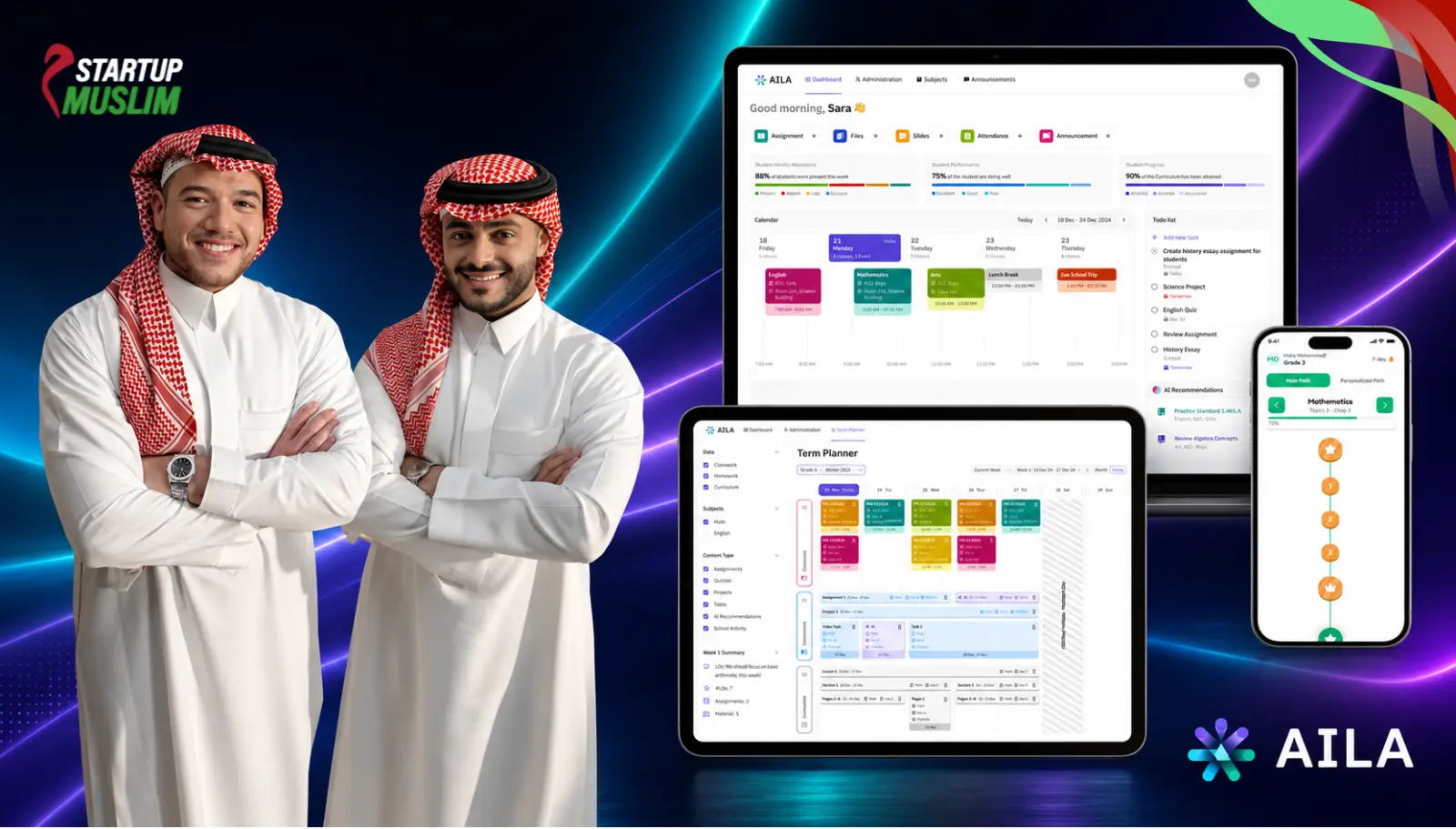
Saudi EdTech AILA has raised $3 million in a Pre-Series A funding round led by RUA Growth Fund, marking a new phase for the Riyadh-based education technology company as it expands its personalized learning products across regional and international markets. AILA Raises $3 Million with participation from Sanabil 500 Global, Bunat VC and Fikr Ventures, alongside strategic investor Jo Academy. The AILA Funding Round will support further product development, market expansion and broader adoption among schools, educators and students.
For the Saudi EdTech startup, the financing comes as artificial intelligence is moving from an experimental layer in education software toward a more central role in assessment, personalization and student support. AILA is positioning itself around that shift by building technology designed to understand where individual learners are struggling and adapt practice around their progress.
AILA Raises $3 Million as It Moves Into Its Next Growth Phase
The new capital gives Saudi EdTech company AILA additional resources to deepen its technology while expanding beyond its existing customer base. RUA Growth Fund led the round, with Sanabil 500 Global, Bunat VC and Fikr Ventures joining as investors. Jo Academy, the Jordan-based digital education company, participated as a strategic investor, bringing sector experience alongside capital.
The latest AILA Funding News places the company within a broader wave of Saudi startup funding going into companies that are using AI to rebuild established industries rather than simply adding new digital interfaces. Startup Muslim has tracked a similar pattern across enterprise software and artificial intelligence, including Signit’s $15 million Series A and RIME’s more than $2 million Seed round.
What makes the AILA Funding Round particularly relevant is the combination of venture backing and strategic education expertise. Jo Academy has built a significant digital education presence in Jordan and has been expanding its footprint in Saudi Arabia, making its participation potentially useful as AILA looks to scale in markets where curricula, assessment systems and institutional buying processes vary widely.
Building Personalized Learning Around the Individual Student
At the center of AILA is a simple problem: students may sit in the same classroom and study the same material, but they do not necessarily learn at the same pace or struggle with the same concepts. AILA Education Technology is designed around the idea that software should respond to those differences rather than treat every student as if they need the same learning path.
The company’s AI powered learning platform identifies learning gaps, personalizes practice and adjusts support based on student progress. For teachers and school leaders, the same system is intended to provide clearer visibility into performance so educators can see where intervention may be needed.
That makes the Saudi EdTech startup part of a broader shift from digitized education toward adaptive education. Earlier generations of EdTech often focused on putting lessons, videos and question banks online. AILA’s model goes further by attempting to use performance data continuously, so that what a learner sees next can change based on what the system understands about that learner.
AILA says it has reached 95,000 active users, more than 30 onboarded clients, 13 partnerships and a presence across four global markets. Those numbers give the company a base of real-world usage as it enters a more capital-intensive phase of growth.
AILA Tests Turns Assessment Data Into Personalized Practice
One of the clearest examples of AILA Education Technology is AILA Tests, the company’s AI-driven exam preparation product for Saudi national assessments including Qudurat, Tahsili and NAFS. The platform combines mock exams, skill analysis, adaptive learning, focused practice and performance tracking.
The difference is not simply that the testing experience is digital. The AI powered learning platform is designed to use a student’s results to determine where additional practice is needed. A learner who has already mastered one area can spend less time repeating it, while another who is struggling with a specific skill can receive more targeted practice.
For schools, that creates a second layer of value. Assessment is no longer only a way to generate a score; it can become a source of data that informs what happens next in the learning process. That is the larger opportunity AILA is pursuing as it moves from exam preparation toward a broader personalized education platform.
This approach also places AILA within the growing EdTech startup Saudi Arabia landscape, where local companies increasingly have the opportunity to build around the specific structures of Saudi education before taking their products into other markets.
Startup Muslim has also explored this transition through Nazir Ahmed’s work building scalable EdTech solutions, highlighting how education founders are increasingly approaching learning as an infrastructure and access problem rather than simply a content problem.
Why Jo Academy Matters as a Strategic Investor
Jo Academy’s participation gives the round an additional strategic dimension. The Jordanian company has spent years building digital education products for students in the Arab world, and its experience offers potential insight into regional student behavior, content distribution, education partnerships and market expansion.
For Saudi EdTech AILA, that matters because education is highly localized. A product can have strong technology and still struggle to scale if it does not account for how different school systems operate, what assessments matter, how teachers use technology and how institutions make purchasing decisions.
The relationship also connects AILA with another company investing heavily in the future of AI-enabled education. Jo Academy’s wider expansion into Saudi Arabia gives both businesses an overlapping geographic interest while allowing them to bring different capabilities to the market.
The strategic participation therefore makes this more than conventional AILA Funding News. It signals that the round is also about building an ecosystem of education expertise around the company as it enters new markets.
Funding the Shift From Product Traction to Scale
In the middle of that transition, AILA Raises $3 Million to move from early traction toward a larger regional and international footprint. The financing is expected to support continued development of the company’s AI capabilities, wider deployment across schools and education systems, and expansion into new markets.
For Saudi EdTech company AILA, the challenge now becomes execution. Personalized learning can be compelling in theory, but schools ultimately need evidence that technology improves outcomes, saves educators time, fits existing workflows and can be deployed reliably across large groups of students.
That is where the next phase of the company’s growth will be decided. AILA already has a product, clients, partnerships and users. New funding gives it more room to deepen those relationships and test whether its model can scale beyond individual implementations.
The Pre-Series A also follows AILA’s $1.15 million pre-seed round in October 2024, which was led by Sabah Hub with participation from White Hill Capital and three Saudi angel investors. That earlier financing was directed toward improving the company’s technology and supporting regional expansion, making the latest round a clear step up in both capital and ambition.
The company’s 2025 partnership with Ibn Roshd is another indication of that institutional direction. AILA says the partnership was created to expand AI-driven education across schools using personalized learning technology and new digital tools.
AILA and the Wider Saudi AI Investment Story
The round also fits into a larger Saudi startup funding story. Capital is increasingly backing companies that are building AI into the operating core of sectors such as healthcare, compliance, enterprise software and education.
Startup Muslim recently covered Hakeem Health’s $1.65 million funding round, where AI is being embedded directly into clinical decision support, as well as Tax Star’s $1.75 million Seed round, which is applying AI to tax compliance across the GCC.
AILA is applying the same broader principle to education: using AI not as a standalone feature, but as a layer that can influence decisions continuously. In this case, those decisions include what a student should practice, where a teacher may need to intervene and how a school can interpret performance data.
That makes the company relevant beyond the EdTech startup Saudi Arabia category. If the model works at scale, it could become part of a broader regional movement toward AI-native infrastructure built from the Middle East for markets inside and outside the region.
The Opportunity Beyond Saudi Arabia
AILA’s international ambition is important because the problem it addresses is not unique to Saudi Arabia. Every education system deals with differences in student ability, comprehension and pace. The challenge is creating personalization without requiring a teacher to manually build a separate learning plan for every student.
Artificial intelligence creates the possibility of delivering some of that personalization at scale, but successful expansion will require AILA to adapt to new curricula, assessment structures and institutional requirements. What works for Saudi national exams cannot simply be copied into another country without localization.
This is where the company’s existing presence across four global markets may become valuable. It gives AILA an early opportunity to understand how its technology performs across different learning environments before it attempts much larger international expansion.
For investors, the opportunity is therefore twofold: building a significant education technology business in Saudi Arabia while testing whether the same personalization engine can travel.
Conclusion: AILA’s Next Test Is Scale
With RUA Growth Fund leading the round and Sanabil 500 Global, Bunat VC, Fikr Ventures and Jo Academy participating, AILA Raises $3 Million with a clear mandate to expand. The funding gives the company more resources to improve its technology, grow institutional adoption and take its personalized learning model into additional markets.
The Saudi EdTech company now has to prove that personalization can deliver measurable value not only for individual learners, but also for teachers, schools and education systems. If it can do that, the opportunity extends beyond exam preparation and toward becoming a broader infrastructure layer for intelligent education.
The story to watch after this round is therefore not simply how quickly AILA grows, but whether it can turn adaptive learning into a repeatable model that works across different education systems. For a company emerging from the EdTech startup Saudi Arabia ecosystem, that would move AILA from a promising local platform toward a regional, and potentially global, education technology business.


