


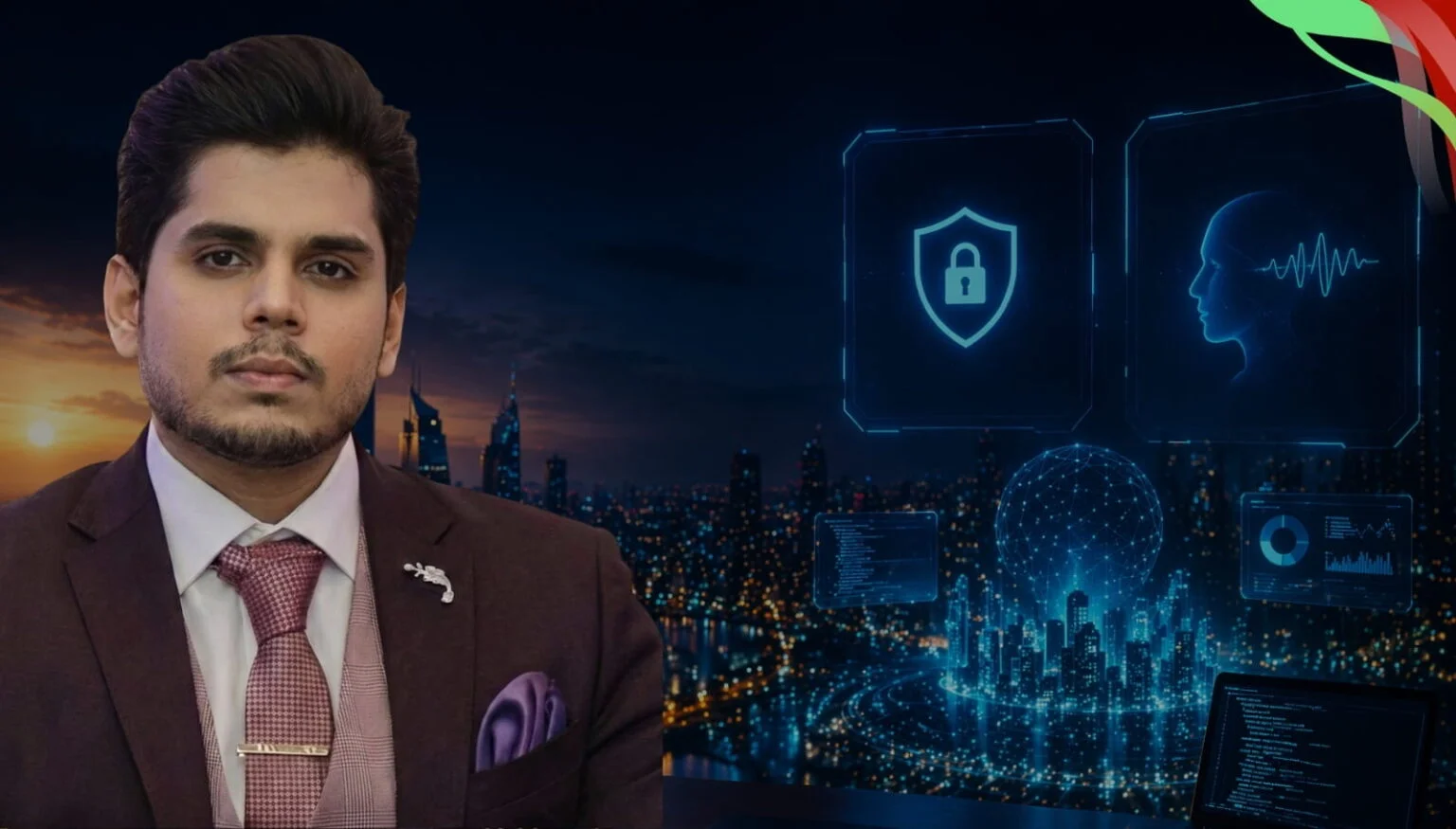
In a world increasingly dominated by artificial intelligence, most companies are racing to build faster models, better interfaces, and smarter applications. Muhammad Laraib Khan is taking a fundamentally different approach.
Instead of building on top of existing systems, he is asking a deeper question: Who truly owns intelligence in the age of AI?
From Startup Exits to Deep Tech Architecture
Laraib Khan, the Founding Architect of Rebootix Research, is not new to building high-stakes technology. Before launching Rebootix, he successfully built and exited a tech startup—gaining firsthand experience in scaling systems and navigating complex technological environments.
His expertise spans AI and system architecture, further strengthened by advanced credentials from institutions like NVIDIA and Oxford. But Rebootix is not just another startup—it is a research-driven initiative focused on redefining how intelligence itself is structured and controlled.
The Core Thesis: The World Is Renting Intelligence
The idea behind Rebootix emerged from a critical observation. “I realized the world is currently renting its intelligence,” Laraib explains. Today’s AI ecosystem largely depends on centralized platforms, legacy operating systems, and third-party infrastructures.
This creates what he calls a “Sovereign Intelligence Deficit.” In simple terms: Users and even nations rely on systems they do not fully control.
Rebootix: Building the Infrastructure of Intelligence
Rebootix positions itself as an AI Research & Development lab focused on Sovereign Intelligence—a concept centered on ownership, control, and deterministic behavior of AI systems. The company is currently developing two flagship technologies:
1. OMEGA-1 — The Governance Kernel
A high-security “Logic Shield” designed for governments and high-stakes institutions. It ensures that sensitive decision-making processes remain:
- Private
- Verifiable
- Mathematically secure
2. Viki OS — The AI-Native Operating System
A next-generation operating system built on a hardened Linux foundation. Unlike traditional systems, Viki OS is designed where:
- AI is the operating system itself
- Users interact via voice and intent
- The system executes complex workflows autonomously
This represents a shift from interface-driven computing to intent-driven computing.
Solving the Problem of “Probabilistic Dependency”
One of Rebootix’s most ambitious goals is addressing what Laraib calls “Probabilistic Dependency.” Most modern AI systems rely on probabilistic outputs—they predict, infer, and sometimes hallucinate. While acceptable in consumer applications, this becomes dangerous in:
- National security
- Financial systems
- Critical infrastructure
Rebootix aims to replace this with Deterministic Governance—systems where AI behavior is:
- Predictable
- Auditable
- Aligned with user intent
“We ensure AI behavior is verifiable and safe,” Laraib says.
From Concept to Deployment
Unlike many deep-tech startups stuck in theoretical phases, Rebootix has reached a significant milestone:
- Achieved TRL 6/7 (Technology Readiness Level)
- Built a containerized, deployable architecture
- Backed by validated intellectual property and research
This indicates that the system is no longer just conceptual—it is approaching real-world implementation.
Rejecting the Hype Cycle
While much of the AI industry is driven by rapid iteration and hype, Rebootix has taken a slower, more deliberate path. “We chose fundamental R&D over quick chatbots,” Laraib notes. The company spent years solving core problems in governance logic—focusing on foundational infrastructure rather than surface-level applications.
This philosophy is captured in a simple belief: “If you don’t own the kernel, you don’t own the future.”
Faith, Responsibility, and Technology
For Laraib, building Rebootix is not just a technical pursuit—it is a moral one. He views technology as an Amanah (trust). “In our tradition, protecting autonomy and well-being is a high calling,” he explains. This perspective shapes the company’s mission: to build systems that empower users rather than make them dependent.
A Global Vision Anchored in the Muslim World
Looking ahead, Rebootix is positioning itself for global impact. The company plans to establish its headquarters in Riyadh—leveraging the region’s growing investment in advanced technologies.
Its long-term goals include:
- Deploying OMEGA-1 in sovereign frameworks
- Launching Viki OS to a global user base
- Building infrastructure for the next billion AI users
Advice to Founders: Stop Being a Tenant
Laraib’s advice to entrepreneurs is direct—and unconventional: “Stop being a tenant.” He warns against over-reliance on external platforms, APIs, and ecosystems.
Instead, he encourages founders to:
- Identify foundational gaps
- Build core infrastructure
- Focus on long-term control and ownership
Because in the next era of technology, those who own the underlying systems will define the future.
A Legacy of Ownership
For Laraib Khan, success is not about building another AI product. It is about shifting the paradigm of how intelligence is created, controlled, and distributed. If Rebootix succeeds, it won’t just compete in the AI race—it will redefine its rules.
And in doing so, it may answer one of the most important questions of our time: Not just how intelligent our systems are but who they ultimately serve.
