





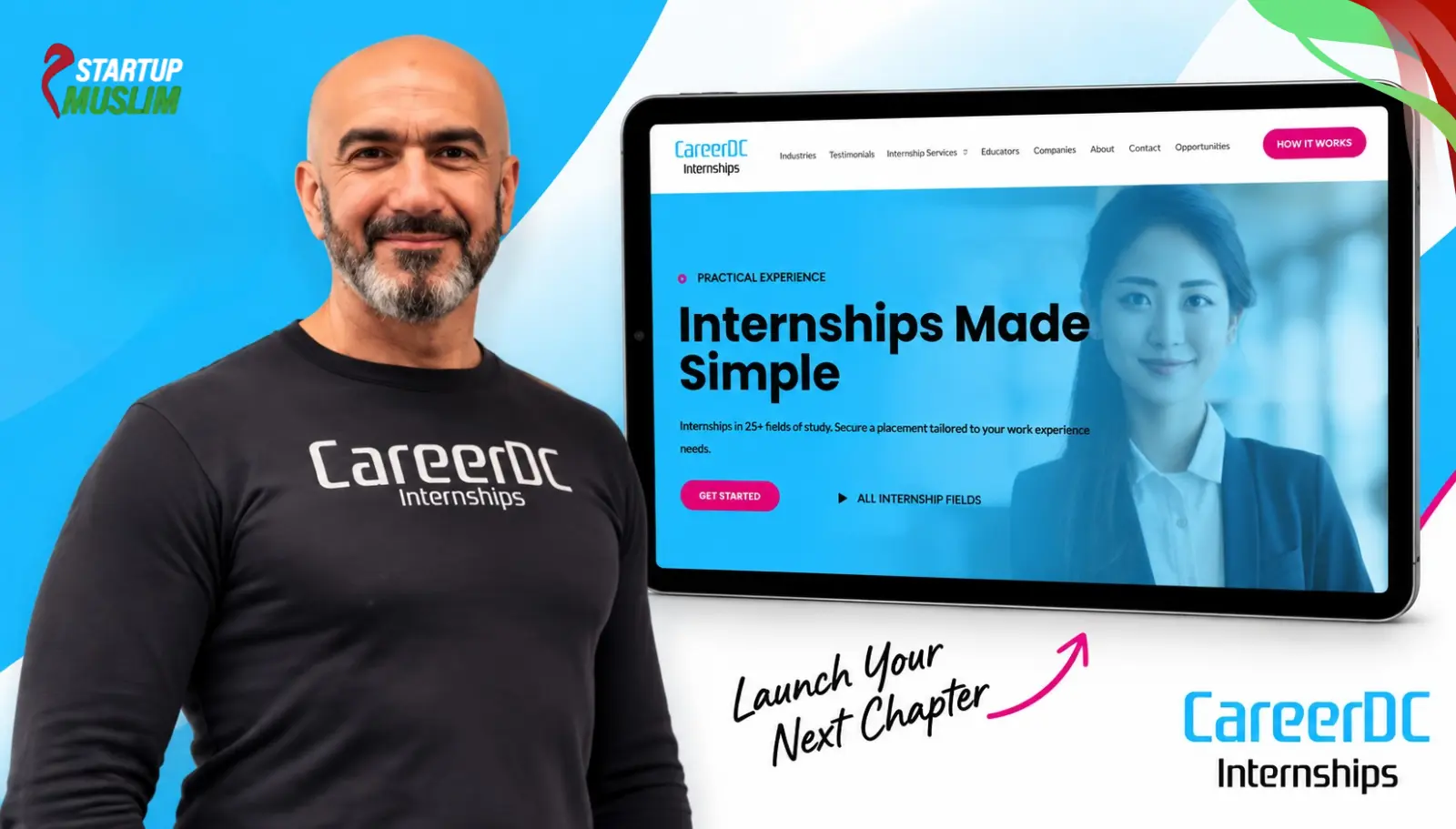
For many university students, graduation marks the beginning of a difficult paradox. They have spent years acquiring knowledge, earned the degree that employers ask for, and completed the assignments and examinations that prove they can learn. Yet when they begin applying for jobs, they are often told they lack the one thing they cannot acquire inside a classroom: experience.
For Miqdad Hassan, Founder and CEO of CareerDC, this problem became personal long before it became a business opportunity. In 2011, while living in Sydney, Hassan met an international student from Bangladesh who had strong academic qualifications but was struggling to secure the internship required to complete his degree. The problem was not capability. It was the absence of local work experience and professional networks. That encounter eventually became the foundation for CareerDC, a company built around a simple idea: higher education should not end at theoretical knowledge. Students should graduate with the practical experience and confidence to actually use it.
Today, CareerDC has supported more than 4,500 students, operating at the intersection of universities, employers and students. But Hassan believes the opportunity extends far beyond arranging internships in Australia. His larger ambition is to build global infrastructure connecting education with employment, allowing students to move from study to graduation to meaningful work, regardless of where they are in the world.
The Moment Hassan Saw the Employability Gap
Hassan did not begin his career intending to reinvent higher education. His background was in Computer Engineering, followed by experience in IT consulting and business strategy. That education taught him systems thinking, structured logic and technical problem-solving, while his professional experience showed him how those frameworks could be applied to complicated operational problems.
The encounter with the Bangladeshi student in Sydney changed the direction of that thinking. Hassan saw that universities could provide strong academic foundations while students could still struggle to translate those foundations into workplace capability. The problem was particularly visible among international students, who could arrive with impressive qualifications but lack the local networks and professional context employers expected.
CareerDC emerged from that gap. Rather than treating internships as informal work experience, Hassan began developing a more structured approach to practical learning, eventually building the company around Work Integrated Learning, or WIL.
The distinction matters.
Why a Degree Alone Is No Longer Enough
Work Integrated Learning is often reduced to the idea of an internship, but Hassan sees it as something much broader. At its core, WIL is the deliberate integration of academic learning with structured professional practice, combining real-world tasks with learning outcomes, workplace mentorship and formal feedback. For students, that changes the value proposition of practical experience. They are not simply spending a few weeks inside a company; they are learning how their academic knowledge behaves when confronted with real customers, deadlines, ambiguity, colleagues and commercial constraints.
Those experiences develop capabilities that are difficult to reproduce inside a lecture hall: communication, critical thinking, workplace awareness, resilience and the ability to navigate unfamiliar problems. Hassan believes these experiences should become an integral part of higher education rather than an optional extra. A university degree can demonstrate that someone has acquired knowledge, but structured workplace experience can demonstrate that they know how to apply it.
The future graduate may need to leave university with both a degree and evidence of what they can actually do.
The Curriculum Moves Slowly. Industry Doesn’t.
At the centre of Hassan’s argument is a structural mismatch between education and employment. University curricula are traditionally designed and updated through relatively long academic cycles. Industry, meanwhile, can change continuously. Technologies evolve, business models emerge, new tools become standard and employers alter the skills they need, sometimes within months rather than years. That creates a difficult situation for universities. Even when institutions want to remain relevant, it is difficult for a static curriculum to move at the same speed as a dynamic labour market.
Hassan believes the answer is not simply to keep adding new subjects to degree programs. Instead, universities need to embed more experiential learning into the educational model itself. Students should work on real client projects, interact with industry mentors and complete structured WIL placements as part of their core academic journey. The shift would fundamentally change what a degree represents. Instead of graduating with a transcript that primarily describes what a student studied, graduates could leave with a portfolio of demonstrated workplace capabilities.
CareerDC is positioning itself as part of the infrastructure required to make that transition possible.
Building a Three-Sided Employability Platform
CareerDC operates across three groups that traditionally have had different incentives: students, education providers and employers.
The company works directly with universities and education providers as an embedded WIL delivery partner while maintaining a network of vetted host organisations across multiple sectors. That means its role extends beyond matching a student with an internship; it is responsible for helping structure the experience so that it creates value for students and host organisations alike.
The business has supported more than 4,500 students, with its commercial model incorporating institutional partnerships, B2B placement services and technology-enabled support systems. Hassan says CareerDC measures its performance not only through revenue but through indicators such as placement completion, host-company retention, institutional satisfaction and graduate employability outcomes. That is an important distinction for an education business. If the ultimate product is employability, the quality of the outcome matters as much as the number of students passing through the platform. And the potential market is enormous.
The Internship Is Changing in the Age of AI
Artificial intelligence is now forcing another question onto the internship debate: what happens when AI can perform many of the tasks traditionally assigned to entry-level employees? Basic data entry, preliminary research and routine drafting are increasingly susceptible to automation. For Hassan, however, that does not make internships less important. It makes them more important, but fundamentally different. If AI can handle increasingly routine work, employers will place greater value on capabilities that machines cannot easily replicate: critical thinking, strategic problem-solving, adaptability, emotional intelligence and cross-cultural communication.
That means the old model of an intern performing repetitive tasks for a few weeks may become increasingly irrelevant. Future internships will need to give students opportunities to use AI as part of higher-value work, interpret information, solve ambiguous problems and contribute to actual business outcomes. In that sense, AI may accelerate the transformation Hassan has been advocating for years. The question is no longer whether students should gain practical experience, but whether the experience they gain reflects the workplace they are actually entering.
From Australia to a Global Employability Network
CareerDC’s ambitions are now moving beyond its Australian foundations. Having expanded into domestic markets including Western Australia, Hassan is focused on international education hubs and on developing the Study, Graduate, Work network as a broader employability ecosystem.
Technology is central to that strategy. A global platform could potentially support cross-border placements, remote internships and collaboration between universities and employers in different countries, reducing the importance of geography in the transition from education to employment.
The ambition is significantly larger than becoming an online internship marketplace. Hassan envisions a system incorporating skill verification, structured industry integration and cross-border opportunities, creating a bridge between what students learn and where they ultimately want to work.
That vision also reflects his own experience of working across different professional and cultural ecosystems. His involvement with networks including MÜSİAD Sydney and the Australia Arab Chamber of Commerce and Industry, alongside his interest in technology and quantified-self communities, has reinforced his belief that entrepreneurial opportunities often emerge where different communities intersect.
Building a Company Around Trust, Not Surveillance
Hassan’s approach to building CareerDC was also shaped by an unexpected experiment during the COVID-19 pandemic. The company transitioned to a fully remote model, forcing him to rethink some of the assumptions behind traditional management. Without a shared office, managers could no longer rely on physical presence as a proxy for productivity. Instead, CareerDC had to build stronger documentation, digital workflows and deliberate communication systems while evaluating employees based on outcomes rather than hours spent at a desk.
For Hassan, the lesson was straightforward: remote work succeeds when organisations replace physical oversight with trust, clarity and accountability. That philosophy fits naturally with the larger problem CareerDC is trying to solve. Whether it is a student entering an unfamiliar workplace or an employee operating from another country, modern professional environments increasingly reward people who can operate independently, communicate clearly and adapt to changing circumstances. The company itself therefore becomes a reflection of the workplace it is preparing students to enter.
The Bigger Opportunity Is the Transition, Not the Internship
Over the next five to ten years, Hassan wants CareerDC and Study, Graduate, Work to become global infrastructure connecting universities, employers and students across borders. The ambition is to move from facilitating internships to helping verify skills, enable international placements and create structured pathways into meaningful careers. It is a deceptively large problem. Education and employment are often treated as two separate markets, with universities responsible for learning and companies responsible for hiring. But the space between the two is where millions of students encounter uncertainty every year.
Hassan’s career has given him a systems-oriented way of looking at that gap. The engineer who once learned to solve technical problems is now applying the same mindset to a much larger social and economic challenge: how do you build a system in which education reliably leads to opportunity? CareerDC’s answer begins with experience. But its ultimate ambition is much bigger: to make the journey from classroom to career more structured, more accessible and increasingly global.
Because in a world where knowledge is becoming easier to access, the ability to prove that you can apply it may become the most valuable credential of all.


