





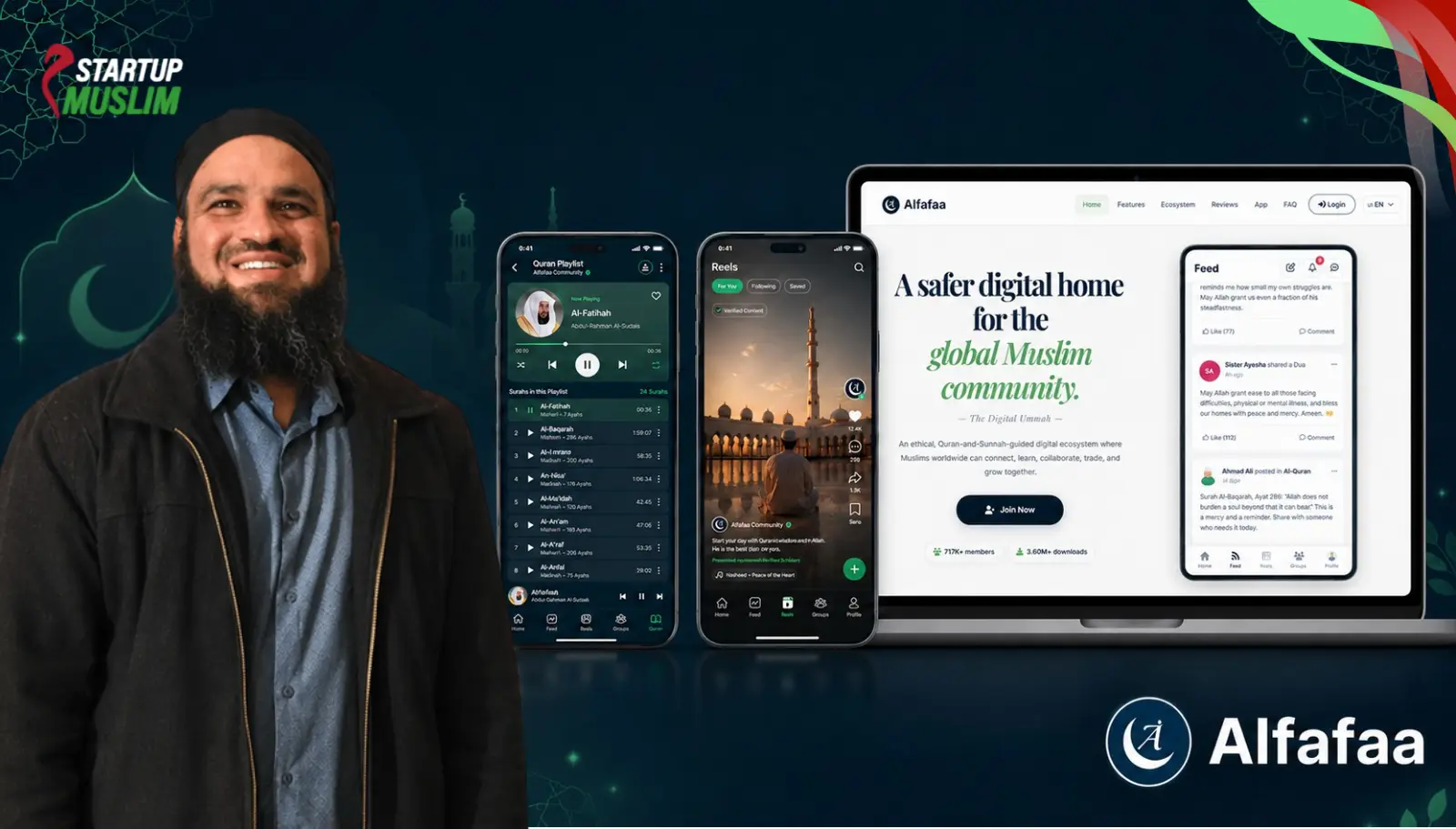
How Asif Syed Is Building Alfafaa Community Into the Digital Infrastructure of the Ummah
For most technology founders, the origin story begins with a market gap, a technical breakthrough or a business opportunity. For Asif Syed, the founder of Alfafaa Community, the journey began with a much more personal question: what should one do with a second chance at life?
At 16, Syed was diagnosed with Stage IV lymphoma and underwent roughly two years of chemotherapy. The experience reshaped his sense of purpose, even as his fascination with technology continued to grow from childhood experiments with an old IBM computer. During treatment, he built an early website focused on Kashmir, discovering that technology could be more than hardware and software—it could also be a tool for communication, representation and giving voice to communities.
A great deal of Syed’s multidisciplinary approach, he says, came from his father. From a young age, his father encouraged him to learn broadly rather than confining himself to a single subject, teaching him practical skills and exposing him to different areas of knowledge while encouraging him to understand how things worked rather than simply accept them at face value. Looking back, Syed credits that upbringing with helping him become what he describes as an all-rounder—someone comfortable moving between technology, science, healthcare, business, history, current affairs and practical problem-solving. That intellectual curiosity would ultimately become one of the defining threads of his career, enabling him to move across seemingly different worlds while continuing to see connections between them.
Decades later, that intersection of technology, purpose and community has become Alfafaa Community, a platform Syed describes as “The Digital Ummah.” What began with the ambition to create a safer online environment for Muslims is now evolving toward something far more ambitious: a connected digital ecosystem spanning community, knowledge, education, employment, business, media, events and potentially an expanding network of Muslim-built technologies.
A Life Lived Across Technology, Healthcare And Business
Syed describes himself, somewhat humorously, as a “polymath-lite,” and his career reflects that multidisciplinary instinct. His early curiosity about computers led him to programming, computer engineering and networking, while his eventual professional career took him deeply into healthcare, where he spent more than two decades working primarily in Nuclear Cardiology.
His roles included clinical, supervisory and leadership responsibilities, covering patient care, regulatory compliance, quality assurance, technology, operations and team management. Yet technology remained a constant parallel track, including extensive work with Cisco technologies and a period as a CCNA Teaching Assistant. He later expanded into business management as Senior Managing Director of MENA Plus Consulting in Doha, working across strategy, operations, investments and partnerships. The common thread was an interest in systems—how they work, how they connect and how they can be improved. That perspective would eventually shape the architecture of Alfafaa.
The Question That Became Alfafaa
The Alfafaa vision formally began in 2014, when Syed and his brother-in-law started Alfafaa, LLC. Even then, the idea was larger than building a Muslim alternative to an existing social network. They imagined what Syed calls a “digital intranet for Muslims”—an environment where people could communicate, learn, conduct business and access digital services within an ecosystem designed around Islamic values.
The idea gained further urgency as Syed watched Muslim communities navigate wars, political instability, humanitarian crises and dramatic changes in media and technology. His concern was not that Muslims should withdraw from the wider internet. It was that a global community of nearly two billion people had limited control over the infrastructure through which it communicated, preserved knowledge, conducted business and told its own stories.
The question was no longer whether Muslims needed another social-media app. It was whether they could build meaningful digital infrastructure of their own.
After returning to the United States and later rebuilding the vision during the COVID-19 period, the founders began assembling the pieces. First came a blog, then a directory, and eventually Alfafaa Community as an ethical Muslim social platform. Five years later, social networking remains an important part of the company, but increasingly, it is being treated as the foundation rather than the destination.
Building Beyond The Attention Economy
The philosophical distinction behind Alfafaa Community is central to Syed’s vision. Mainstream social platforms have become extraordinarily effective at connecting people, but their underlying incentives often revolve around maximizing attention, engagement and time spent scrolling. Syed believes those incentives can conflict with the principles Muslims are encouraged to apply to communication. Verification, restraint, dignity and the responsibility to consider whether information is truthful or beneficial can sit uneasily inside systems where controversy, outrage and sensationalism frequently generate the strongest engagement.
The Islamic principle of tabayyun i.e. careful verification, has therefore become an important part of how he thinks about digital behavior. So has the Prophetic teaching to speak what is good or remain silent, a principle that challenges the assumption that every person must immediately react to every controversy. “We also needed to think about the environment itself,” Syed explains through his broader argument about digital platforms. The goal, he says, is not to eliminate disagreement or isolate Muslims from mainstream technology, but to create an additional environment where participation does not require compromising core principles.
That philosophy changes what success looks like. For Alfafaa, engagement is not automatically beneficial simply because it is high.
From Social Network To “Digital Mothership”
The ecosystem now being built around Alfafaa was part of the original vision, but users have helped determine its evolution. As the community grew, recurring needs became clearer: reliable Islamic knowledge, Muslim-owned businesses, employment, education, events, professional connections and safer communication. That feedback has pushed Alfafaa toward a broader proposition. The company now envisions a connected environment where community members can move across different parts of their digital lives through a trusted ecosystem, rather than treating social networking as a standalone product.
Syed calls the long-term model a “digital mothership.”
The metaphor is significant because it does not mean Alfafaa intends to build every product itself. Instead, Syed sees the company potentially providing the connective layer—community, identity, trust, distribution and infrastructure—through which other Muslim entrepreneurs and technology companies can reach users. A startup building Islamic fintech, education technology, travel, charitable infrastructure or professional tools would not necessarily need to recreate an entire social network or acquire a massive audience independently. In Syed’s ideal model, trusted technologies could eventually integrate into the wider Alfafaa ecosystem. The ambition, in other words, is collaboration rather than digital isolation.
715,000 Members And A Platform Built Lean
Alfafaa’s vision is large, but the company already has meaningful evidence of demand. According to Syed, the platform has grown to more than 715,000 registered members across over 160 countries, while its broader mobile ecosystem has accumulated more than 3.6 million downloads. Syed is careful, however, not to blur downloads, registrations and active users into a single headline number. During stronger growth periods, the core community platform has recorded approximately 300,000 visits per month, while engagement is spread across posts, groups, messaging, Islamic content, pages and short-form video.
Its reels section has grown to more than 20,000 videos, generating millions of views, while the company’s directory contains thousands of Muslim businesses, masajid, organizations and other resources. The community spans North America, Europe, the Middle East, South Asia, Southeast Asia and Africa—a diversity that creates both global reach and significant product complexity.
Much of that progress has been achieved through a relatively small distributed team, limited marketing budgets and substantial founder funding. For Syed, however, one of the most important forms of traction is harder to measure: trust.
Can AI Help Moderate A Community Built On Islamic Values?
As Alfafaa scales, one of its biggest challenges is maintaining community standards without relying entirely on human moderators. The company’s answer is HayaAI, an AI-assisted compliance technology designed to help identify inappropriate content, suspicious activity, scams, harassment and other potential violations. But Syed is explicit about what HayaAI is not.
It is not a Mufti. It is not the final authority on what is halal or haram. Instead, Alfafaa describes a layered model in which qualified Ulama provide guidance, the Compliance Department exercises human judgment and oversight, and HayaAI provides technological assistance at scale. The system is intended to assist with visual-content moderation, including material that may violate the platform’s modesty standards. It can also support enforcement of gender boundaries in communication and eventually help flag harassment, abusive behavior, misinformation and attempts to circumvent platform protections.
AI provides scale. Human beings remain responsible for judgment. That distinction may become increasingly important as Alfafaa pursues growth. Syed believes technology alone cannot create good character, which is why he sees Alfafaa as both a technology project and a community-culture project.
Monetizing Utility, Not Addiction
A mission-driven social platform still requires a business model. Servers, developers, compliance teams and continued innovation all require capital, and Syed acknowledges that good intentions alone cannot sustain a technology company. Alfafaa’s emerging model therefore includes multiple revenue streams, including ethical advertising, premium services, business promotion, education, marketplace opportunities, partnerships and integrations. The company also sees potential in creating tools that help Muslim businesses reach customers, educators reach students and entrepreneurs gain distribution through the ecosystem.
But Syed wants to draw a philosophical distinction from the traditional attention economy. Rather than primarily monetizing the amount of time a person spends scrolling, he wants Alfafaa to increasingly monetize utility. Helping someone find a job, discover a business, take a course, attend an event or access a useful service can create economic value without deliberately making the platform more addictive. That may occasionally mean rejecting revenue opportunities that conflict with the platform’s standards. For Syed, that is not a weakness in the model. It is the point of it.
From Separate Islands To A Connected Digital Economy
Looking ahead five or ten years, Syed does not define success by simply becoming the world’s largest Muslim social network. He wants Alfafaa Community to become infrastructure through which Muslims can connect, learn, work, trade, build companies and access an expanding range of digital services. The larger opportunity, he argues, is not merely to create more individual Muslim startups. It is to connect them. Today, many projects operate as separate islands, each independently trying to solve user acquisition, identity, distribution, trust and community building. Alfafaa’s “Digital Ummah” model is an attempt to make those islands increasingly interoperable.
Syed’s own journey has taught him that large visions require patience. He says he would do many things differently if starting again—owning more core technology earlier, building stronger analytics, developing strategic partnerships sooner and thinking more seriously about capitalization. But he would not change the mission.
The next challenge for Alfafaa is to prove that a large Muslim digital community can become the foundation for something even bigger: an interconnected ecosystem where businesses, scholars, educators, professionals, organizations and startups create value together. As Syed puts it, Alfafaa has spent years demonstrating that there is demand for a digital environment built around Muslim values. Now comes the harder and potentially far more consequential question “How much can the Ummah build on top of it”?


