





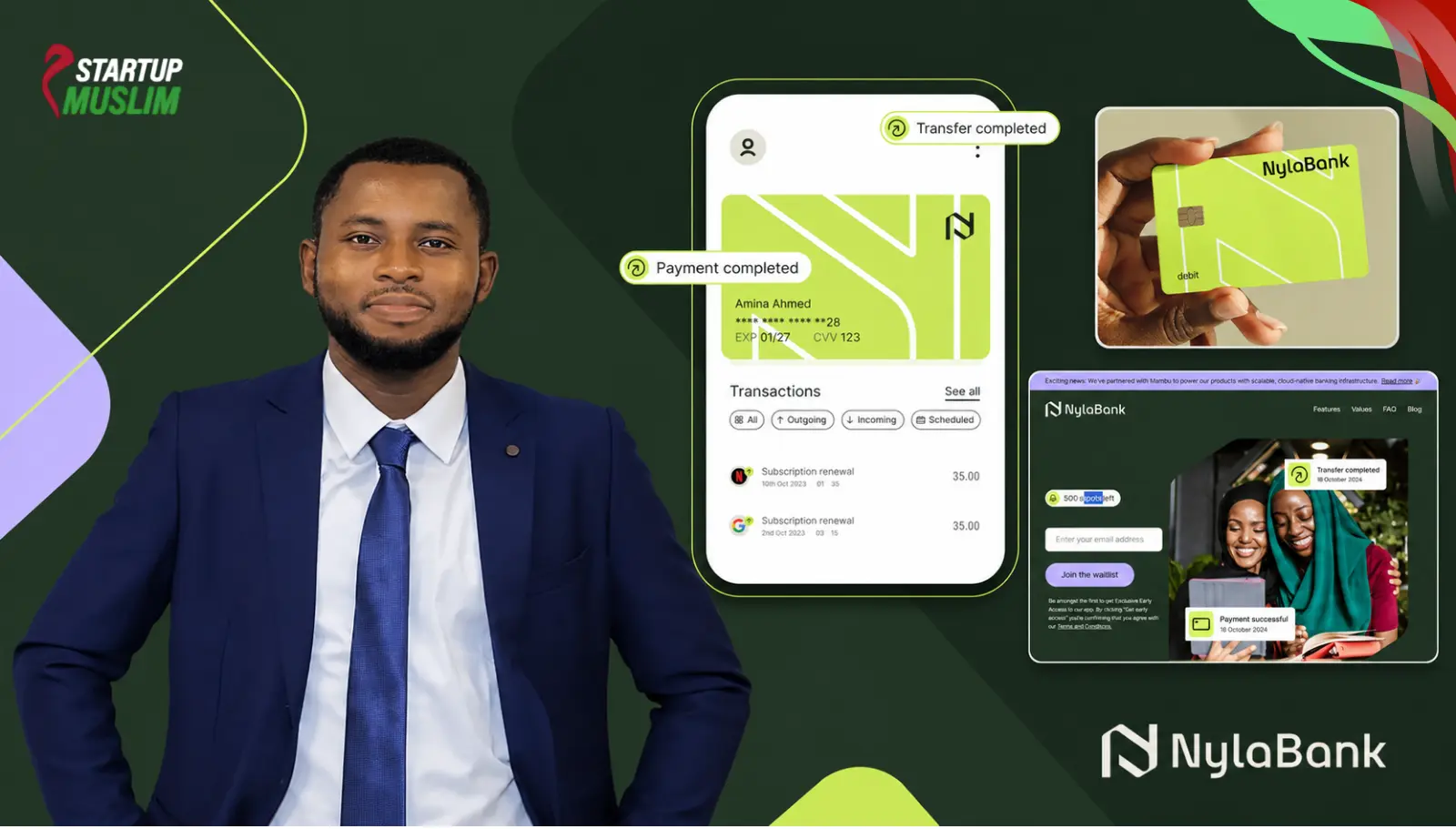
The Personal Question Behind a Pan-African Ambition
The idea for NylaBank did not begin with a spreadsheet, a market report or a venture capital pitch deck. It began with a conversation at home. After exiting his first technology company and taking time to recover from years of startup stress and burnout, Mubarak Sumaila visited his mother. During a conversation about money, she explained why she and others in her community hesitated to use conventional banks. The problem, he discovered, was not simply access to financial services. Banks were available, but many of the products and practices behind them did not align with the ethical and religious values they wanted their money to reflect.
For Mubarak Sumaila, that realization changed the question he was asking. He had previously assumed that financial exclusion was primarily an infrastructure problem. Now, he began to see another form of exclusion: people who technically had access to banking but felt they had to compromise their beliefs to participate in it. Concerns around interest, investments in industries they considered unethical, speculation, transparency, fairness and social responsibility pointed to a market gap that was both deeply personal and potentially enormous.
That insight became NylaBank, a company built around the idea that modern financial services should not require people to choose between convenience and their values.
Seeing a Market Where Others Saw a Niche
The more Mubarak studied the opportunity, the bigger it appeared. His mother’s community alone, he says, included thousands of people with similar concerns, while the broader numbers across Africa were far more significant. In his interview, he pointed to an estimated 250 million Muslims in West Africa and around 450 million across Africa, yet said the continent represented only a small fraction of the global Islamic finance market.
The opportunity was not limited to religious identity. At its core, NylaBank is built around principles that Mubarak believes have wider relevance: transparency, fairness, equity and ethical financial management. The company’s thesis is that a growing number of consumers want to understand how their money is managed and where it ultimately goes.
Islamic finance has traditionally faced a difficult challenge across many African markets: regulation, infrastructure and innovation have not always developed at the same pace. Mubarak believes that without enabling regulatory frameworks for Islamic banking, Sukuk and other Shariah-compliant products, banks and fintech companies have struggled to build and distribute such services at scale.
The regulatory environment, however, is beginning to evolve in some markets. Ghana, for example, moved toward a formal framework for non-interest banking in 2026, potentially creating new pathways for institutions seeking to offer Shariah-compliant financial services. For Mubarak, the larger goal is not to create a niche banking app. It is to help build financial infrastructure for an underserved population at continental scale.
Why NylaBank Is Starting With Infrastructure, Not Banking Licenses
That ambition creates an immediate practical problem. Banking is highly regulated, and obtaining a license in every African market would require substantial capital, time and regulatory navigation. NylaBank’s initial answer is to build the technology and customer experience while partnering with licensed financial institutions that can hold customer funds and provide the regulated banking infrastructure.
The approach gives the startup a potentially faster route to market. Instead of rebuilding its operating structure for every country, NylaBank aims to connect local licensed banks—including Islamic banks or traditional banks with Islamic banking windows to a scalable technology infrastructure. Over time, Mubarak says, the company intends to pursue its own banking licenses in strategically important markets, giving it greater control over products, economics and infrastructure.
A key part of that strategy is the company’s partnership with Mambu, which provides core banking infrastructure with Islamic finance capabilities. NylaBank has said the collaboration will support its launch in Ghana and provide a foundation for expansion into other African markets without requiring the company to redesign its technology stack from scratch. Mambu publicly announced the partnership in March 2026, describing Nyla as its digital Islamic banking partner for the African market and positioning the infrastructure to support the company’s expansion from Ghana into West Africa. For a startup with continental ambitions, the architecture of expansion may matter as much as the product itself.
A Waitlist Before Launch—and a Bigger Test Ahead
NylaBank has yet to fully prove itself at scale, but the early signals have given Mubarak reason to believe the demand exists. In his interview, he said the company had raised a $550,000 oversubscribed pre-seed round, led by Ingressive Capital with participation from a partner at Mubadala Capital, and had built a 12-person team across engineering, finance and operations.
The company had also attracted more than 34,000 people across 43 countries to its waitlist as it prepared for launch. That figure has since continued to grow, with NylaBank’s current website showing more than 35,000 waitlist users, highlighting the early international interest around its proposition.
But waitlist numbers are not the same as an operating bank. The real test begins when those prospective customers become active users. Mubarak’s immediate focus is converting early interest into transaction volume, trust and engagement while gradually expanding the product suite. The company’s early launch is expected to target individual customers first, before broadening into additional consumer and business financial services. This is where the vision must meet execution: customer acquisition is only the beginning; NylaBank now has to become part of how people actually manage their financial lives.
Payments, Remittances and Financing: Building the Growth Engine
Mubarak sees payments, cross-border remittances and financing products as NylaBank’s most important future growth engines. Payments and cards can create frequent engagement, while remittances address a significant flow of money moving into Africa from the GCC, Europe and North America.
Financing presents another major opportunity. NylaBank plans to explore products including buy now, pay later and other Shariah-compliant financing structures aimed at customers who may lack traditional credit histories or prefer alternatives to interest-based lending. Over time, the company also intends to introduce Sukuk, Shariah-compliant stocks and ETFs, allowing customers to save, transact, finance purchases and invest within a broader financial ecosystem.
The monetization model follows that ecosystem approach. Mubarak says revenue could come from transaction and interchange fees, remittance fees and foreign-exchange spreads, profit-sharing and margins on Shariah-compliant financing, and fees or revenue-sharing from investment products. The strategy is straightforward in principle: as a customer’s financial needs grow, NylaBank wants to grow with them. That is a far more ambitious proposition than building a single-purpose fintech product.
From Ghana to a Pan-African Financial Institution
NylaBank’s immediate launch market is Ghana, but Mubarak’s map stretches much further. His plan is to use Ghana as a starting point before expanding across West Africa, with Nigeria representing one of the most important potential markets because of its large Muslim population and substantial financial services sector. From there, the company envisions expansion into East, North and Southern Africa.
The founder says NylaBank’s growth will depend on three things: deep market penetration, strategic partnerships and acquisitions. That is an unusually broad roadmap for an early-stage startup, but it reflects the scale of the institution Mubarak hopes to build. His mission is even larger. In the interview, Mubarak described NylaBank as a vehicle for taking established principles of ethical money management, organizing them through technology and making them accessible at scale. He says he wants to build an enduring company that can survive its founder and continue creating value across generations.
That is why the company’s long-term ambition is not simply to become a successful African fintech. It is to build what Mubarak believes could eventually become the world’s largest Islamic bank.
A Bank for the People
For all the technology behind NylaBank—the core banking infrastructure, digital products, payments systems and future investment offerings—the company’s founding idea remains remarkably human. A founder went home after burnout. He spoke to his mother about money. He discovered that people could have access to banks and still feel excluded from the financial system because its underlying values did not reflect their own. That experience gave Mubarak a problem he says is deeply aligned with his own ethics, beliefs and values—and one he believes he could spend the rest of his life solving. He sees the opportunity as serving more than 2 billion Muslims globally while building technology around principles of transparency, fairness and equity.
NylaBank is still at the beginning of that journey. Its waitlist, pre-seed funding, infrastructure partnerships and expansion roadmap are early pieces of a much larger puzzle, and the company’s ability to convert ambition into active users and durable trust remains to be proven. But if Mubarak’s bet is right, Africa’s next major financial institution may not begin with another bank branch. It may begin with a conversation about why the existing system was never built for everyone.


