





Curiosity, Conviction, and the Birth of a Bigger Vision
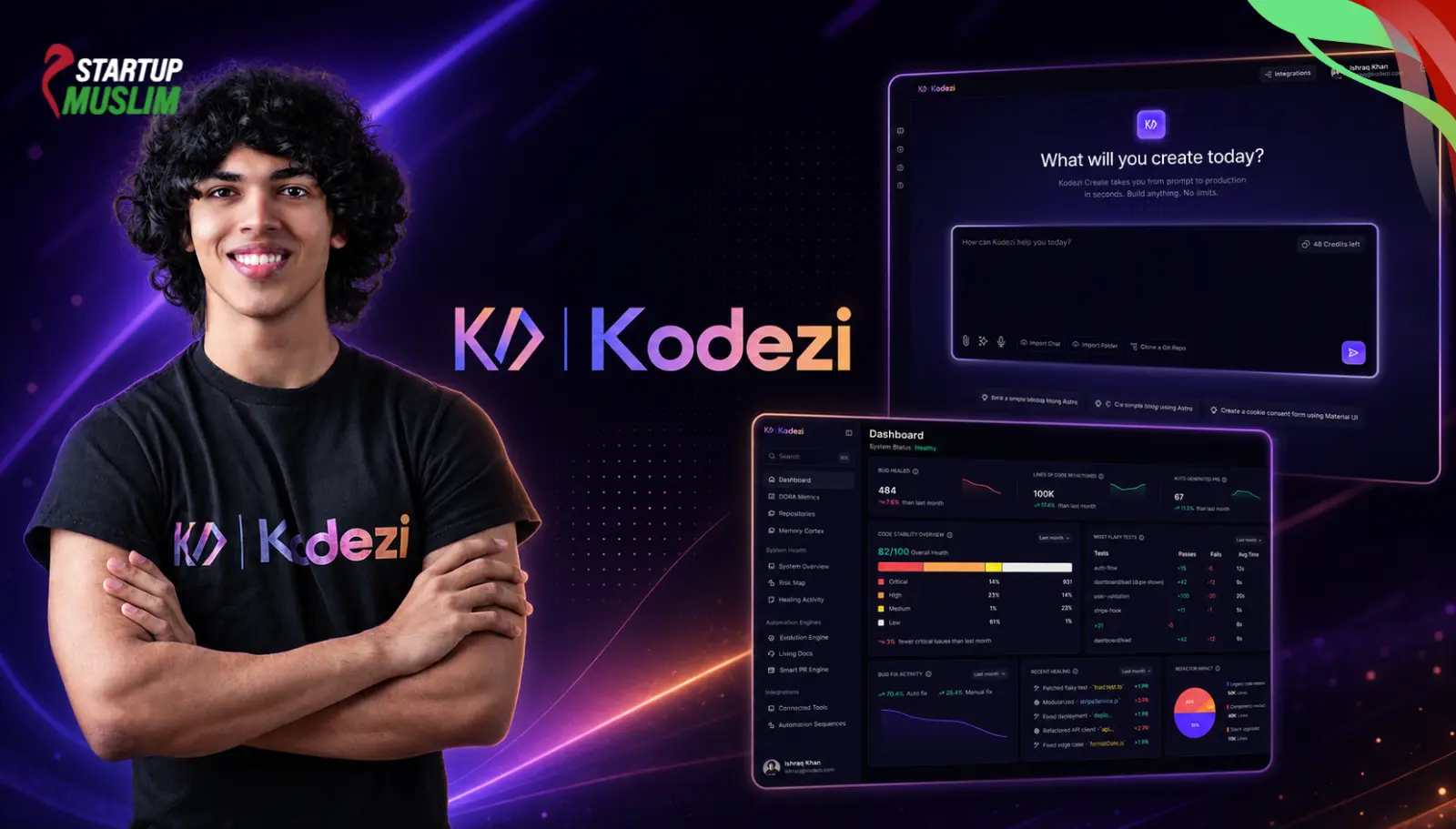
In the race to build the next generation of artificial intelligence, most startups are focused on helping developers write code faster. Every few weeks, a new AI coding assistant promises to generate applications, automate programming tasks, or accelerate software development. But while much of the industry competes to create more code, Ishraq Khan is solving a problem that receives far less attention—maintaining the billions of lines of software that already power the modern world.
As the Founder and CEO of Kodezi, Ishraq believes the future of software engineering will not be defined by AI that simply writes code on command. Instead, he envisions AI becoming a permanent engineering partner—one that continuously understands entire codebases, identifies problems before they become outages, remembers years of technical decisions, and helps organizations keep increasingly complex software systems healthy. It is an ambitious vision that has already attracted more than five million registered users worldwide and positioned Kodezi as one of the emerging innovators in AI-powered software infrastructure.
Yet long before venture funding, global users, and sophisticated AI models, Ishraq’s story began with a much simpler challenge: adapting to a completely new country.
Finding Opportunity in Uncertainty
Born in Dhaka, Bangladesh, Ishraq moved to the United States with his family in 2011. Like many young immigrants, the transition required learning far more than a new language. He had to navigate an unfamiliar culture, build new friendships, and develop confidence while adjusting to a completely different environment. For many children, such uncertainty can feel overwhelming. For Ishraq, however, it became the catalyst that shaped his future.
Technology quickly became his companion during those early years. Initially, he turned to YouTube simply to improve his English. But what began as a language-learning exercise gradually evolved into something much bigger. Programming tutorials captured his imagination, and at around eight years old, he began teaching himself how to code. The experience transformed the way he viewed technology. Instead of seeing computers merely as tools for consuming information, he discovered they could become platforms for creating entirely new ideas.
That realization sparked an entrepreneurial mindset at an unusually young age. Writing his first working program was not a groundbreaking technical achievement, but it changed the way he thought about the world. For the first time, he understood that he did not have to wait for someone else to build the products he wished existed. He could build them himself.

The Startup That Accidentally Changed Everything
Many successful startups begin by solving one problem before discovering a much larger one. Ishraq’s journey followed a similar path.
While still in middle school, he launched TeachMeCode, an online platform designed to help students learn programming from peers who were closer to their own age and experience level. His original vision centered on making coding education more approachable for beginners. However, once students began using the platform, an unexpected pattern emerged.
Rather than spending most of their time consuming educational content, users repeatedly found themselves struggling with one persistent challenge—debugging their code. They were less interested in learning programming concepts and far more interested in understanding why their software wasn’t working.
For many founders, such user behavior might have been seen as a distraction from the original product roadmap. Ishraq saw something different. He saw a signal.
That insight stayed with him long after TeachMeCode’s initial development. It raised a much bigger question: if software tools could already identify that code was broken, why couldn’t they also understand what had gone wrong, explain the problem in plain language, and help developers fix it automatically?
The answer to that question would eventually become Kodezi.
Building Kodezi Before Graduation
Most founders begin building companies after graduating from university or spending years in the workforce. Ishraq took a very different route.
He started developing Kodezi while still attending high school. At the time, artificial intelligence had not yet become the center of the software industry, and explaining the product often required a simple analogy. Ishraq would describe Kodezi as “Grammarly for programmers.” Just as Grammarly identifies grammatical mistakes and suggests improvements, Kodezi analyzed code, explained errors, and recommended fixes to developers.
Running a startup while attending school demanded extraordinary discipline. Between classes, he was writing software, speaking with users, managing an early team, emailing potential investors, and taking fundraising calls. While many of his classmates were focused on exams and extracurricular activities, Ishraq was balancing product development with the responsibilities of building a venture-backed company.
His age, however, often became one of his greatest obstacles. Potential investors and business partners were intrigued by the technology but frequently questioned whether someone so young possessed the experience to build a serious technology company. Rather than allowing skepticism to discourage him, Ishraq learned an important lesson that would shape his leadership philosophy for years to come. Credibility is not determined by age, prestigious institutions, or impressive job titles. It is earned through execution.
Consistently delivering results gradually replaced assumptions about what a teenage founder could or could not accomplish.
Choosing an Unconventional Path
As graduation approached, Ishraq found himself facing a decision that many young entrepreneurs eventually encounter: pursue a traditional education or continue building the company that was already gaining momentum.
His academic achievements opened remarkable opportunities. He applied to approximately 60 colleges and received more than 40 acceptance letters. Yet by then, Kodezi had already evolved beyond a school project. The company was attracting users, employing people, raising venture capital, and serving real customers around the world.
Rather than stepping away from that momentum, Ishraq chose an unconventional route. He declined the traditional residential college experience, completed his business degree online, and dedicated himself to building Kodezi full-time. It was a decision rooted not in rejecting education but in recognizing that entrepreneurship had become his classroom. Every product launch, hiring decision, customer conversation, and investor meeting offered lessons that no textbook could fully replicate.
That willingness to embrace an unconventional path would soon shape not only Ishraq’s own future but also the direction of Kodezi itself. What began as an AI-powered debugging assistant would gradually evolve into something far more ambitious—an intelligent operating layer designed to fundamentally change how software is maintained across the world.
From a Debugging Tool to a Global Developer Platform
Every successful startup reaches a point where its founders realize they are solving a much bigger problem than they originally imagined. For Ishraq Khan, that moment came as Kodezi matured beyond helping developers fix individual coding errors.
The early versions of Kodezi were designed to identify mistakes in source code, explain why they occurred, and recommend corrections. The comparison to “Grammarly for programmers” made the product easy to understand, and developers quickly embraced the idea. But as more engineers and software teams adopted the platform, a deeper challenge began to emerge.
Modern software is no longer built inside a single file.
Enterprise applications often consist of thousands of files spread across multiple repositories, supported by years of documentation, configuration files, test suites, infrastructure logs, security policies, deployment pipelines, and countless engineering decisions made by developers who may no longer even work at the company. Fixing one bug frequently requires understanding years of technical history rather than simply correcting a few lines of code.
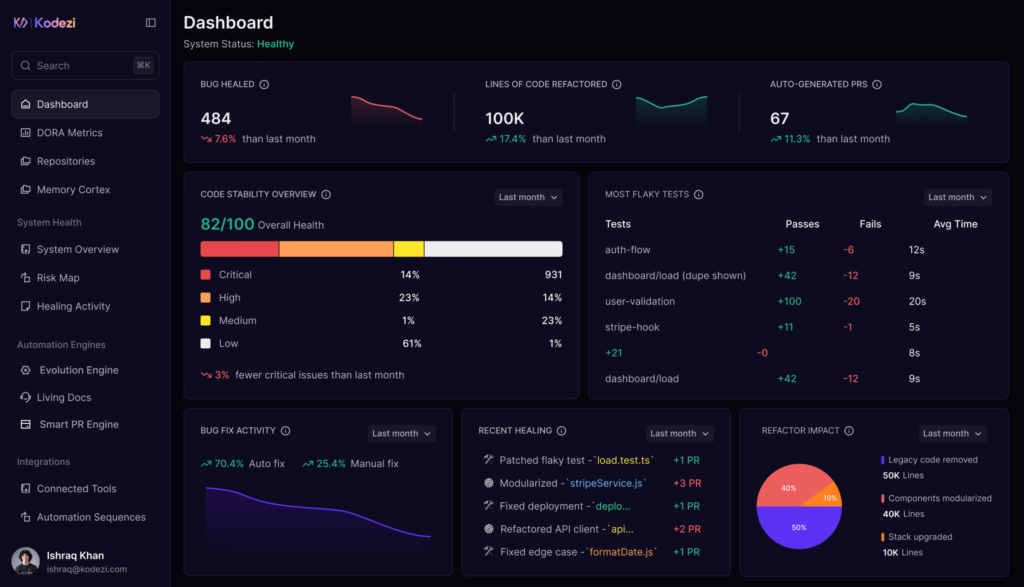
That realization fundamentally changed the direction of Kodezi. Instead of becoming another AI coding assistant competing to generate code faster, Ishraq began building something much more ambitious—what he describes as an AI CTO for codebases. Rather than waiting for engineers to discover problems, Kodezi is being designed to continuously understand an organization’s software, remember its history, identify risks before they become outages, determine root causes, recommend fixes, update documentation, monitor technical debt, and help software evolve safely over time.
Why Writing Code Is No Longer the Biggest Challenge
Artificial intelligence has dramatically changed how software is created. Today, developers can generate applications, APIs, and features in a fraction of the time previously required. While many celebrate this acceleration, Ishraq believes the industry has become fixated on only one side of the equation.
Generating more software does not automatically make software better. Every new feature introduces new dependencies. Every deployment creates additional complexity. Documentation quickly becomes outdated, security vulnerabilities emerge, tests begin failing, and institutional knowledge disappears whenever experienced engineers leave an organization. As AI enables developers to produce software faster than ever before, the maintenance burden grows at an equally unprecedented pace. For Ishraq, this represents one of the defining infrastructure challenges of the AI era.
“The world may soon have more software than human engineering teams can responsibly maintain,” he explains. Rather than creating another chatbot that responds only when prompted, he envisions “quiet AI”—intelligent systems that operate in the background, constantly monitoring software health and eliminating problems before developers even realize they exist.
It is a philosophy that shifts AI from being a productivity tool into becoming an operational partner.
Scaling From an Idea to Millions of Developers
Transforming that vision into reality required years of relentless execution.
Since its founding in 2019, Kodezi has grown from a high school project into one of the world’s fastest-growing AI developer platforms. Across its suite of products, the company has now reached more than five million registered users globally, demonstrating strong adoption among developers seeking more intelligent ways to maintain and understand complex software systems.
Behind those users lies an extraordinary volume of technical activity. Kodezi’s systems have analyzed more than one billion lines of source code, while at peak scale processing over 50 million API calls every month. Its original Visual Studio Code extension surpassed 100,000 installations, and the company has since expanded beyond integrated development environments into browsers, command-line tools, GitHub workflows, CI/CD pipelines, and enterprise engineering environments.
The company’s growth has also been supported by investor confidence. Ishraq raised his first external funding while still a teenager, securing approximately US$800,000 by the age of nineteen. Since then, Kodezi has raised more than US$2 million in venture funding while assembling a globally distributed team spanning the United States, Asia, and Europe. At its largest, the company employed more than 35 engineers, researchers, and contractors, reflecting the increasingly international nature of both AI talent and software development.
Yet Ishraq insists that headline metrics tell only part of the story.
For him, sustainable customer value matters far more than vanity metrics such as user counts or funding announcements. Revenue models evolve, products change, and technologies mature. What remains constant, he believes, is whether customers receive measurable long-term value from the platform.
Research Before Marketing
One characteristic that distinguishes Kodezi from many AI startups is its emphasis on publishing technical research rather than relying solely on product demonstrations or marketing claims.
A major milestone came with the development of Kodezi Chronos, the company’s debugging-first language model designed specifically for repository-scale code understanding. Unlike general-purpose AI models trained primarily for text generation, Chronos focuses on understanding how complex software systems fail—and how they can be repaired.
According to the company’s published research, Chronos was trained using more than 15 million debugging sessions and evaluated across 5,000 real-world debugging scenarios, achieving 67.3% fix accuracy. On the widely recognized SWE-bench Lite benchmark, the model achieved an 80.33% resolution rate. Rather than presenting these numbers simply as marketing achievements, Kodezi publicly released its methodology, architecture, evaluation process, and known limitations, allowing the broader research community to scrutinize and validate its work.
That commitment to transparency reflects a broader philosophy guiding the company. In an industry where AI capabilities often evolve faster than independent verification, Ishraq believes credibility should come from openness, reproducible research, and measurable results rather than bold promises. It is an approach that aligns with his own entrepreneurial journey—a journey where execution consistently mattered more than appearances.
As Kodezi continues to evolve, its mission remains remarkably consistent. The company is no longer trying to become just another AI coding assistant. Instead, it is building an intelligent infrastructure layer capable of preserving technical knowledge, reducing engineering complexity, and helping organizations maintain increasingly sophisticated software systems for years to come.
Building With Tawakkul—The Legacy Ishraq Khan Hopes to Leave Behind
For many entrepreneurs, growth is measured by funding rounds, valuations, customer acquisition, or revenue milestones. While Kodezi has achieved remarkable traction in each of those areas, Ishraq Khan believes the true test of a company lies elsewhere.
Can it continue creating value long after the headlines fade?
That question has shaped not only the future direction of Kodezi but also Ishraq’s philosophy as a founder. As artificial intelligence transforms software development at an unprecedented pace, he is determined to ensure that Kodezi remains focused on solving enduring engineering problems rather than chasing the latest industry trends.
Choosing Focus Over Hype
Artificial intelligence has become one of the most competitive sectors in technology. Every month, new startups emerge with AI assistants capable of generating code, completing programming tasks, or responding to increasingly sophisticated prompts. While this rapid innovation has expanded what’s possible for developers, it has also created a crowded marketplace where many products compete on incremental improvements.
Rather than joining that race, Kodezi has deliberately chosen a different path.
“Our goal is not to become another general-purpose coding assistant,” Ishraq explains. Instead, the company is concentrating on autonomous software maintenance, debugging, reliability, and long-term codebase understanding—areas he believes will become increasingly critical as AI accelerates software creation around the world.
The roadmap reflects that long-term thinking. Throughout 2026, Kodezi plans to deepen the integration of its Chronos AI model across its platform while improving repository-scale root cause analysis that spans source code, configuration files, test failures, deployment logs, historical commits, and engineering incidents. The company is also building persistent technical memory, enabling its AI systems to remember previous failures, understand how those issues were resolved, and recognize when similar problems begin emerging again.
Beyond that, Kodezi aims to strengthen integrations with GitHub, CI/CD platforms, observability tools, issue trackers, and enterprise engineering workflows while continuing to enhance enterprise-grade security, governance, and deployment controls. Rather than continuously adding new features, Ishraq says the company is focused on refining the workflows that create the greatest value for engineering organizations.
Looking further ahead, his ambition extends beyond creating another software product. He wants Kodezi to become a persistent technical operating layer—an intelligent system that continuously understands the health of an organization’s software, identifies accumulating technical debt, predicts recurring failures, recommends architectural improvements, and autonomously resolves repetitive maintenance tasks before they disrupt engineering teams.
It is a vision that could fundamentally change how software is maintained in the AI era.
The Hard Lessons Behind Rapid Growth
Like many founders, Ishraq’s greatest lessons did not come during periods of rapid expansion. They came when growth created entirely new challenges. As Kodezi attracted millions of users, the company faced an issue common to many AI startups but rarely discussed publicly: infrastructure costs. Every repository analyzed, every AI model executed, every debugging workflow completed, and every autonomous engineering task carried real computational expense. Success, paradoxically, made the business more operationally complex.
At the same time, Kodezi had expanded into multiple products serving different categories of developers. While the diversity created excitement, it also increased engineering complexity, operational overhead, and strategic uncertainty. Eventually, Ishraq and his team were forced to ask difficult questions. Were they building the company that generated the most attention—or the one capable of creating lasting value?
The answer required discipline. Kodezi narrowed its product focus, prioritized enterprise customers with long-term needs, reduced infrastructure inefficiencies, streamlined operations, and became increasingly selective about where it invested its resources. It was not the most glamorous phase of the company’s journey, but it may have been one of the most important.
For Ishraq, sustainable businesses are not built by chasing every opportunity. They are built by repeatedly choosing focus over distraction and durability over short-term momentum.
Faith as a Founder’s Greatest Competitive Advantage
Throughout his journey, one constant has remained larger than technology, fundraising, or product strategy. His faith. While many entrepreneurs speak about resilience in purely psychological or business terms, Ishraq describes entrepreneurship through a deeply spiritual lens. During some of Kodezi’s most difficult moments—when technical obstacles appeared overwhelming or business decisions carried significant consequences—he found himself turning not only to analysis and execution but also to prayer.
“There were nights when I prayed extra salah, made dua, and placed my trust in Allah because I did not know how we would overcome the challenge in front of us,” he recalls. Again and again, unexpected opportunities emerged, technical breakthroughs materialized, and solutions appeared where none had previously existed. Those experiences strengthened his conviction that hard work and tawakkul are not competing philosophies but complementary ones. One requires effort; the other provides peace while making that effort.
That perspective also shapes how he leads Kodezi.
He frequently speaks about amanah—the Islamic concept of trust and responsibility. Investor capital, customer data, employees, influence, and leadership are all trusts that founders must steward carefully. Likewise, ihsan, the pursuit of excellence, reminds him that being a Muslim entrepreneur should never become an excuse for lower standards. Instead, it should inspire even greater integrity, transparency, humility, and commitment to quality.
These principles influence everything from product development to company culture, encouraging ownership, honesty, humility, and an unwavering commitment to serving customers rather than pursuing external recognition.
A Legacy Beyond Software
When asked about the legacy he hopes to leave behind, Ishraq does not mention fundraising totals, market share, or billion-dollar valuations. Instead, he speaks about building systems that continue creating value long after public attention has moved elsewhere.
He hopes Kodezi will make software more reliable, more understandable, and more resilient at a time when nearly every aspect of modern society depends on digital infrastructure. Healthcare, banking, transportation, education, communications, and government services increasingly rely on software that must operate safely and reliably. If Kodezi can help engineers prevent failures, preserve technical knowledge, and maintain those systems more responsibly, he believes the company’s impact will extend far beyond software engineering itself. Equally important, he hopes his own journey broadens the ambitions of young Muslims, immigrants, and aspiring entrepreneurs around the world.
Growing up in Bangladesh, learning programming through YouTube, and building a startup while still in high school were hardly the conventional ingredients of a Silicon Valley success story. Yet his experience demonstrates that geography, age, and background need not define the scale of one’s aspirations. For the next generation of Muslim founders, that may be the most powerful lesson of all.
Excellence in technology and excellence in faith are not mutually exclusive. A Muslim entrepreneur can build globally significant products, compete at the highest levels of innovation, and still remain grounded in integrity, humility, accountability, and service to humanity.
As artificial intelligence reshapes the future of software, Ishraq Khan hopes Kodezi will be remembered not simply as another AI startup, but as a company that helped redefine how software is maintained—and as proof that when curiosity is combined with discipline, excellence, and tawakkul, extraordinary things become possible.


