





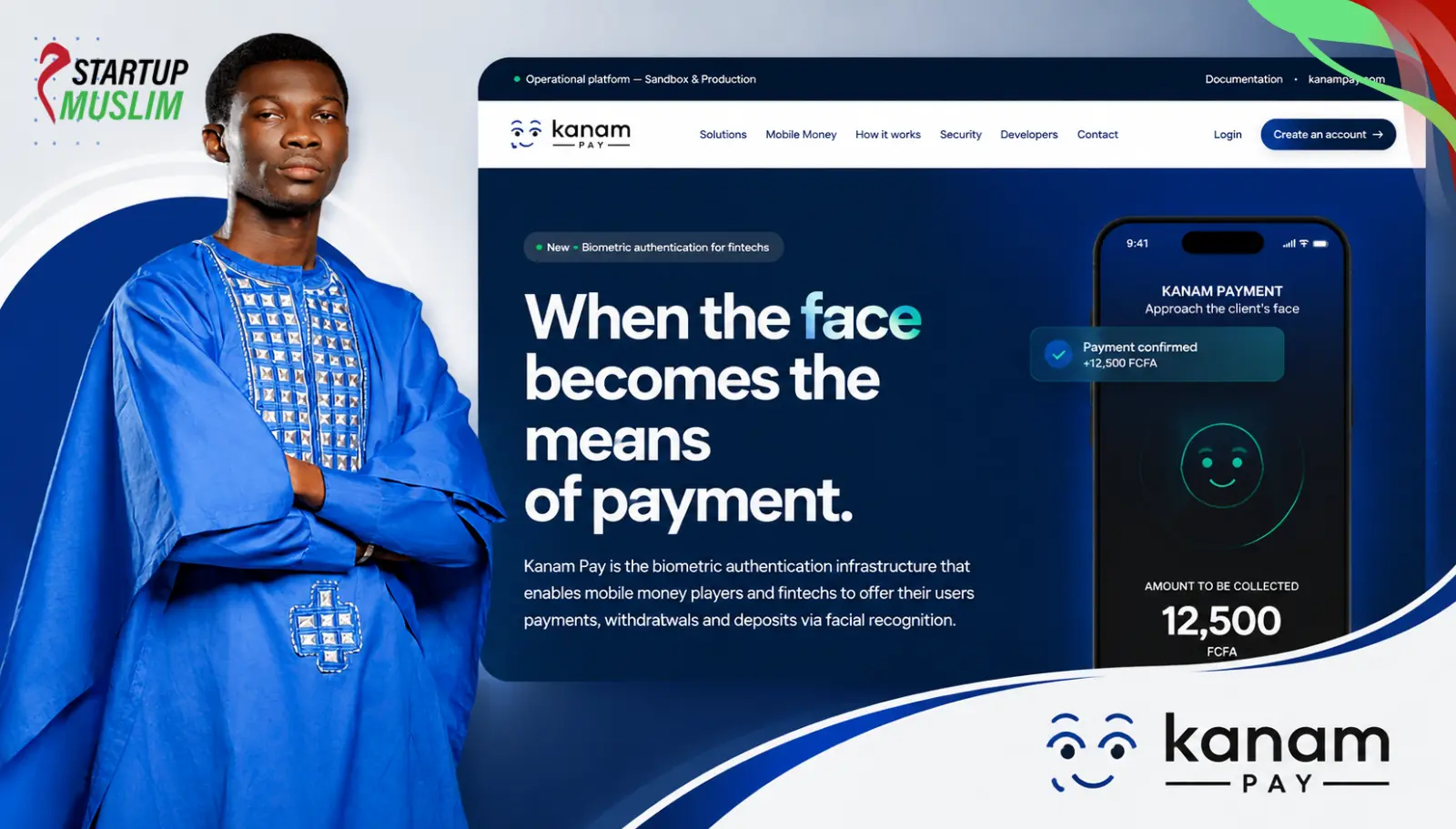
From Student Leadership to Reinventing Payments
The idea behind Kanam Pay began with a problem that sounds almost trivial: a ticket, a payment, a phone that is suddenly unavailable. But for Aarif Mohamed Konnon Tiama, Co-Founder and CEO of Kanam Pay, those moments exposed something much larger about the way financial services work in Africa. If access to money depends entirely on a device, what happens when that device is lost, stolen, broken or simply out of battery?
Tiama’s answer is increasingly ambitious: what if your face could become the key to accessing your money?
Today, Kanam Pay is building biometric technology that allows financial institutions to offer payments, withdrawals and authentication through facial recognition. But the journey to that idea began years earlier, through student leadership, entrepreneurial experiments and a willingness to change direction when the original business model stopped making sense.
Learning Leadership Before Becoming a Founder
Tiama’s entrepreneurial education began at CESAG, where student leadership taught him lessons that would later prove essential in building a fintech company. Leadership, he learned, was not about holding a title; it was about listening to people with different perspectives, making decisions with limited resources, convincing others to move in the same direction, and taking responsibility when things did not go according to plan.
His early entrepreneurial experiences gave those lessons a commercial dimension. Before Kanam Pay, Tiama worked on Tickets Place, a ticketing platform that exposed him to customers, event organizers, payment flows and technology providers. More importantly, it taught him that building a startup is fundamentally different from presenting one: a product has to work in the real world, under real conditions, for real customers.
Programs such as Jeune Mansa, TV5 Monde’s Les Nouveaux Boss and MTN Y’ello Startup further challenged him to defend his assumptions and explain his ideas outside the founder bubble. They also revealed that technology represents only one component of a fintech business. Regulation, security, distribution, partnerships, business models and trust can be just as decisive as the underlying product. Those experiences would eventually teach Tiama one of the most important lessons of his entrepreneurial career: founders should protect the problem they are trying to solve, not necessarily the first solution they imagine.
The Face as the New Ticket
Kanam Pay’s story actually starts with a different use case: event ticketing. While building Tickets Place, Tiama and his team noticed that attendees frequently lost physical tickets or struggled to find digital tickets when they arrived at events. The team began experimenting with a simple but unconventional question: what if a person’s face could become their ticket?
The concept immediately made sense to users. They did not necessarily care about the underlying artificial intelligence or facial-recognition technology. What they cared about was eliminating a frustrating step: searching for a ticket. That experiment planted the technological seed for Kanam Pay. Then came the moment that changed the company’s direction.
When the Phone Became the Problem
Tiama experienced an urgent situation in which he needed to make a payment, only to discover that his phone battery had died. The money was available. The account existed. But the device through which he normally accessed that money was no longer usable. The experience connected two seemingly unrelated ideas. If a face could act as a secure key to access a concert, why couldn’t it also become a secure key to access financial services?
That question became the foundation for Kanam Pay. The company’s thesis is not that facial recognition should replace Mobile Money or smartphones. Instead, it can provide another secure interface through which customers access financial services, particularly in markets where mobile phones have become central to everyday financial transactions. The opportunity is particularly relevant across Africa, where Mobile Money has transformed financial access but also created a dependency on the mobile device. A phone can be lost, stolen, damaged or discharged at precisely the moment someone needs access to their money. Kanam Pay wants the face to become another way through that door.
The Startup Had to Reinvent Itself
The first version of Kanam Pay pursued this vision through a B2C model, attempting to build its own consumer community and merchant acceptance network. On paper, the strategy was straightforward: attract users, convince merchants, and create a new payment network around facial recognition. In practice, it was extraordinarily difficult for a young startup to build both sides of that marketplace simultaneously. Without enough merchants, consumers had limited reasons to use the service; without enough consumers, merchants had little incentive to adopt it. At the same time, Kanam Pay would have had to develop biometric technology, build a consumer brand, create an acceptance network and navigate regulated financial infrastructure.
The founders could have interpreted those difficulties as evidence that the idea itself was wrong. Instead, they changed the model. Tiama realized that Kanam Pay did not need to become another financial institution. It could become the technology layer that existing financial institutions use to add biometric access to their own services. Banks, fintechs and Mobile Money operators already possess customers, accounts, merchant networks and regulatory infrastructure. Kanam Pay could provide the missing piece: the biometric interface. That pivot transformed the company’s potential scale.
From Payment App to Financial Infrastructure
The Kanam Pay of today is therefore very different from the startup Tiama initially imagined. Its B2B model allows a financial institution to integrate Kanam Pay’s API into its own environment and offer biometric payments or withdrawals under its existing brand. The institution retains its customers, financial rails and regulatory responsibilities, while Kanam Pay provides the biometric technology.
For a customer, the experience is designed to be remarkably simple. After enrolling with consent, the user’s face is securely linked to an existing account or wallet, with a PIN providing an additional layer of confirmation. At a participating merchant or agent, the customer can be identified through their face, confirm the transaction, and allow the partner financial institution to execute it through its existing payment infrastructure.
That simplicity is deliberate. Behind the scenes, however, Kanam Pay combines biometrics, PIN authentication, liveness detection and anti-spoofing mechanisms, alongside encrypted and access-controlled data infrastructure. The company is also explicit that no biometric system is infallible; its responsibility is to continuously test, audit and strengthen the technology rather than promise absolute security. The transformation from a consumer payment app into B2B financial infrastructure may have been born from a setback. But it has given Tiama a much bigger opportunity. Instead of trying to build the network himself, Kanam Pay can plug into networks that already exist. And that is where the company’s story—and its ambition to reshape financial access across Africa—really begins.
Turning a Face Into a Secure Financial Key
The most radical part of Kanam Pay’s proposition is also the easiest to misunderstand. The company is not trying to make a person’s face a replacement for money, a bank account, or Mobile Money. The face is the key—a biometric layer that allows an existing financial account to be accessed through a different interface.
That distinction sits at the heart of Aarif Mohamed Konnon Tiama’s vision. If the technology is going to handle people’s money and identities, convenience cannot come at the expense of security. Kanam Pay therefore has to solve two problems simultaneously: make financial access dramatically simpler while building enough safeguards for financial institutions and their customers to trust the system.
The Face Is Not the Money
Under Kanam Pay’s current B2B model, a fintech, bank, Mobile Money operator or other financial institution integrates the company’s API into its existing environment. The institution continues to own the customer relationship, account and financial rails; Kanam Pay provides the biometric authentication layer. For the customer, the process begins with consent-based enrollment. Their face is registered and associated with an existing account or wallet, while a PIN provides another layer of confirmation. At a participating merchant or agent, the customer can then be identified through facial recognition and authorize the transaction, while the partner institution executes it through its own financial infrastructure.
The company is already positioning the technology around payments, withdrawals and deposits without requiring the customer to have their phone, SIM card or battery available. Its current product materials describe a model in which the merchant can use a smartphone to initiate a transaction while the customer’s face provides the biometric authentication. The result is a deliberately simple experience: the customer does not need to carry the financial interface with them.
Security Has to Be Designed Into the System
For a technology built around facial recognition, however, simplicity creates an obvious question: what happens if someone attempts to fool the system? Tiama is careful not to describe biometrics as infallible. Instead, Kanam Pay combines multiple security layers, including facial biometrics, PIN authentication, liveness detection and anti-spoofing mechanisms designed to prevent attacks using photographs, videos or manipulated media. API exchanges are secured, while biometric information is intended to be encrypted, access-controlled and appropriately separated from transactional data.
The company’s public product information currently highlights 99.8% biometric accuracy, liveness detection and a 99.99% infrastructure SLA. These figures are presented by Kanam Pay as product performance metrics rather than as a claim that biometric authentication eliminates risk. That distinction matters to Tiama. His philosophy is that trust in fintech cannot be created by telling users that a system is secure. It has to be demonstrated through architecture, testing, compliance, transparency and continuous improvement.
Financial Inclusion Without the Smartphone
The strongest argument for Kanam Pay may not be convenience at all. It may be continuity of access. Africa’s financial revolution has been heavily driven by mobile phones and Mobile Money. That has brought financial services to millions of people who previously had limited access to traditional banking. But it has also created a new dependency: the phone has effectively become the gateway to the wallet. Kanam Pay asks what happens when that gateway disappears.
Someone may have a basic phone, a damaged phone, a stolen SIM, a discharged battery, or no smartphone at all. Under Kanam Pay’s model, a customer with an account at a participating institution can potentially visit an authorized merchant or agent, have their face authenticated on the agent’s device, confirm the transaction, and access their funds. The company’s public product positioning similarly emphasizes payment, cash-in and cash-out without a phone, SIM or battery, with the biometric layer connecting into existing Mobile Money infrastructure.
But Tiama makes an important distinction: Kanam Pay cannot create financial inclusion by itself. A regulated institution still needs to onboard the customer, complete the required checks and provide the underlying account or wallet. Kanam Pay’s role is to make that financial relationship easier to access. That is precisely why the B2B model matters.
One Integration Can Replace Thousands of Acquisitions
The lesson from Kanam Pay’s early B2C experience was that building a payment network from scratch is expensive. The company had to acquire users and merchants simultaneously, creating the classic chicken-and-egg problem faced by marketplaces and payment networks. The B2B model changes that equation. Instead of convincing 100,000 consumers to download a new app, Kanam Pay can integrate with a financial institution that already has 100,000 customers. Instead of recruiting thousands of merchants individually, it can connect to an established agent network.
The clearest example is LigdiCash. According to Tiama, the partnership has the potential to give Kanam Pay access to more than 100,000 users and over 6,000 withdrawal points and merchants. That is a fundamentally different growth model. The company has also worked with or engaged financial players including Peya Pay in Côte d’Ivoire, Soutra Money in Guinea, LigdiCash and Sank Money in Burkina Faso, and Ziguida Cash in the Central African Republic, alongside opportunities involving aggregators such as PayTech, Money Fusion and Yenga Pay.
Building for UEMOA and CEMAC First
Kanam Pay’s immediate geographic ambition is concentrated on UEMOA and CEMAC, two regional ecosystems where Mobile Money and agent-based financial services play an important role. The B2B model gives the company a potential path to expand across those markets without having to recreate its consumer acquisition strategy in every country. Financial institutions effectively become distribution partners, bringing Kanam Pay’s biometric capability into ecosystems where customers already have established financial relationships.
The company’s business model follows the same logic. Rather than requiring each institution to build its own biometric infrastructure, Kanam Pay provides the technology and charges primarily according to usage—such as biometric requests or transactions—depending on the commercial agreement. That creates the possibility of a network effect without Kanam Pay needing to own the entire network itself.
A Bigger Question Than Payments
Tiama sees payments as the starting point, not necessarily the final destination. Technically, Kanam Pay is developing a biometric identity and authentication infrastructure. Its origins in ticketing demonstrate that the underlying technology can serve purposes beyond financial transactions, while future possibilities could include public transport, ticketing, secure account recovery and authentication for sensitive transactions. Healthcare and government services could eventually become opportunities as well, although Tiama recognizes that these environments demand even stricter standards around consent, privacy and governance.
For now, however, the company is deliberately focused. The immediate objective is to become exceptionally good at payments, withdrawals and financial authentication before extending the technology into other sectors. That discipline may ultimately be what allows the broader vision to become reality. Kanam Pay is not trying to make facial recognition relevant to everything at once. It is starting with one of the most fundamental human activities—accessing money—and attempting to remove one of the biggest points of friction between people and their financial lives.
The ambition is simple: if the phone can disappear, the customer’s access to their money shouldn’t have to disappear with it. And as Kanam Pay moves from pilots toward institutional deployments, the next challenge will be turning that compelling idea into a scalable piece of Africa’s financial infrastructure.
From a Biometric Payment Idea to Financial Infrastructure Across Africa
For Aarif Mohamed Konnon Tiama, the next chapter of Kanam Pay is no longer about proving that people can pay with their face. That experiment has already demonstrated its appeal. The bigger challenge is turning the technology into infrastructure that banks, fintechs and Mobile Money operators can deploy at scale across markets where financial access is increasingly digital but still heavily dependent on the mobile phone.
That is why Kanam Pay’s B2B pivot matters so much. Instead of trying to build another consumer payment network from scratch, the company is positioning itself as the biometric layer that existing financial institutions can integrate into their own products. The strategy allows Kanam Pay to leverage networks that have taken years to build while concentrating its own resources on biometrics, security, APIs and financial infrastructure.
Turning Regulatory Complexity Into an Advantage
Fintech infrastructure cannot be built on technology alone. Kanam Pay operates at the intersection of payments and biometric identity, two areas where regulation, privacy and security are particularly sensitive. The company must consider consent, data protection, KYC, security, traceability, responsibilities between partners and the necessary authorizations in every market where it operates.
Tiama says this was one of the biggest changes in his understanding of entrepreneurship. Early on, the team viewed the problem primarily through the lens of technology: build the innovation, prove the prototype and deploy it. Building financial infrastructure revealed a much longer journey between “technology that works” and “technology that can be deployed at scale.”
The company is responding by making its APIs, documentation and contractual framework increasingly standardized. Financial institutions can have long procurement and integration cycles involving technical, legal, security, compliance and management teams, but Tiama believes that each integration should make the next one easier. In that sense, regulatory complexity is not simply an obstacle; it can become a barrier to entry that favors companies willing to build the necessary infrastructure correctly.
Trust Is the Real Product
There is an even more fundamental challenge when the technology involves someone’s face: trust. A face is not a password that can simply be changed if compromised. It is part of a person’s identity, which means users need to understand what information is collected, why it is collected, how it is protected and what control they retain over it. Kanam Pay therefore combines facial authentication with additional security measures such as PIN verification rather than presenting biometrics as a magical replacement for every other security mechanism.
That philosophy is likely to become increasingly important as the company expands. A biometric payment system succeeds only when users are comfortable using it and financial institutions are comfortable putting their customers behind it. For Kanam Pay, technical performance is therefore only one component of the product; privacy, security, compliance and transparency are equally central to earning adoption.
Expanding Across Africa, One Network at a Time
Kanam Pay’s immediate focus is UEMOA and CEMAC, where the company believes its B2B model provides a particularly scalable route into new markets. Under the previous B2C strategy, entering a new country meant rebuilding almost everything: brand awareness, consumer acquisition, merchant acceptance, payment partnerships and regulatory relationships.
The B2B model fundamentally changes that equation. A bank, Mobile Money operator, payment institution or aggregator can become both a customer and a distribution channel, bringing Kanam Pay’s biometric infrastructure to an existing user base and merchant network. The company intends to replicate the LigdiCash model across multiple institutions before expanding into other African regions. The commercial model follows the same logic. Financial institutions do not need to spend years developing their own facial-payment infrastructure; they integrate Kanam Pay and primarily pay according to usage, such as biometric requests or transactions, depending on the commercial agreement. That gives Kanam Pay a potentially recurring infrastructure business rather than a model dependent on one-time customer acquisition.
The Next 24 Months
The company’s priorities over the next 12 to 24 months are consequently focused on turning its existing partnerships into production deployments. Kanam Pay plans to advance its LigdiCash deployment, sign additional financial institutions across UEMOA and CEMAC, industrialize its APIs, strengthen liveness detection and fraud prevention, and further consolidate its compliance infrastructure.
The company also intends to prepare a strategic fundraising round to accelerate deployment and regional expansion. Until now, Kanam Pay has been primarily funded by its founders, supplemented by support and opportunities generated through programs such as Jeune Mansa, TV5 Monde’s Les Nouveaux Boss and MTN Y’ello Startup. The focus of the next phase will therefore be less about registrations and more about measurable institutional usage. If financial institutions begin deploying Kanam Pay at scale, the company’s real traction will be reflected in the number of people who use facial authentication to make payments or access cash through services they already know.
When the Technology Becomes Invisible
Tiama’s long-term vision is striking because it does not involve making Kanam Pay famous. In fact, he wants the opposite. He imagines a future in which a customer walks into a merchant, looks at a device, and completes a payment or withdrawal without thinking about the technology underneath. The customer may never know that Kanam Pay powers the biometric layer, because the service will simply be part of the financial product they already use. If millions of people across Africa can eventually access their money through their face—without depending entirely on a phone, SIM card or battery—Kanam Pay will have achieved something larger than creating a novel payment method.
It will have made financial access more resilient. And that may be the most compelling part of Aarif Mohamed Konnon Tiama’s journey. What began with a lost ticket and a dead phone battery has evolved into a broader vision for African financial infrastructure: one where the technology does not demand attention, but quietly removes barriers between people and the financial services they already depend on. The ultimate ambition is not to make people use Kanam Pay. It is to make financial access so seamless that they no longer need to think about how it works.


