


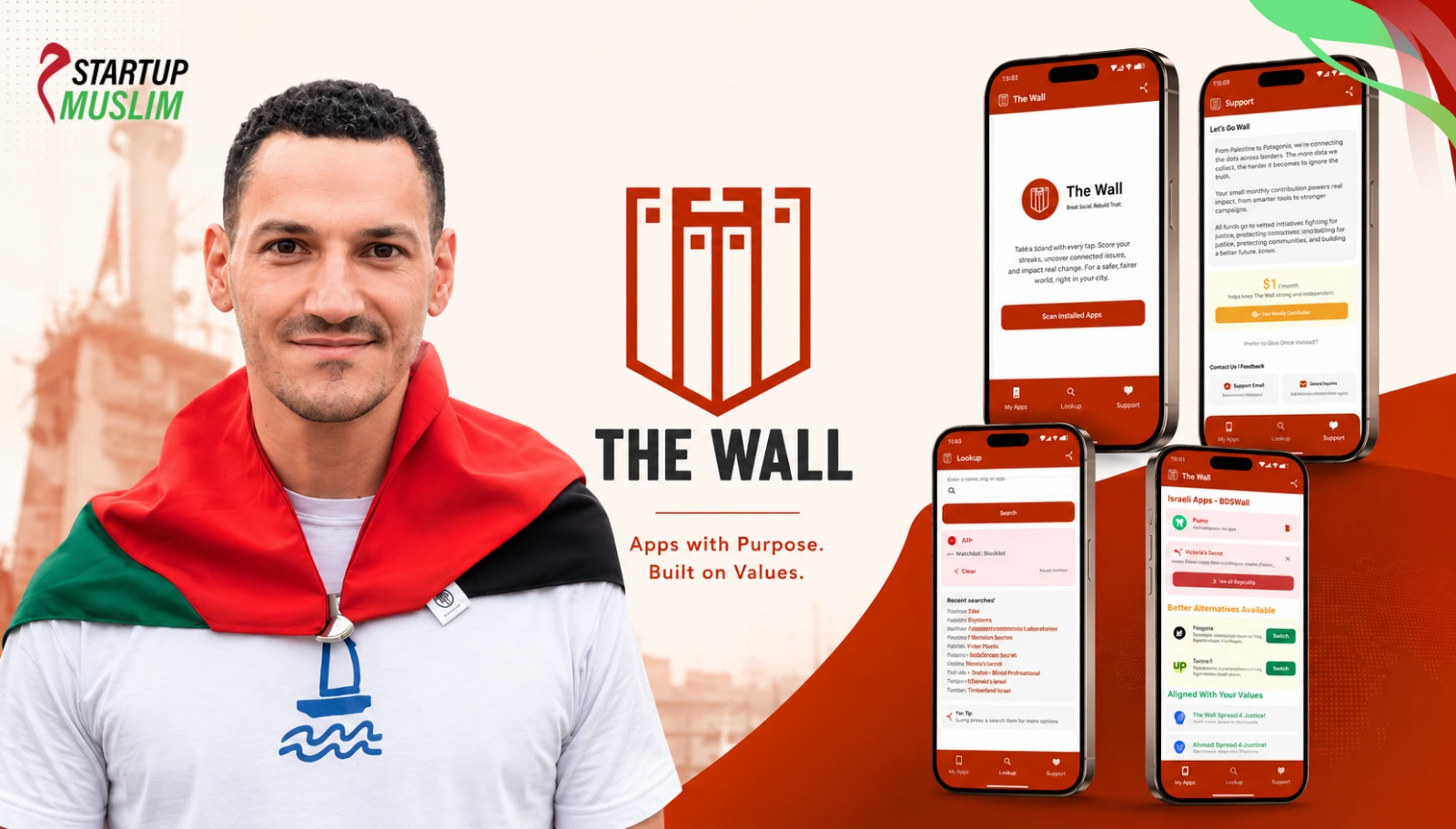
Technology has transformed almost every aspect of modern life. We work online, shop online, consume news online, and spend countless hours every day navigating websites and social media platforms. Yet for many consumers, particularly those seeking to make ethical purchasing decisions, one challenge remains remarkably difficult: knowing who is behind the companies they interact with.
For Ahmed Hassanein, a software developer with more than fourteen years of experience, this problem became deeply personal. While searching for job opportunities, he found himself spending hours researching companies, checking their headquarters, ownership structures, and investment backgrounds to ensure they aligned with his personal values. The process was repetitive, frustrating, and almost impossible to scale.

“I kept thinking,” Ahmed recalls, “instead of doing this manually for every company, why isn’t there a tool that simply tells me the moment I open a website?”
That simple question eventually evolved into The Wall, a free platform that today identifies and blocks more than 20,000 Israeli-linked websites and social media accounts, helping users make informed decisions before they engage with businesses online.
A Project Born from Personal Conviction
Unlike many technology startups that begin with market research or investor presentations, The Wall started as a personal productivity tool. Ahmed wasn’t trying to launch a company or build a commercial product. He was simply trying to solve his own problem.
While applying for jobs, he realized how difficult it was to verify whether companies had connections to Israel or investors linked to the Zionist entity. Every application required opening multiple websites, searching ownership records, reviewing investor lists, and checking various databases. It was time-consuming, and there was no automated solution that delivered trustworthy information instantly.
Existing boycott tools, he explains, were either incomplete, filled with advertisements, or designed primarily around monetization.
“I wanted to build something I would actually enjoy using myself,” he says. “It had to be free, ad-free, and completely focused on helping people.”
That commitment remains one of The Wall’s defining principles today. Despite its growing popularity, Ahmed has deliberately refused to introduce advertising or paid features, believing that trust should never be compromised by commercial incentives.
Building a Digital Wall
Over the past eighteen months, Ahmed transformed that initial idea into a multi-platform ecosystem available across Chrome, Firefox, Safari, Android, iOS, and macOS.
Today, whenever users visit a website or social media profile included in The Wall’s database, the platform immediately alerts them and explains why the organization has been flagged. Rather than relying on anonymous reports or unverified claims, every result is supported by clearly identified evidence.
Accuracy, Ahmed insists, matters more than volume. To build the platform’s database, he relies primarily on Crunchbase, one of the world’s most trusted business intelligence platforms, together with the official Boycott, Divestment and Sanctions (BDS) movement’s published lists. Companies headquartered in Israel are automatically identified, while organizations with Israeli investors are also flagged. Every notification includes the reason behind the classification so users understand exactly why a website has been identified.
“If I’m not confident,” he explains, “I don’t include it until I can personally verify it.” That disciplined approach has allowed The Wall to achieve what Ahmed estimates is approximately 99.9% accuracy, prioritizing credibility over aggressive expansion.
More Than a Browser Extension
Although The Wall uses sophisticated technology behind the scenes, Ahmed believes the project is fundamentally about awareness rather than software.
He describes it first and foremost as a consumer awareness platform. Technology simply makes that awareness effortless.
Most people, he explains, recognize the names of a handful of globally known companies. What they don’t realize is that thousands of lesser-known businesses, software providers, venture-backed startups, and digital services often remain completely invisible to consumers.
“Even I still discover new companies every few days,” Ahmed says.
By bringing this information directly into users’ browsing experience, The Wall removes the friction that previously prevented many consumers from making informed decisions. Instead of asking people to research every company manually, the platform delivers the information automatically.
Measuring Success One User at a Time
Unlike traditional startups that obsess over revenue or profitability, Ahmed measures success differently. Downloads are his primary metric.
Without spending a single dollar on advertising or marketing, The Wall’s Chrome extension alone surpassed 10,000 users, making it the platform’s most widely adopted product. Considering that the project has grown almost entirely through word of mouth, Ahmed views that milestone as one of his proudest achievements.
The broader ecosystem now includes browser extensions for Chrome, Firefox, and Safari, together with native applications for Android and iOS, allowing users to carry the experience across virtually every device they use.
For Ahmed, however, downloads represent something much larger than installation numbers. Every installation means another person making more informed choices online.
Can Individual Choices Really Matter?
One of the most common criticisms directed toward consumer boycotts is that individual actions rarely produce meaningful economic consequences.
Ahmed disagrees. He regularly receives messages from users explaining that The Wall prevented them from signing significant business contracts or making expensive purchasing decisions involving companies identified by the platform.
Some involve major B2B transactions. Others involve high-value consumer purchases. For Ahmed, these stories demonstrate that technology can influence behavior at scale.
“Money runs the world,” he says. “Weapons and corrupt politicians need it. Less money means less corruption, less control, and less killing.”
While individual purchases may appear insignificant in isolation, millions of small decisions made collectively have the potential to influence broader market behavior.
Building Despite Resistance
Launching a mission-driven platform has not been without challenges. Ahmed expected resistance from the very beginning and consciously prepared himself for it long before The Wall became publicly available. For him, the project has always been an act of conviction rather than a commercial venture. “I reminded myself that I’m doing this for the sake of Allah, regardless of the outcome,” he says. That mindset has helped him remain focused despite the obstacles that have come his way.
Some of those challenges have come from the very platforms on which The Wall operates. Firefox temporarily removed the browser extension for several months after receiving what Ahmed describes as unfair third-party complaints, although it was eventually reinstated. More recently, he says Google has delayed Android application updates without clear justification and believes the Chrome extension’s download statistics may also have been affected. While these setbacks have slowed growth, they have not changed his commitment to the project.
Financial sustainability has proven to be another significant challenge. Maintaining multiple browser extensions, native mobile applications, servers, and a constantly evolving database requires considerable time and resources. Yet Ahmed remains firm on one principle: The Wall will remain completely free and free from advertising. “The project is free to use,” he explains, “but it’s not free to build.” He believes that introducing advertisements or commercial interests could undermine the trust users place in the platform, making community donations the most sustainable path forward.
A Community That Grows Together
Ahmed does not see The Wall as an isolated initiative. Instead, it forms part of a broader ecosystem known as Tech for Palestine, a collaborative network of developers and founders building technology projects that support the Palestinian cause through innovation and digital solutions. Rather than competing for users, these projects actively recommend one another, creating an ecosystem where every success strengthens the others.
Through this community, Ahmed regularly introduces users to projects such as Thaura.ai, UpScrolled, NewsCord, and several other initiatives focused on education, awareness, and digital activism. He believes collaboration is far more powerful than competition when the objective is social impact rather than commercial dominance. “I love that mutual growth dynamic,” he says. “When one project succeeds, it helps the others, and together we all scale.”
That philosophy reflects a broader shift taking place within mission-driven entrepreneurship, where founders increasingly measure success by the strength of the communities they build rather than simply by market share or revenue. For Ahmed, every new project that empowers ethical decision-making contributes to a larger movement.
The Future of Digital Activism
Looking ahead, Ahmed imagines a future where The Wall reaches tens of millions of users across the globe. He believes that every installation represents another individual making more informed purchasing decisions, and that collective action at this scale could significantly influence consumer behavior and corporate incentives. “Imagining ten million daily users makes me incredibly happy,” he says. “Every install means less money flowing to the genocide machine and more pressure for change.”
He also believes technology has fundamentally transformed how social and economic movements can be organized. Previous generations relied on physical campaigns, printed materials, or traditional media to spread awareness. Today, purchasing decisions, entertainment, employment, and communication all happen online. That means digital tools have become one of the most powerful ways to educate consumers and encourage ethical decision-making at scale.
“We live a digital life,” Ahmed explains. “We buy, work, play, watch and learn through our phones and laptops. That’s where the money is, so that’s where the boycott must be.” While artificial intelligence and social media are often criticized for amplifying misinformation, he believes they can also become powerful instruments for awareness when used responsibly. Even when technology platforms impose restrictions, innovative digital products still have the ability to reach millions—and eventually billions—of people.
Technology in Service of Values
Ahmed Hassanein never set out to build a conventional startup. The Wall began as a solution to a problem he personally experienced while trying to align his professional and consumer choices with his values. What started as a simple browser tool has grown into a cross-platform ecosystem helping thousands of people make more informed decisions every day.
In an era where artificial intelligence is reshaping industries and software increasingly influences how people live, work, and spend, Ahmed has chosen to apply technology toward a different objective—not maximizing engagement or advertising revenue, but empowering ethical decision-making. His ambition is not to tell people what choices they should make. Instead, it is to ensure they have transparent, credible information before making those choices.
As digital commerce continues to dominate everyday life, The Wall represents a new form of activism—one where code, data, and automation become tools for awareness rather than simply convenience. For Ahmed, that is the true power of technology: not replacing human judgment, but giving people the knowledge they need to exercise it with confidence.
