





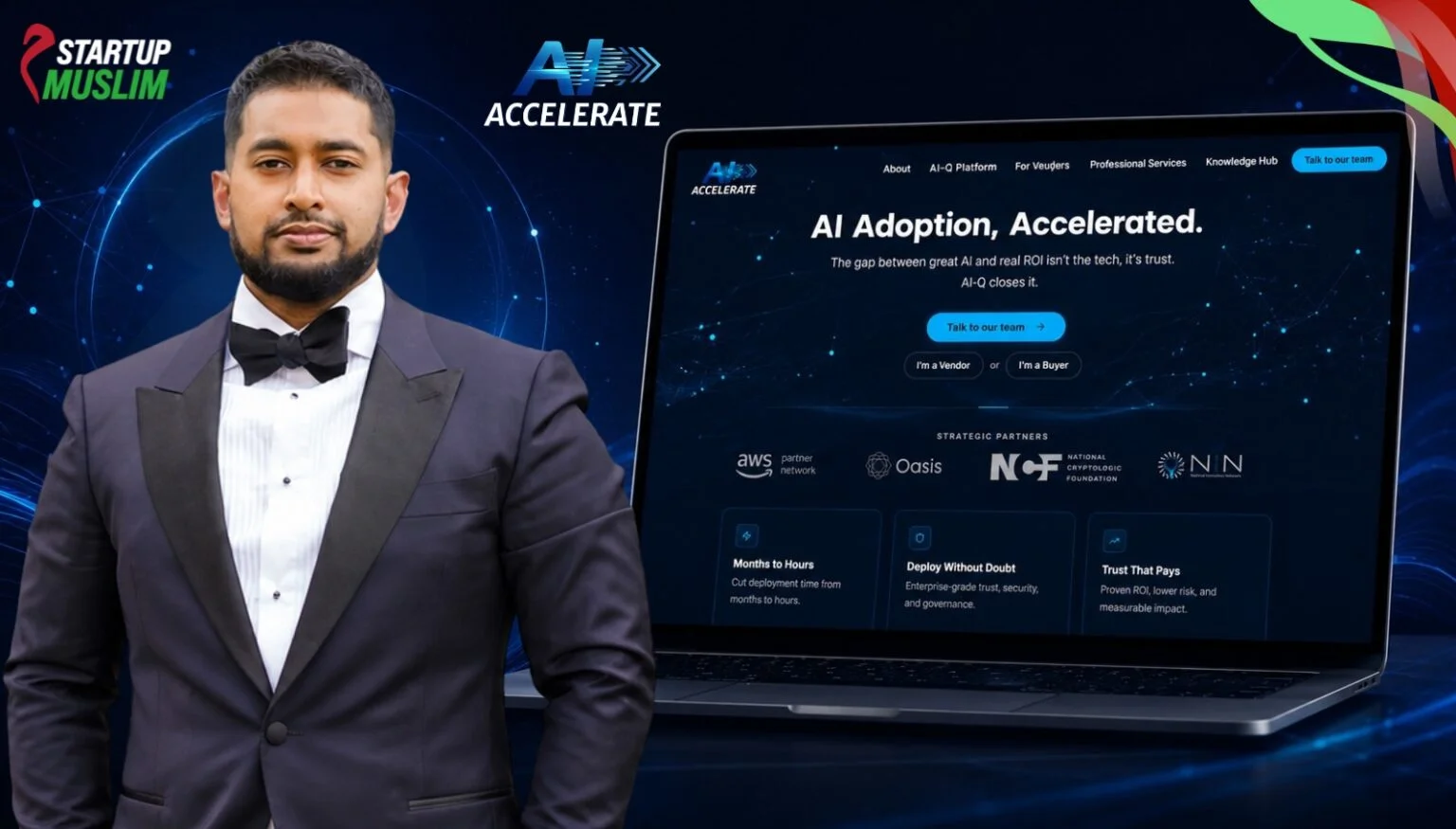
Artificial intelligence has rapidly become one of the biggest priorities for enterprises across the world. Organizations are investing billions of dollars into generative AI, autonomous agents, and intelligent automation, hoping to transform everything from customer service to healthcare and financial decision-making. Yet despite the excitement, many AI initiatives never make it beyond the pilot stage. While headlines often celebrate breakthroughs in large language models and AI capabilities, a quieter problem continues to hold enterprises back—how do you prove that an AI system is actually ready for production?
For Asad Mansoor, Co-Founder and CEO of Accelerate AI, that question has defined his entrepreneurial journey. Rather than building another AI application, Asad is focused on building something far more fundamental: trust. His startup is developing the governance and risk infrastructure that enables organizations to measure AI risk, generate evidence for decision-makers, and confidently deploy artificial intelligence in highly regulated industries. “The technology usually isn’t the problem,” he says. “The real challenge is proving that it’s safe enough to deploy.”


A Career Built Around Risk, Security, and Trust
Long before founding Accelerate AI, Asad spent years working at the intersection of cybersecurity, governance, and enterprise risk management. His career began in cyber risk consulting at Deloitte before moving to Amazon Web Services (AWS), where he worked on security due diligence for acquisition targets. Every acquisition required answering one critical question: can this organization be trusted, under what conditions, and can that recommendation be defended with evidence? It was a role that demanded analytical thinking, structured decision-making, and the ability to transform complex technical risks into clear business recommendations.
As generative AI began reshaping enterprise technology, Asad found himself working on one of AWS’s most important initiatives—developing a security framework for customers using AWS Bedrock. Later, while supporting Governance, Risk and Compliance Engineering at SoFi, he observed an entirely different challenge. Companies were building impressive AI applications, leadership teams wanted to move quickly, and engineers had solved difficult technical problems. Yet projects repeatedly stalled at the final stage because executives lacked the evidence needed to approve deployment.
“I’d sit in conversations where leaders had done all the hard work,” Asad recalls. “Then someone would ask how they’d quantify and defend the AI risk, and the room would go quiet.” That moment convinced him that enterprises did not need another AI model. They needed a way to measure trust.
Turning AI Risk into Business Decisions
Throughout his career, Asad had become accustomed to translating technical uncertainty into decisions that executives could understand. Whether evaluating cybersecurity risks or reviewing acquisition targets, the outcome was always clear: proceed, proceed with conditions, or don’t proceed. When AI entered the picture, he noticed that same discipline simply didn’t exist. Organizations were relying on subjective opinions, theoretical concerns, and lengthy review meetings instead of measurable evidence.
That observation became the foundation of Accelerate AI. Rather than treating governance as a compliance exercise performed after development, the company helps organizations build trust into the deployment process from the very beginning. Its flagship platform, AI-Q, evaluates an organization’s AI systems against business objectives, security controls, regulatory frameworks, and operational risks before producing a recommendation supported by evidence. Instead of relying on instinct, leadership teams receive clear guidance backed by measurable data.
“We work backwards from the business,” explains Asad. “What does this AI need to accomplish? Who has to approve it? What would concern them? Then we measure exactly those things.” By transforming vague concerns into quantifiable metrics, Accelerate AI enables organizations to move from uncertainty to confident decision-making.
Why Governance Should Accelerate Innovation
One of the biggest misconceptions surrounding enterprise AI is that governance slows innovation. Many organizations view risk management as an obstacle that delays projects and increases bureaucracy. Asad believes that perspective is fundamentally wrong. In his experience, governance becomes a bottleneck only when it is introduced as paperwork after development has already been completed.
“Governance only looks like a barrier when it’s treated as paperwork at the end,” he says. “Done right, it’s the thing that lets you move.”
By quantifying risk early, organizations dramatically reduce approval cycles, minimize compliance uncertainty, and avoid expensive failures after deployment. This approach is particularly valuable in highly regulated industries such as healthcare, financial services, and non-profit organizations, where AI systems influence decisions involving patient safety, financial integrity, and sensitive personal information. As AI agents become increasingly autonomous, traditional governance models designed for conventional software are no longer sufficient.
“The bottleneck has moved,” Asad explains. “It’s no longer whether the model is good enough. It’s whether you can prove it’s ready.”
Building a Business That Scales with Customer Success
Accelerate AI has adopted a hybrid business model designed to combine deep customer engagement with scalable software. The company’s professional services division helps organizations deploy governance frameworks, conduct initial risk assessments, and establish operational processes. Those engagements naturally evolve into recurring relationships as customers continue monitoring AI systems and adapting to changing regulatory requirements.
Alongside its consulting practice, the company is rapidly expanding AI-Q into a subscription-based SaaS platform. Customers pay a predictable licensing fee while purchasing assessments based on actual usage, ensuring that pricing grows alongside customer value. “The more organizations rely on our assessments because they’re genuinely useful, the more the relationship grows,” says Asad. “Our success is directly tied to the value the platform delivers.”
This balanced approach also provides long-term stability. Rather than depending exclusively on consulting revenue or software subscriptions, Accelerate AI benefits from both predictable recurring income and deeper strategic partnerships with enterprise customers.
Three Years of Persistence Before the Breakthrough
Like many successful founders, Asad’s entrepreneurial journey required far more patience than outsiders often realize. For nearly three years, he bootstrapped the company while refining the product, validating customer demand, and navigating one of the fastest-moving industries in technology. Every customer conversation strengthened the platform, while every iteration moved the product closer to solving a genuine market need.
The breakthrough finally arrived when Accelerate AI secured its first investor. That initial commitment created momentum, eventually enabling the company to raise approximately half a million dollars. “After spending almost three years bootstrapping, raising our first half-million dollars was one of the best feelings,” Asad says. Yet he views fundraising not as the destination, but as validation that the market recognizes the importance of trustworthy AI governance.
Becoming the Trust Layer for Artificial Intelligence
Looking ahead, Asad’s ambition extends well beyond building another successful software company. He wants Accelerate AI to become the trusted operational layer that enterprises rely on whenever they evaluate, deploy, or monitor artificial intelligence. In much the same way consumers instinctively trust Amazon Prime or verified social media accounts, he envisions Accelerate AI becoming an instantly recognizable signal that an AI system has been independently measured, assessed, and proven ready for deployment.
“I want Accelerate AI to carry that same weight for AI,” he says. “A clear signal that this system has been measured, proven, and is safe to rely on.”
As enterprises continue investing heavily in artificial intelligence, the conversation is gradually shifting from capability to accountability. Boards increasingly want to understand not only what AI can do, but also whether the investment is secure, compliant, and capable of delivering measurable business value. Accelerate AI positions itself precisely at that intersection, helping organizations move faster without lowering their standards.
Building AI That People Can Trust
Reflecting on his journey, Asad believes the future of artificial intelligence will not belong exclusively to the companies building the smartest models. Instead, it will belong to those capable of building the greatest trust. Sophisticated algorithms alone will never convince regulators, customers, investors, or executives to embrace AI at scale. Trust must be measurable, transparent, and continuously maintained.
For young Muslim entrepreneurs, his advice is equally practical. Solve meaningful problems, stay close to customers, and remember that integrity is a competitive advantage rather than a limitation. Companies that treat governance, ethics, and accountability as strategic assets will ultimately move faster than those that ignore them.
As artificial intelligence reshapes every industry, Accelerate AI is quietly solving one of its biggest challenges. By turning trust from an abstract concept into measurable evidence, Asad Mansoor isn’t just helping organizations deploy AI more safely—he’s helping them deploy it with confidence.


