





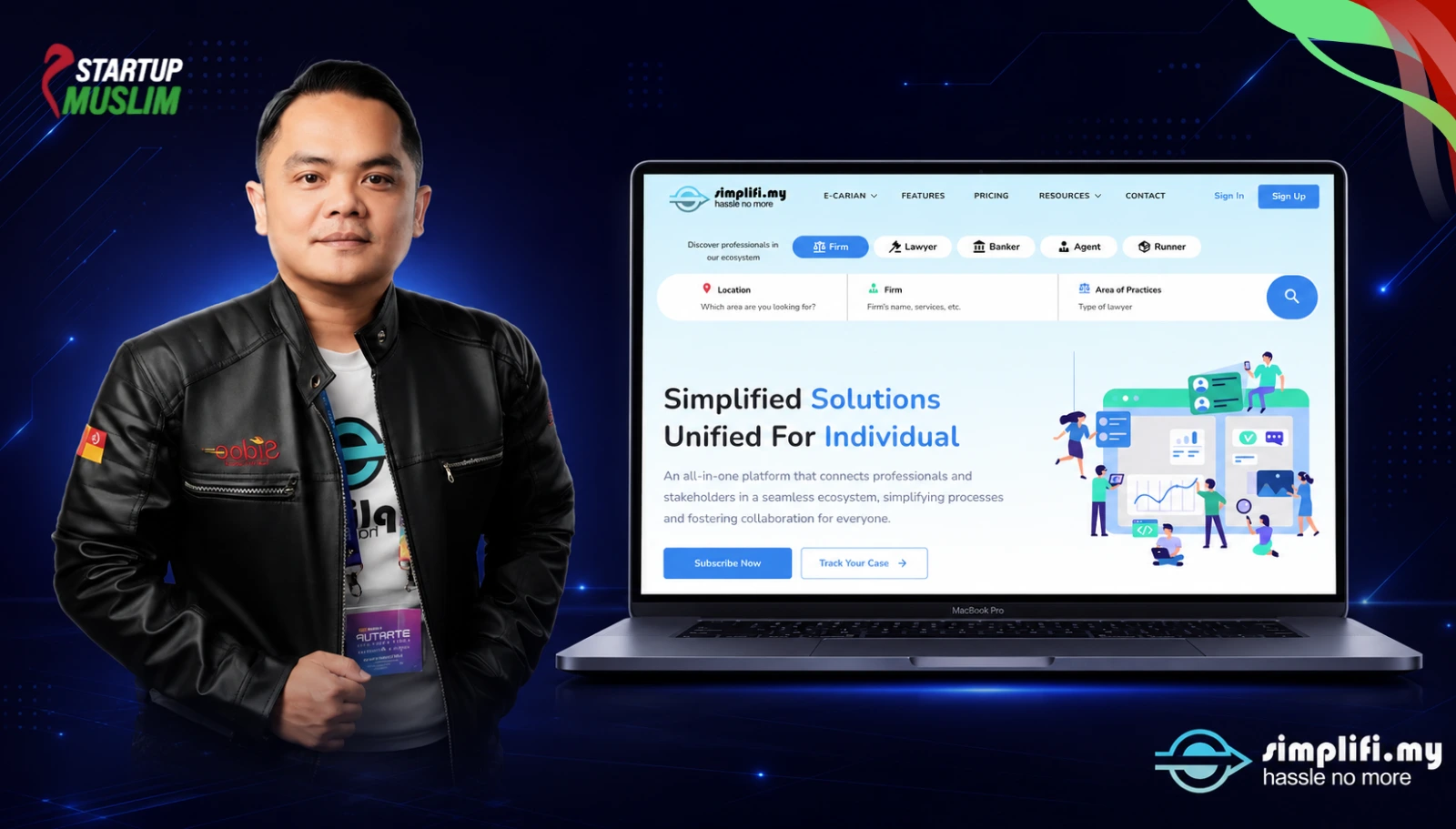
The Malaysian entrepreneur turned years of frustration with property and legal transactions into a platform now used by hundreds of law firms.
Mohammad Hafiz Hasan did not begin his career as a software engineer, nor did he grow up surrounded by entrepreneurs or technology founders.
He grew up as the fifth of seven siblings in a family where both of his parents had no formal education and did not complete primary school. Hafiz would go on to become the first member of his family to attend university, graduating with First Class Honours in Finance from Universiti Teknologi MARA before later earning a First Class MBA.
That trajectory would eventually take him through more than 16 years of experience spanning banking, property transactions, legal operations and business development.
But it was not technology itself that pushed him toward entrepreneurship. It was frustration.
A Founder Who Started With the Problem, Not the Technology
Years spent working around financing, property and legal transactions gave Hafiz a front-row view of how complicated routine processes could become.
Documents moved through fragmented workflows. Administrative tasks consumed time. Communication between parties could be cumbersome. Businesses and individuals looking for legal assistance were often navigating systems that had not been designed around speed, transparency or convenience.
Hafiz initially began thinking about technology as a way to make his own work easier. What started as an attempt to solve an operational problem eventually became Simplifi.my.
“The idea came from my own experience working in banking, property, and legal transactions for over 16 years,” Hafiz explained in information provided to Startup Muslim. “I experienced first-hand how fragmented and time-consuming legal processes could be.”
The realization that changed the trajectory of the business was that his frustration was not unique. Law firms were experiencing many of the same problems. Clients were experiencing them too.
That transformed Simplifi.my from a solution to an individual workflow problem into a much larger entrepreneurial thesis: legal services could be made easier to access while the professionals delivering those services could be given better digital tools.
Building a Technology Company Without Being a Technologist
For many founders, a lack of technical training can become a psychological barrier before a company has even started.
Hafiz took a different approach. Rather than positioning himself as the person who needed to write every line of code, he focused on what he understood deeply: the underlying industry problem.
“One of my biggest challenges was building a technology company without coming from a software engineering background,” he said.
That limitation ultimately influenced how he thinks about entrepreneurship. His conclusion is that founders do not need to know everything themselves. They need to understand the problem, assemble capable people around them, listen closely to customers and continue improving the product.
For Hafiz, domain knowledge became an advantage. Simplifi.my was not conceived as technology looking for an application. It emerged from years of observing how actual banking, property and legal transactions worked.
“Innovation doesn’t always begin with a breakthrough,” Hafiz says. “It often begins with solving a problem you’ve experienced yourself.”
When Customers Became the Validation
There is a significant difference between identifying an inefficient process and convincing an established professional industry to change how it operates.
For Simplifi.my, one of the most important moments came when law firms began adopting the platform.
Hafiz describes that adoption as the company’s key turning point. It demonstrated that the problems he had experienced personally were sufficiently widespread for other professionals to pay attention.
Since March 2023, Simplifi.my says it has onboarded more than 250 law firms and more than 1,000 lawyers in Malaysia. The company also reports facilitating more than 25,000 legal and property transactions, representing more than RM12 billion in transaction value.
Those numbers matter because legal technology faces a particular challenge: the product cannot simply look innovative. It must fit into the day-to-day work of professionals operating in a regulated industry.
Simplifi.my has consequently focused on practical workflows including case management, document management, online consultations, client communication, e-invoicing and workflow automation.
The company is also introducing artificial intelligence into parts of that ecosystem while maintaining a distinction Hafiz considers important.
“Technology should never replace professionals; it should empower them to create greater value for the people they serve.”
From Back-Office Software to a Consumer Legal Platform
Hafiz’s ambition for Simplifi.my has gradually expanded beyond making law firms more efficient.
The company is attempting to build a broader ecosystem connecting lawyers, businesses and individuals. That strategy has now moved onto mobile.
Simplifi.my recently launched its mobile application for both iOS and Android, giving users another way to find and connect with lawyers, book legal consultations, access property-related services and interact with professionals across the legal and property ecosystem.
For a company that began with workflow problems behind the scenes, the app represents an important evolution.
Simplifi.my is increasingly positioning itself not merely as software used by legal firms, but as infrastructure connecting both sides of the legal-services market.
The distinction is significant. Digitising what happens inside a law firm can improve efficiency. Making legal professionals easier for the public and businesses to discover and engage with could address a different problem entirely: access.
Building Around Trust
Technology companies operating around legal services cannot treat trust as an afterthought.
Simplifi.my says its approach is built around integrity, transparency, service and social responsibility. Hafiz also points to the company’s Pro Bono initiative, through which it aims to help underserved communities connect with participating lawyers.
The company states that its technology is designed to support — rather than replace — the professional judgment and independence of qualified lawyers, while operating within applicable Malaysian regulations including the Personal Data Protection Act and relevant legal professional standards.
For Hafiz, those principles are connected to something broader than product strategy. They reflect the values he wants embedded into the company. His definition of success is therefore not purely financial.
“Success isn’t measured by how far you’ve come alone, but by how many lives your ideas and innovations can improve.”
The Next Chapter: Southeast Asia
Hafiz now wants Simplifi.my to expand beyond its current position in Malaysia.
Over the next 12 to 24 months, the company plans to enhance its AI capabilities, expand online consultations, automate more legal workflows, strengthen its Malaysian footprint and begin exploring neighboring Southeast Asian markets.
It is an ambitious progression for a company whose origins were considerably more personal. Solve one frustrating problem. Discover that thousands of others share it. Build a product around it.
Then gradually build an ecosystem. Hafiz’s journey also offers a different version of the stereotypical technology founder story. He was not a programmer who identified a market for his technology.
He was an industry practitioner who understood a problem well enough to recognize that technology could solve it. And perhaps the most striking part of the story comes before Simplifi.my at all.
The son of parents who never completed primary school became the first in his family to attend university, built a career across finance and property, and ultimately became the CEO of a technology company attempting to transform an industry.
“Coming from a family with no formal education taught me that your starting point never determines your destination,” Hafiz says.
For the next generation of founders, that may be as important a lesson as anything Simplifi.my builds.


