





From Investor to Founder
For Nurmukhammad Ismoilov, the origins of entrepreneurship did not begin with a startup idea. They began with years of investing, learning how markets work, and discovering that financial decisions are ultimately less forgiving than the stories people tell about them. After eight years in the market, one lesson stayed with him: narratives are cheap, but numbers decide whether an investment actually works.
That mindset would eventually shape Akinda, a fintech platform designed to help Muslim investors determine whether companies are Shariah-compliant and, importantly, understand the reasoning behind those decisions. But Akinda did not begin as a fintech venture. It began with a question Ismoilov’s own audience kept asking him.
Before Akinda, Ismoilov had already spent years building an audience around investing. NURINVEST began as an effort to educate people in Uzbek, at a time when relatively little investing content was available in their native language. His book, Million Daromad, went on to sell more than 8,000 physical copies, while his videos attracted an audience with increasingly sophisticated questions about investing. One question kept returning: “Is this stock halal?”
The problem was that Ismoilov did not have a satisfactory answer. Existing solutions were largely in English, often hidden behind paywalls, and frequently presented users with a simple compliant-or-not verdict without showing how that conclusion had been reached. For someone making an actual investment decision, that lack of transparency was more than an inconvenience. It meant that people could end up allocating their money based on a friend’s opinion, a social-media post, or an unexplained badge on a website.
That was the moment the idea for Akinda took shape. “I wasn’t trying to start a fintech company,” Ismoilov explains. He was trying to answer a question his own audience would not stop asking—and discovered that the same question was being asked by Muslim investors around the world.
Building From Uzbekistan With a Global Ambition
Ismoilov’s international education and experience also influenced how he approached building the company. At APU, roughly half the student population was international, exposing him to people from different countries and business cultures. The experience taught him that there is rarely one correct way to build a company—and that founders should not use geography as an excuse for thinking small.
Japan added another lesson: respect for the unglamorous parts of building a business. Process, reliability, consistency, and attention to detail may not make for exciting startup stories, but they become critical when a company is dealing with financial compliance. That is particularly true for Akinda. A mistake in screening is not merely a technical bug if an investor relies on that information to make a financial decision. For Ismoilov, therefore, the quality of the underlying process matters as much as the sophistication of the interface.
Building from Uzbekistan, meanwhile, has not changed the company’s ambition. Ismoilov sees the domestic market as a distribution challenge rather than a ceiling on product quality. Akinda was written in English from the beginning, targeting users in the United States and Europe while applying the same AAOIFI standard that major institutions in the Gulf would recognize. The result is a company being built in Central Asia with a deliberately global customer base.
The Problem With a Green Badge
Akinda emerged from Ismoilov’s frustration with the way Shariah-compliant stock screening was traditionally presented. The first problem was accessibility. Many platforms required users to pay before they could even determine whether a stock they already owned was Shariah-compliant. Ismoilov considered that backwards. If compliance information is closely connected to a Muslim investor’s religious obligations, he believes the basic screening should be available without a paywall. Akinda therefore made stock screening free and ungated, while placing its paid offering around deeper research and analysis.
The second problem was transparency. Investors were often given a verdict without the underlying ratios, figures, or source information necessary to understand how the decision had been reached. Akinda’s approach is to expose the methodology so users can examine the reasoning themselves—and, if necessary, discuss it with their own scholars. But Ismoilov identified a third problem that would ultimately shape Akinda’s broader positioning: a compliance verdict is not the same as an investment decision.
Knowing that a company is halal does not tell an investor whether it is a good investment. It does not explain the company’s financial performance, valuation, risks, or prospects. Most screening tools stop at compliance, leaving investors to move elsewhere to conduct the actual research.
Akinda wants to close that gap. That is why Ismoilov describes the company not simply as a stock screener, but as a research and analysis platform for Muslim investors. And beyond the individual investor, he saw another opportunity: the institutions serving them. Banks and fintech companies looking to introduce Shariah-compliant investment products often lack reliable infrastructure for screening. Building those systems internally can be expensive and difficult, while failing to build them properly creates significant compliance risks. That gap became the foundation for Akinda’s B2B business. The company, in other words, began with a simple consumer question—but the answer could become infrastructure for an entire Islamic fintech ecosystem.
Building Trust in Shariah-Compliant Investing
For Akinda, the hardest part of building a Shariah-compliant investment platform is not producing a halal or non-halal verdict. It is earning the right to have someone trust that verdict with their money. Nurmukhammad Ismoilov understood early that a green badge on a stock ticker was not enough. If an investor is going to make a financial decision based on a religious standard, they should be able to understand the reasoning, inspect the numbers, and know where the methodology comes from.
That philosophy has become one of Akinda’s central differentiators. The platform screens stocks according to AAOIFI Shari’ah Standard No. 21, using business-activity and financial-ratio tests rather than relying on an unexplained proprietary score. Akinda’s methodology is also documented publicly, allowing users and institutional customers to examine the rules and the figures behind a verdict.
Making the Methodology Visible
Akinda’s screening begins with what a company actually does. Businesses whose core activities involve prohibited sectors—including conventional banking and insurance, alcohol, pork, gambling, tobacco, adult content, and certain weapons-related activities—are excluded. Companies with otherwise permissible businesses can still be assessed for incidental non-compliant income, which Akinda measures against a 5% threshold.
The second part looks at the company’s financial structure. Akinda measures interest-bearing debt against market capitalization and applies a 30% threshold, alongside a corresponding screen for interest-earning and non-compliant investments. Where a company passes the relevant screens but has a small amount of impermissible income, the platform can also calculate a purification amount so investors can understand what portion of their dividends should be given away.
The underlying technology is designed to make those calculations increasingly scalable. Akinda’s API can analyze regulatory filings and extract information such as interest-bearing debt, operating leases, and non-compliant revenue from filings across supported markets, returning both the verdict and the financial data behind it. For Ismoilov, however, technology is not a substitute for scholarship.
Where Technology Stops and Scholarship Begins
Akinda’s Shariah methodology is reviewed by Dr. Muhammad N. Khan, who advises the company on its screening approach and holds the AAOIFI CSAA certification. Ismoilov is also explicit that automated screening should support a Muslim investor’s decision rather than present itself as a replacement for qualified scholarly judgment.
That distinction is important because Islamic finance does not operate in a vacuum. Scholars can differ in their interpretations, and certain companies or financial situations can involve questions that cannot be reduced neatly to an automated binary answer. Akinda’s role, as Ismoilov sees it, is therefore to make the underlying information clearer and more accessible rather than claim authority it does not possess.
This philosophy also explains why transparency matters so much to the company. If a user can see the ratios and underlying figures, they can question the result, compare methodologies, and take the analysis to a scholar if necessary. The objective is not to eliminate human judgment but to give that judgment better information.
From Stock Screener to Investment Research Platform
This is also where Akinda’s ambition extends beyond conventional halal screening. A Muslim investor may want to know whether Apple, Microsoft, Nvidia, or another public company is compliant. But once that question is answered, a much larger set of questions follows: Is the company financially healthy? How is it valued? What are its risks? How does it compare with competitors? Is it worth owning?
Ismoilov believes the industry has historically focused too much on the first question. Akinda is trying to build around the entire research process instead. The company positions itself as a research and analysis platform, with compliance serving as the foundation rather than the final destination.
That positioning is reflected in the product’s evolution toward deeper data and developer infrastructure. Akinda’s API currently offers a fast compliance verdict, more detailed financial-ratio reports, and a full report incorporating AI-extracted information from regulatory filings. Its stated vision is to make Shariah data a standard component of fintech products serving Muslim investors, much like conventional financial platforms already depend on market-data infrastructure.
The Numbers Behind the Platform
The company’s early traction suggests that the problem is resonating beyond Ismoilov’s original audience. Akinda has reached more than 10,000 monthly active users, with 154,000+ screenings conducted on the platform and around 200 paying B2C subscribers. It also has three live B2B API contracts, with users across the United States, United Kingdom, UAE, Canada, Uzbekistan, Germany, and more than ten additional countries.
The company remains deliberately lean, with a team of fewer than ten people. CTO Mahmud Buriev leads the B2C product, while the AI/ML function supporting the B2B API is led by Firdavs. The company also works with Dr. Khan on Shariah matters and Saidakhror Burkhanov, a former J.P. Morgan professional, on risk.
Akinda has also established brokerage integrations through a US-based partner, enabling users to connect accounts from platforms including Interactive Brokers, Alpaca, Webull, Trading212, Public, TradeStation, E*Trade, Moomoo, and Charles Schwab. The company does not custody client funds or execute trades; its role remains research, analysis, and compliance infrastructure.
For Ismoilov, though, one metric stands above the rest: 154,000 screenings. Users can be acquired through marketing, but repeated use of a compliance tool is much harder to manufacture. It suggests that Akinda is becoming part of an investor’s actual decision-making process.
A Regulatory Window Opens in Uzbekistan
Akinda’s opportunity is not limited to individual investors. A major part of Ismoilov’s vision is to become infrastructure for the institutions that will serve the next generation of Islamic finance. That opportunity has become particularly relevant in Uzbekistan. According to Ismoilov, Law ZRU-1126, signed on March 27, 2026 and effective from June 29, establishes a dual banking system that includes dedicated Islamic banks and Islamic windows within conventional banks, while creating a regulatory framework for Islamic finance under the Central Bank.
For Akinda, the significance is straightforward. Financial institutions entering Islamic banking need reliable Shariah-compliance processes, governance, and data. Building that infrastructure internally can be expensive and time-consuming, creating an opening for specialized technology providers. “We’re not a bank and we have no ambition to become one,” Ismoilov says. “We want to be the compliance and research layer those banks build on.”
That may prove to be one of Akinda’s most important strategic opportunities: moving from a consumer-facing halal stock screener to becoming part of the infrastructure powering Islamic fintech itself.
Building the Infrastructure for a New Generation of Muslim Investors
For Nurmukhammad Ismoilov, Akinda’s opportunity ultimately extends far beyond helping an individual investor determine whether a stock is halal. His larger ambition is to build financial infrastructure that makes Shariah-compliant investing easier to understand, easier to access, and easier for fintech companies to deliver at scale. That means serving consumers today while quietly building the technology that banks, brokers, wealth platforms, and other financial institutions may need tomorrow.
It is an ambitious transition for a company that began with a simple question from Ismoilov’s audience. But the evolution makes sense. Once the company began solving the information problem for individual investors, it became clear that the same infrastructure could potentially solve a much larger problem for the financial institutions serving millions of Muslim customers.
From Consumer Product to Financial Infrastructure
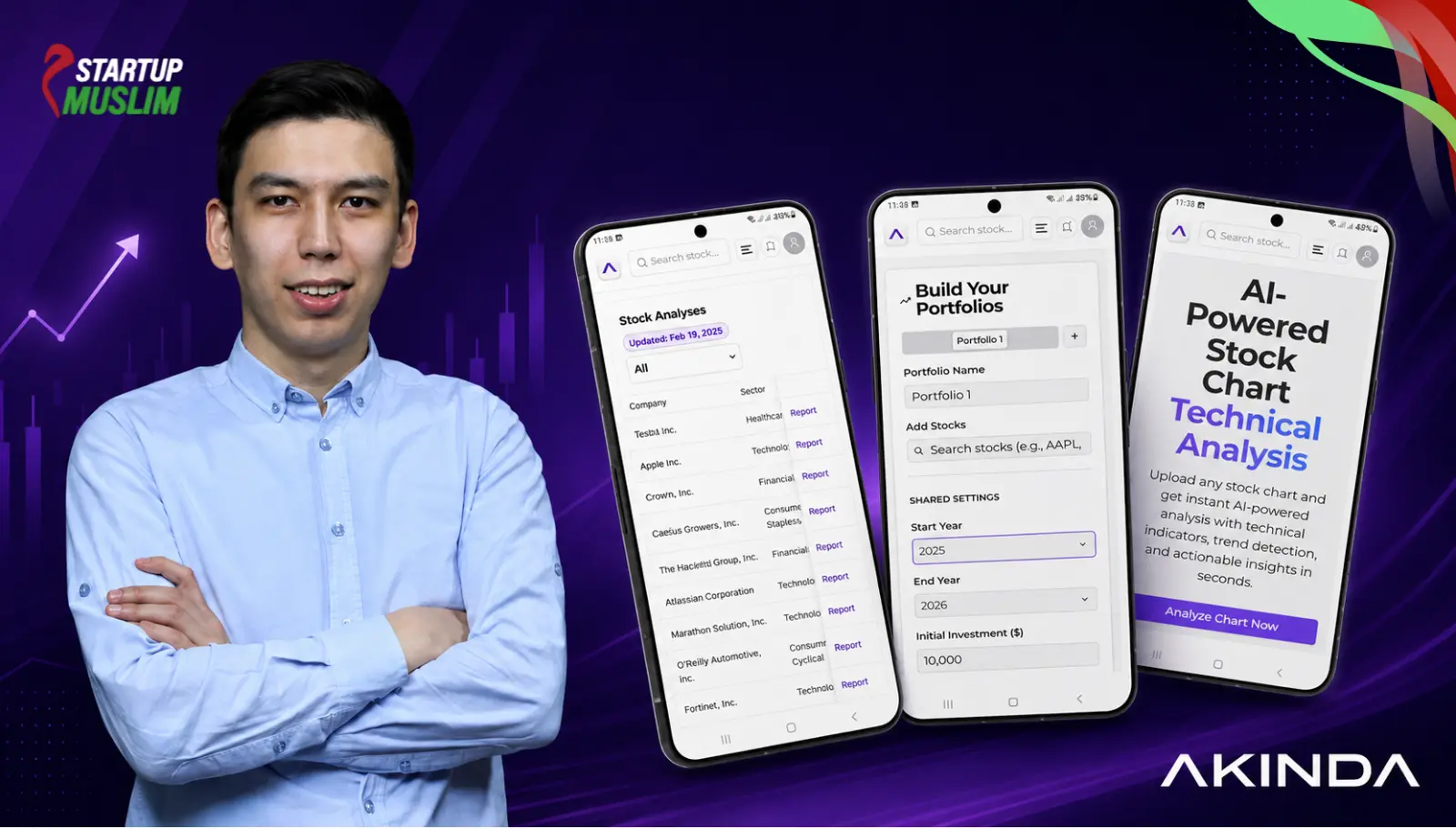
Akinda’s consumer platform remains an important part of the company’s strategy. Users can screen stocks, build portfolios, access research, and increasingly use AI-powered tools to make sense of financial information. The platform’s current positioning reflects that broader ambition: it is no longer simply a place to check whether a ticker is halal, but a research and investment companion built around Shariah compliance.
At the same time, the B2B opportunity could become the more significant long-term business. Akinda’s API allows fintech companies and other financial platforms to integrate Shariah screening into their own products instead of building the entire compliance infrastructure internally. The company’s vision is effectively to make Shariah data an underlying layer that other financial products can use, much as conventional fintech companies rely on external providers for market data and financial infrastructure.
That model also changes the potential scale of the business. A consumer application grows one user at a time; infrastructure can reach users through the institutions that already serve them. For Ismoilov, that creates the possibility of Akinda becoming a quiet but important component of a much broader Islamic fintech ecosystem.
A Window of Opportunity in Uzbekistan
Uzbekistan could become an especially important market in that strategy. The country’s financial system is beginning to create greater room for Islamic finance, opening the possibility of new Islamic banking products and dedicated services for customers seeking alternatives aligned with Islamic principles.
For Akinda, this creates a particularly interesting timing opportunity. New Islamic financial institutions will require reliable systems for screening investments, maintaining Shariah governance, and providing customers with transparent information. Rather than becoming a bank itself, Ismoilov wants Akinda to provide some of the technology underneath those institutions. The distinction is deliberate.
Akinda does not need to own the customer relationship to become essential to the financial ecosystem. If banks and fintech companies can integrate Akinda’s compliance and research infrastructure into their own products, the company’s reach could expand well beyond the users who download its consumer application.
Building From Uzbekistan, Thinking Globally
There is also a geographic dimension to Ismoilov’s ambition. Although he is building from Uzbekistan, Akinda was designed from the beginning with international users in mind. Its English-language product and focus on globally traded equities reflect a deliberate decision not to limit the company to its home market. That approach is already reflected in its user base, which spans the United States, United Kingdom, UAE, Canada, Uzbekistan, Germany, and other markets. The company has also established brokerage integrations that allow users to connect accounts from several major platforms, reinforcing its position as a research and compliance layer rather than a custodian or traditional broker.
For a founder from Central Asia, the strategy carries a broader message. Geography no longer has to determine the size of a technology company’s ambition. A startup can be built in Tashkent while designing for customers in London, New York, Dubai, Toronto, and beyond. Ismoilov’s own career reflects that philosophy. His education in Japan and Germany, combined with years spent investing and educating an audience in Uzbekistan, gave him exposure to different financial systems and business cultures. Rather than choosing one geography, he has used those experiences to build a product intended to connect Muslim investors with global capital markets.
The Discipline of Building With Limited Resources
Akinda is also being built with the discipline of a lean startup. The company has maintained a relatively small team while developing both its consumer platform and B2B infrastructure, relying on specialized expertise across product, engineering, AI/ML, risk, and Shariah advisory.
That constraint has influenced Ismoilov’s approach to entrepreneurship. Rather than attempting to build every possible feature, the company has focused on problems users repeatedly demonstrate they need solved. His earlier experience building NURINVEST reinforced that philosophy: education, trust, and practical usefulness had to come before technology for technology’s sake.
The lesson is particularly relevant in fintech, where complexity can easily become a substitute for value. For Akinda, the challenge is to make sophisticated financial and Shariah analysis accessible without making the underlying methodology opaque.
A Bigger Vision for Halal Investing
The long-term opportunity is ultimately about changing how Muslim investors participate in global markets. For years, the conversation around halal investing has often revolved around whether sufficient investment opportunities exist. Ismoilov believes the next phase should focus on making those opportunities understandable, transparent, and accessible. A Muslim investor should not have to choose between participating in modern capital markets and understanding the religious principles governing their investments. That is why Akinda’s ambition reaches beyond screening. The company wants to bring together Shariah compliance, financial research, portfolio intelligence, and technology in a single ecosystem, while giving institutions the infrastructure to deliver those capabilities to their own customers.
For Ismoilov, the ultimate measure of success may therefore not be the number of people who know Akinda’s name. It could be the number of financial products where Shariah-compliant intelligence becomes an invisible but essential part of the experience.
The journey began with a question from an investor: “Is this stock halal?” Akinda’s answer is becoming something much bigger. It is an attempt to build the infrastructure that allows millions of Muslims to participate in global investing without having to leave their values at the door. And for a founder who started by educating investors in his native language, that may be the most meaningful evolution of all: turning financial knowledge from something difficult to access into infrastructure that an entire generation of Muslim investors can build upon.


