


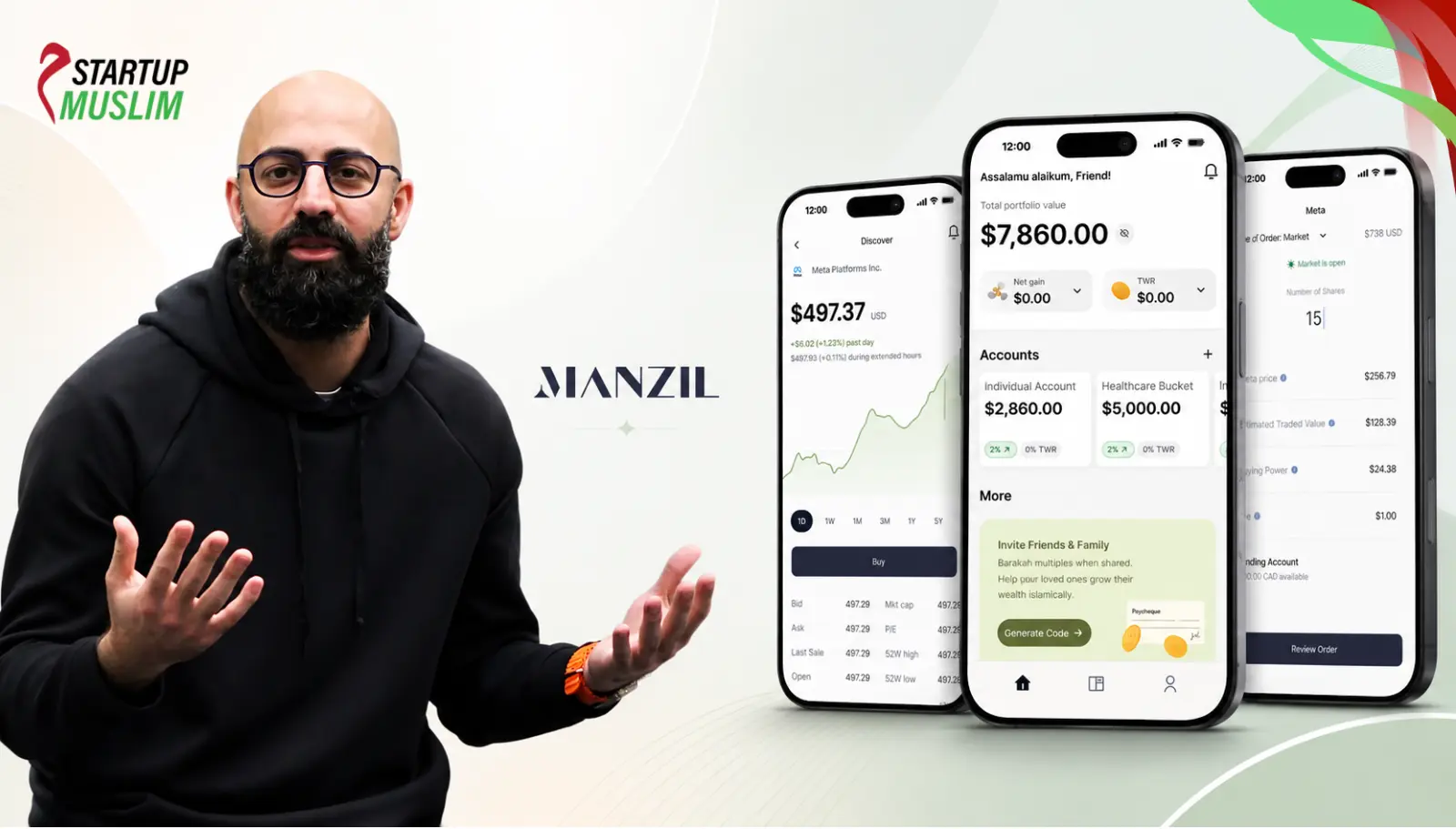
Toronto-based Islamic fintech Manzil has launched self-directed halal stock trading in the United States, allowing Muslim investors to select and trade individual U.S. equities that have already been screened for Shariah compliance — all within a single app.
Founded in 2017 by Dr. Mohamad Sawwaf, Manzil describes the product as the first halal self-directed trading app launched in North America — a first-in-North-America designation that is a company claim.
The move expands Manzil’s American investment offering beyond the professionally managed portfolios it introduced in 2025 and signals a much larger ambition: building a global financial platform for the world’s nearly two billion Muslims.
“It’s like a halal version of Robinhood,” Sawwaf told BetaKit, positioning Manzil as a faith-aligned alternative to the popular U.S. trading platform. But the comparison captures only part of Manzil’s vision. In a statement shared with Startup Muslim, Sawwaf framed the launch as something bigger than a product release:
“With the launch of self-directed halal trading inside Manzil Invest US, we’re giving American Muslims direct access to Shariah-screened equities, in real time, without compromising their faith. This is more than a feature, it’s a statement that halal investing can be just as sophisticated and accessible as any conventional platform. It also marks Manzil’s entry onto the global stage, and we see this as the foundation for a truly global Islamic financial platform that Muslims anywhere can trust and rely on.”
Dr. Mohamad Sawwaf, Founder and CEO, Manzil
The company is not simply building another stock-trading app. It is assembling a broader financial ecosystem designed to help Muslims invest, plan and build wealth without separating their financial goals from their faith.
Solving the Two-App Problem
For many Muslim investors, buying a stock has never been as simple as opening a brokerage account.
Shariah-compliant investing requires screening companies not only for prohibited business activities — including alcohol, gambling, tobacco, conventional banking and other restricted industries — but also for financial measures such as interest-bearing debt and income derived from interest. A company operating in an otherwise permissible industry can still fail a Shariah screen because of the way its finances are structured.
In practice, that has often meant moving between two platforms: a dedicated screening application to verify whether a stock is compliant and a separate brokerage application to place the trade.
Manzil Trading brings those functions together. Stocks available through the platform are pre-screened against standards established by the Accounting and Auditing Organization for Islamic Financial Institutions (AAOIFI), an international standard-setting body for the Islamic finance industry, with screening delivered in partnership with Zoya. Rather than simply displaying a compliance score, Manzil limits the investable universe to stocks that meet its Shariah criteria — and the company says investors are notified when a stock’s compliance status changes, allowing them to decide how to manage an existing position.
For the investor, the value proposition is straightforward: choose from a screened universe of equities and place a trade without conducting a separate compliance search through another platform.
Built for Everyday Muslim Investors
The platform is designed to lower the barrier to entry for first-time investors while also supporting customers with more established portfolios. Investors can begin with as little as $100 and use fractional shares to access companies whose full share prices might otherwise be out of reach.
It also includes tools built specifically around Islamic financial obligations. Integrated Zakat tools help customers calculate and track annual Zakat obligations associated with their investments, while purification features help identify portions of investment returns that may need to be donated when an otherwise compliant company generates a limited amount of non-permissible income.
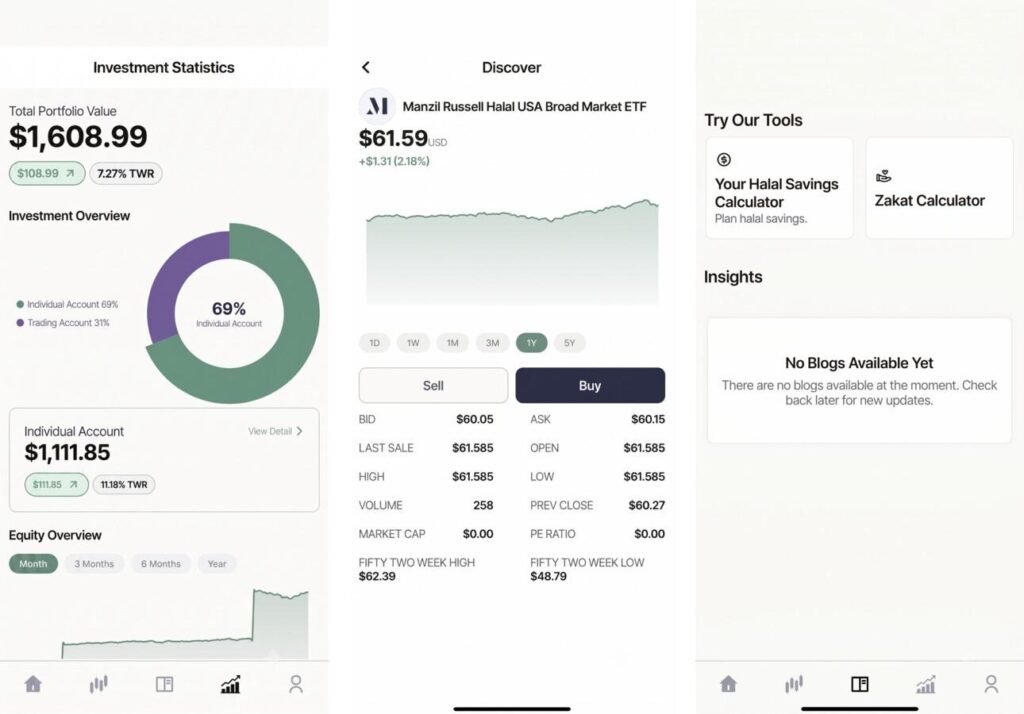
Inside Manzil Invest US: the investment overview, the Discover tab showing the MNZL ETF, and in-app Zakat and halal savings tools. Screenshots courtesy Manzil.
Pricing is straightforward: a 0.40% annual advisory fee, plus a $48 annual subscription for accounts under $100,000 — waived for accounts at or above that threshold, although the asset-based fee continues to apply.
Brokerage services are provided through Alpaca Securities, while investment-advisory services are offered through Manzil Investment Advisors, an investment adviser registered with the U.S. Securities and Exchange Commission. The structure allows Manzil to serve different types of investors: customers who want professional portfolio management can select a managed strategy, while those seeking more control can choose individual stocks through the self-directed platform.
From Halal Mortgages to a Full Financial Ecosystem
Manzil’s U.S. trading launch is the latest step in a deliberate, multiyear expansion. The company first became known in Canada for addressing one of the most persistent financial challenges facing Muslim families: purchasing a home without using a conventional interest-bearing mortgage. From there, Manzil expanded into investing, wealth management and estate planning.
In 2022, it acquired Muslim Will Solutions, a Canadian digital platform that helps Muslims create wills consistent with Islamic principles. In 2024, Manzil acquired the technology and investment-advisory business of Aghaz Investments, a U.S.-based Islamic fintech focused on halal investing — giving Manzil an established regulatory and technological foundation from which to enter the American market.
Manzil launched managed halal portfolios in the United States in 2025, followed by the Manzil Russell Halal USA Broad Market ETF, which trades on Nasdaq under the ticker MNZL. The fund tracks a custom index built on the Russell IdealRatings 1000 Islamic Index and, in addition to Shariah screening, applies an ethical filter intended to exclude companies associated with certain serious human-rights concerns.
Together, the products give Muslim investors several ways to participate in the market: professionally managed portfolios for those seeking simplicity, the MNZL ETF for diversified U.S.-market exposure and self-directed trading for investors who want greater control over the companies they own. Manzil is building an ecosystem in which investing, compliance, wealth planning, home financing and estate planning can be addressed through a single faith-aligned institution.
The Founder Behind the Platform

Dr. Mohamad Sawwaf. Image courtesy Manzil.
Sawwaf founded Manzil after identifying a critical gap in the Canadian market for ethical, faith-aligned home financing. Under his leadership, the company has grown into North America’s leading Islamic finance company, with over $250 million in assets under management across Shariah-compliant mortgage, investment and wealth management platforms in Canada and the United States.
He has also been a tireless advocate for policy reform, playing a central role in the Government of Canada’s Budget 2024 halal mortgage consultation and delivering remarks at Queen’s Park in support of expanded access to Murabaha and Musharaka financing structures for Ontario’s Muslim community. A former Chair of the Canada-Arab Business Council, one of Canada’s longest-standing bilateral trade organizations, Sawwaf holds a Doctorate in Islamic Finance from Henley Business School, an MBA from the Rotman School of Management at the University of Toronto, and an MSc in Corporate Governance.
A $341 Billion Market Opportunity
Manzil’s expansion speaks to a significant gap in global financial services. The Global Islamic Fintech Report 2025/26 estimates that the Islamic fintech market represented approximately $198 billion in transaction volume and assets under management during 2024 and 2025 — and projects that figure will reach $341 billion by 2029. The report identified 484 Islamic fintech companies operating across 41 countries, but found that approximately 80% were concentrated in only 10 markets, leaving Muslim communities in North America, Europe and other regions with comparatively fewer modern, consumer-friendly Islamic financial products.
The demographics underscore the opportunity. Canada is home to roughly 1.8 million Muslims, while estimates place the Muslim population of the United States at approximately 4.5 million — together only a small portion of the global Muslim population Manzil ultimately hopes to serve.
The company is betting that Muslim consumers want more than financial products carrying a halal label. They want the speed, accessibility, transparency and control offered by mainstream fintech platforms — without being required to compromise their religious principles.
From North America to the Global Muslim Market
The U.S. launch is also serving as the foundation for Manzil’s wider international rollout. The investment platform is currently available to eligible customers in the United States, United Kingdom, Bahrain, Qatar, Saudi Arabia and the United Arab Emirates. Manzil says its international know-your-client infrastructure can support a broader global expansion, and the company is gradually working toward availability in more than 100 countries. Sawwaf has also expressed interest in eventually introducing self-directed halal stock trading in Canada, subject to market conditions and the capabilities of Manzil’s brokerage partners.
Expanding a financial platform across borders, however, will require more than enabling international registrations. Each market brings its own securities laws, licensing requirements, investor-protection standards and financial infrastructure. Manzil will also need to navigate differences in how scholars and institutions apply Shariah-screening methodologies — Islamic equity standards generally combine prohibited-industry exclusions with financial-ratio tests, but there is no single methodology followed universally across every market.
That makes transparency particularly important. As Manzil expands, investors will need clear information about which standards the company follows, how frequently stocks are reviewed and what happens when a company’s compliance status changes.
More Than a “Halal Robinhood”
Comparing Manzil with Robinhood makes the product immediately understandable: both give individual investors the ability to choose stocks and manage their portfolios through a digital platform. But Manzil’s strategy extends well beyond trading. Robinhood is primarily an investment platform; Manzil is attempting to build financial infrastructure around the broader lives of Muslim consumers — from investing and wealth management to home financing and estate planning.
Self-directed trading could become an important gateway into that ecosystem because it gives customers a reason to engage with Manzil regularly. Investors may return to the platform to evaluate companies, contribute funds, monitor their portfolios and respond to changing market conditions. Over time, those relationships may extend into other financial services.
For Manzil, the larger opportunity is to become an institution Muslims can turn to throughout their financial lives — not because it has adapted conventional products after the fact, but because its services were designed around their needs from the beginning.
The Road Ahead
Manzil’s self-directed trading launch arrives as Muslim consumers increasingly demand financial products that combine religious integrity with the convenience and quality expected from modern technology companies. The company has spent several years assembling the pieces needed to meet that demand: regulatory infrastructure, managed portfolios, brokerage capabilities, Shariah screening, an exchange-traded fund and now self-directed trading. Its next challenge will be bringing those pieces together at scale.
Success will depend on Manzil’s ability to maintain trust, communicate its screening methodology clearly, deliver a competitive customer experience and navigate the complexities of international financial regulation. But the direction of the company is becoming increasingly clear.
What began as an effort to make homeownership more accessible to Muslim Canadians is evolving into something much larger: a global financial institution through which Muslims can invest, plan and build wealth without being asked to separate their financial ambitions from their faith. For a community that has long been told to compromise, Manzil is betting that the future of finance does not require it.
