





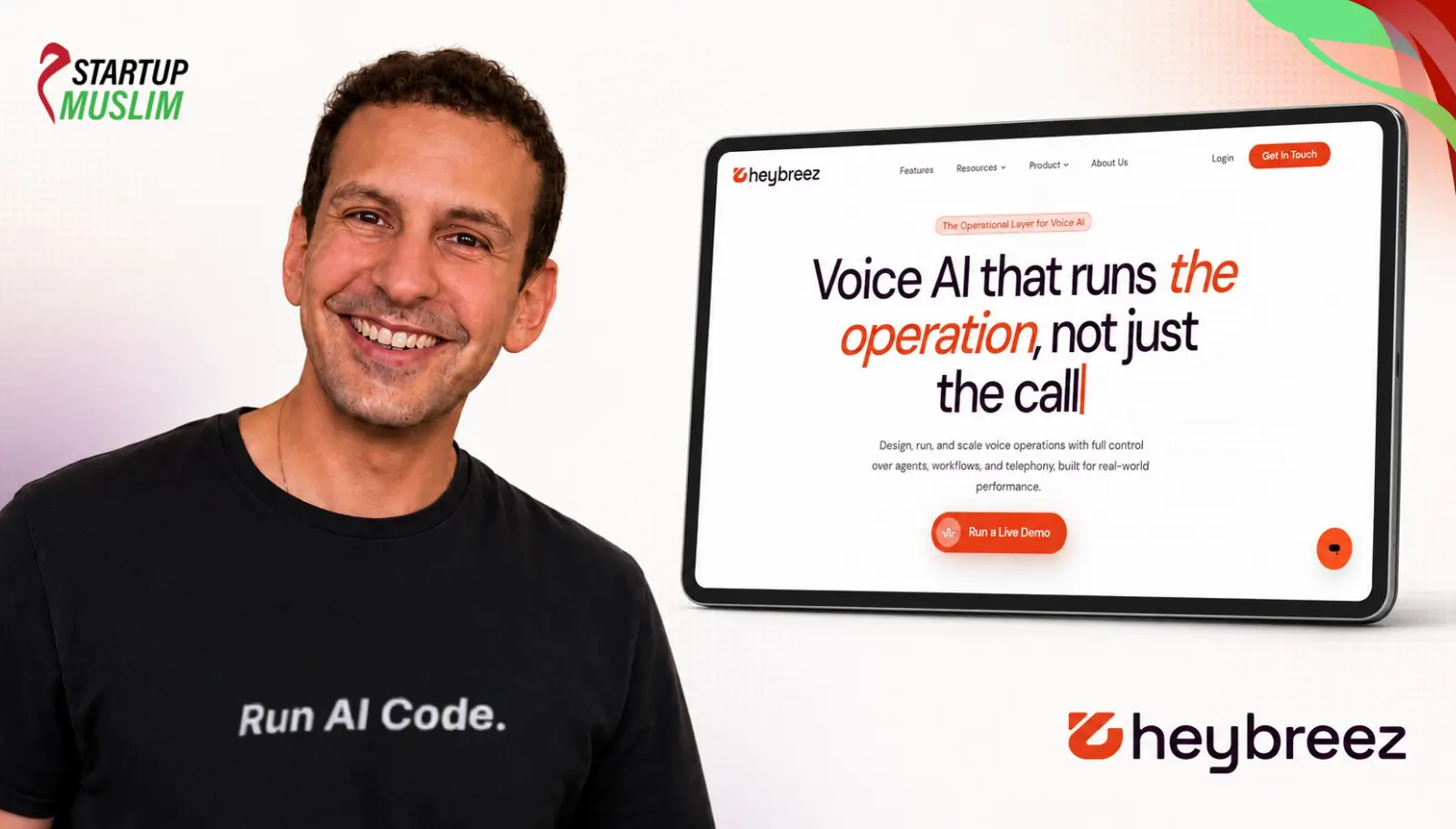
MENA-born enterprise voice AI startup HeyBreez has raised $2.5 million in an oversubscribed Seed round, as demand grows for infrastructure that can move voice AI beyond individual conversations and into reliable, enterprise-scale business operations.
The round was led by Lunara Partners, with participation from Jabbar Group, DASH Ventures and a group of prominent founders and strategic angel investors. Founded in 2025 by Karim Malhas, HeyBreez is headquartered in Delaware with offices in Amman and Dubai, and is already processing more than one million calls per month across MENA, Europe, the US and Latin America.
Moving Beyond the AI Voice Agent
The market for voice AI has advanced rapidly, with AI systems increasingly capable of recognizing, generating and translating speech at levels approaching human performance. But HeyBreez believes the harder enterprise problem begins after the voice agent starts talking.
Most voice platforms focus on enabling an AI agent to conduct a conversation. HeyBreez is building the infrastructure around that conversation—handling telephony, retries, callbacks, follow-up logic, branching journeys, integrations and other operational workflows required to turn a voice interaction into a reliable business process.
“Everyone in this market helped companies make the call. No one helped them run the operation behind it. That is the hard part, and what we built for from day one,” said Karim Malhas, Founder and CEO of HeyBreez.
The distinction is important for enterprises running voice AI at scale. A successful call is only one component of a broader workflow that may involve retrying unanswered calls, scheduling callbacks, updating customer records, triggering follow-ups and connecting the conversation to existing enterprise systems.
Already Processing More Than One Million Calls a Month
HeyBreez says its platform is already processing more than one million calls every month, with individual customers conducting campaigns reaching 10,000 calls per day.
The company serves four distinct customer segments: enterprises that require dedicated support, agencies and resellers building voice solutions for their own clients, developers and small businesses using self-serve plans, and regional AI companies embedding HeyBreez technology into their own products.
Its infrastructure supports multilingual voice workloads across sectors including banking, healthcare, logistics, hospitality and customer experience, where voice remains an important channel for customer interaction.
The company is also building a partner-led distribution strategy. Arabic.ai and Xaia are among its solutions integration partners, helping resell HeyBreez to enterprise customers across the region.
From MENA to a Global Voice AI Infrastructure Play
For Lunara Partners, HeyBreez’s opportunity lies in solving an infrastructure problem that becomes increasingly important as enterprises deploy more voice agents.
“Every platform in this market solved the conversation. Almost none solved the operation around it—the retries, callbacks, integrations, and governance that determine whether voice agents hold up in production,” said Said Murad, Co-Founder and Managing Partner of Lunara Partners.
The startup sees the MENA region as its commercial starting point, particularly as demand grows for Arabic-language voice automation and sovereign-cloud and data-residency requirements become increasingly important across the GCC. At the same time, HeyBreez is designed for global deployment and is already operating across MENA, Europe, the US and Latin America.
The new capital will be used to deepen platform infrastructure, accelerate product development, expand the team and support sales growth across the Middle East, Americas, Europe and Asia-Pacific.
The latest round follows a $1.3 million pre-Seed round in January 2026, led by Wamda Capital with participation from DASH Ventures and strategic angel investors.
For Malhas, the timing of the Seed round is driven less by a conventional fundraising cycle than by demand from the market. With more than a million calls already moving through its infrastructure every month, HeyBreez is betting that the next phase of voice AI will not be defined merely by how naturally an AI can speak.
It will be defined by whether businesses can reliably operate voice AI at scale.


