


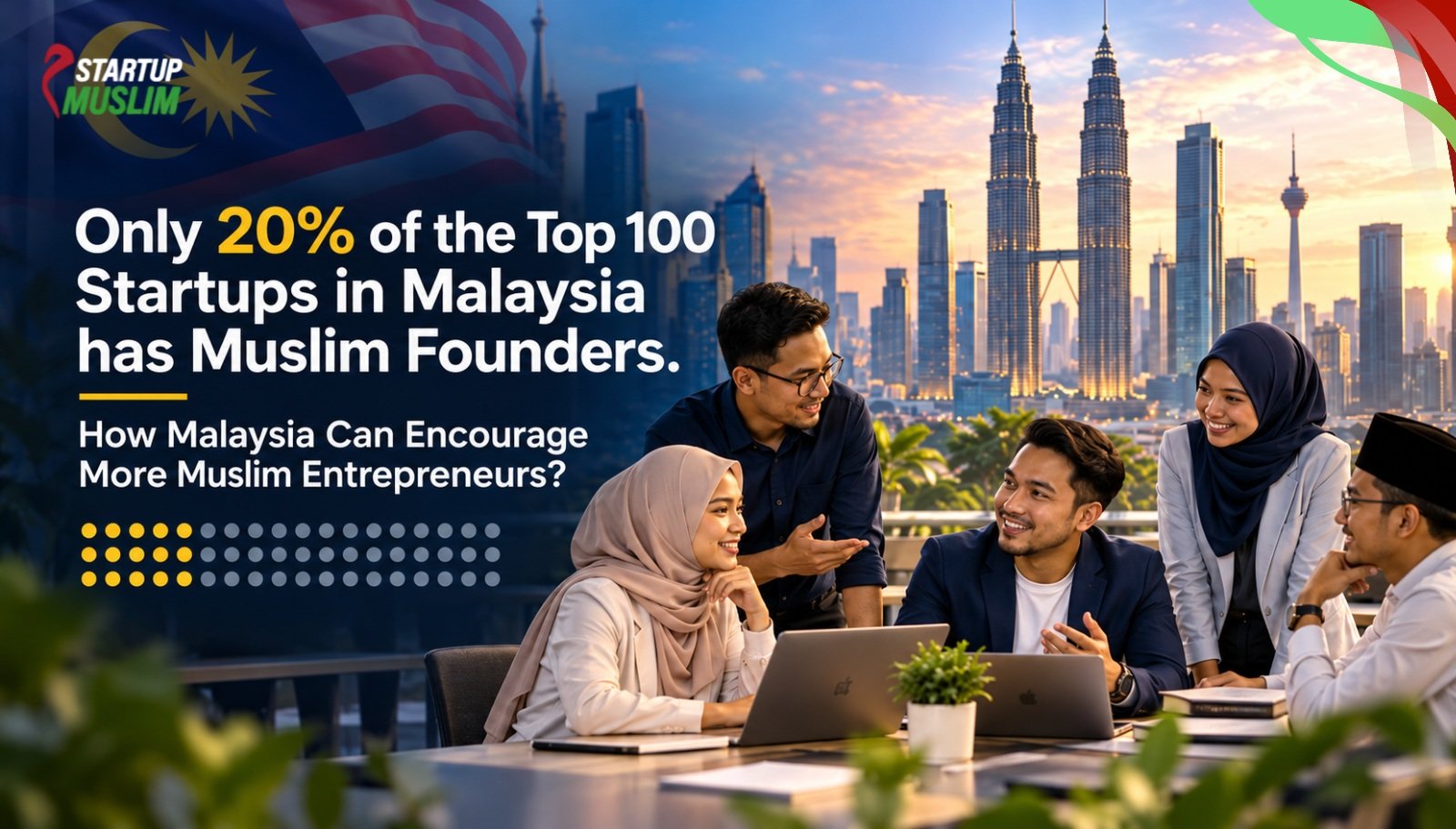
Muslims make up 63.5% of Malaysia’s population, yet only 20 of the 100 startups in Cradle’s Malaysia Top 100 Startups list have Muslim founders, according to StartupMuslim.com’s research. The findings raise an important question about entrepreneurship, access to capital, and the support available to aspiring Muslim founders.
Malaysia has the ingredients to produce a much larger generation of successful entrepreneurs. It has a substantial Muslim population, a growing technology ecosystem, access to regional markets, and government institutions supporting startups. Yet, a review by StartupMuslim.com of Cradle’s Malaysia Top 100 Startups, 2026 Edition, identified just 20 companies with Muslim founders.
This is not a measure of the entire Malaysian startup ecosystem, nor does it explain why this representation gap exists. However, it provides a useful starting point for a conversation about how more Muslim Malaysians can be encouraged and supported to build ambitious, scalable businesses. The objective should not simply be to increase the number of Muslim-owned businesses. It should be to help more founders build companies that create jobs, develop technology, attract investment, and compete in international markets.
Changing the Mindset Around Entrepreneurship
Umar Munshi, General Partner at Hasan.VC, believes the challenge extends beyond the technology sector. “Muslims are underrepresented in business in general and especially in tech. Two key factors that contribute to this are a lack of entrepreneurship spirit and a shortage of available risk capital from the community,” he says.
Munshi believes that changing attitudes towards entrepreneurship is essential. “In my view it’s mainly mindset. We need to acknowledge and embrace entrepreneurship as a legitimate path. Society needs to step up and provide moral and commercial support for founders.”
His comments raise an important question about how entrepreneurship is perceived within families, communities, and educational institutions. Young people are often encouraged to pursue stable employment, but fewer may have access to the guidance and networks needed to build a business of their own. Those with promising ideas may not know how to find a cofounder, validate a market, approach investors, or secure their first customers. Changing this requires more than motivational speeches. Aspiring founders need practical guidance, experienced mentors, access to customers, and opportunities to learn by building real businesses.
Munshi also emphasises the importance of telling the stories of successful Muslim entrepreneurs and educating institutions about the importance of supporting startup founders.
Think Beyond Muslim Specific Products
Hafiz Hasan, Co-founder and CEO of Simplifi.my, believes Muslim entrepreneurs should also broaden their ambitions. “We should also avoid limiting Muslim entrepreneurship to Muslim-specific products. Muslim founders can build globally competitive companies in legal technology, healthcare, finance, logistics, AI and many other sectors, while remaining guided by their values,” he says.
Muslim-focused businesses can address important needs, but they represent only one part of the opportunity. Muslim founders can build companies that solve universal problems, serve international customers, and compete across industries. They can develop artificial intelligence tools, improve healthcare delivery, modernise legal services, or build technology that makes businesses more efficient.
The ambition should be to identify important problems and develop commercially viable solutions, regardless of whether the target customer is Muslim. A founder’s values can guide how a business operates without limiting its market or potential for growth. Malaysia needs more entrepreneurs who aspire to build globally competitive companies, not just businesses serving a specific community.
Government Awareness Must Reach Beyond Kuala Lumpur
Government support for entrepreneurship is important, but awareness of available opportunities must reach aspiring founders across the country. Startup events, investor meetings, and technology conferences in Kuala Lumpur can be valuable. However, they are unlikely to reach every talented student, professional, or small business owner in smaller towns and rural communities.
A young person in Kelantan, Terengganu, Kedah, Sabah, or Sarawak should have a clear pathway to learn about entrepreneurship, access mentorship, and discover available funding opportunities without having to depend on personal connections in the capital. Government agencies such as Cradle, together with universities, colleges, community organisations, and local business associations, should organise regular grassroots awareness programmes across Malaysia.
These programmes should explain how to start a business, test an idea, develop a product, apply for grants, approach investors, and access incubators or accelerators. They should include practical workshops, founder mentorship, and opportunities to meet potential cofounders and customers. Importantly, these initiatives should not end with a one-day events. Participants should be connected to ongoing support, with progress measured by how many go on to develop products, secure customers, launch businesses, or obtain investment. The goal is to make entrepreneurship accessible to talented people wherever they live, rather than concentrating opportunities among those already connected to the startup ecosystem.
What Muslim Entrepreneurs and Policymakers Should Do
Closing the gap requires action from both the entrepreneurial community and the institutions that support it.
Muslim entrepreneurs and investors should
- Mentor the next generation. Experienced founders should offer practical guidance, introductions to customers, and honest lessons from their own journeys.
- Make more capital available. Muslim investors and business leaders should consider investing in promising early stage companies, while maintaining sound investment discipline.
- Build beyond familiar markets. Founders should identify significant problems across industries and develop products that can compete regionally and globally.
- Share success stories. Entrepreneurs should make their journeys visible, helping young people understand that building a company is a viable career path.
Government and ecosystem leaders should
- Take awareness to the grassroots. Organise regular entrepreneurship programmes in smaller towns, rural communities, and educational institutions across every Malaysian state, rather than concentrating activities in Kuala Lumpur.
- Improve access to support. Make information about grants, incubators, mentorship, and funding accessible and easy to understand, including for first time founders without established networks.
- Connect founders with the market. Help promising startups meet investors, corporations, potential customers, and experienced entrepreneurs.
- Measure outcomes. Track how many participants launch businesses, acquire paying customers, secure investment, create jobs, and expand into new markets.
Building the Next Generation
The 20 startups identified by StartupMuslim.com provide a starting point for a much larger conversation about Muslim entrepreneurship in Malaysia. As Umar Munshi highlights, a stronger entrepreneurial mindset and greater community support are essential. Hafiz Hasan reminds us that Muslim founders should not limit their ambitions to Muslim specific markets.
Together, these perspectives point towards a broader goal. Malaysia needs more aspiring founders to see entrepreneurship as a realistic path, more experienced entrepreneurs willing to support them, more investors prepared to back promising ideas, and government programmes that reach talent wherever it exists. The responsibility does not rest with Muslim entrepreneurs alone. Universities, corporations, investors, community leaders, and policymakers all have a role in building an environment where promising founders can thrive.
The next generation of Malaysian Muslim entrepreneurs should not merely aspire to be represented among the country’s leading startups. They should aspire to build the companies that shape Malaysia’s economy and compete with the best in the world. The question is whether the community and its institutions will do enough to help them get there.
