


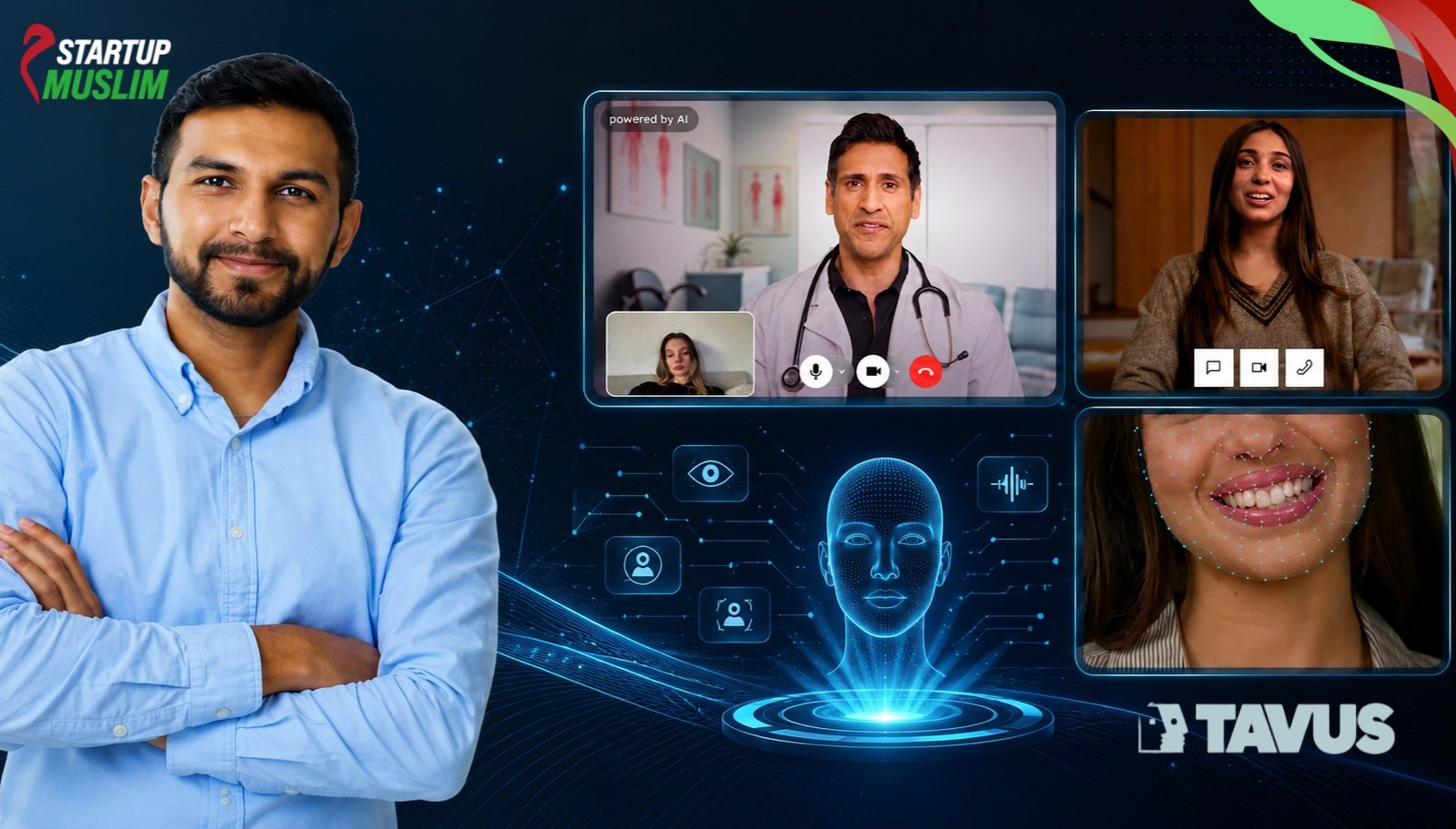
San Francisco-based AI platform Tavus has raised $40 million in Series B funding, marking a major step forward for the company’s vision of making human-AI interaction feel as natural as speaking face-to-face.
The round was led by CRV, with participation from Scale Venture Partners, Sequoia Capital, Y Combinator, HubSpot Ventures, and Flex Capital. The funding comes as Tavus moves beyond its earlier work in AI-generated personalized video and into a more ambitious category it calls “human computing” — a future where AI systems can see, hear, respond, remember, and interact with people in a deeply human-like way.
Founded by CEO Hassaan Raza and co-founder Quinn Favret, Tavus is building infrastructure for what it describes as AI humans: emotionally intelligent, multimodal agents that can communicate through text, voice, and face-to-face video. The company’s latest product direction centers around PALs, or Personal Affective Links, which are designed to behave less like traditional chatbots and more like human-facing digital counterparts capable of perception, context, emotion, and action.
For Raza, the shift is not simply about making AI smarter. It is about making technology more natural.
“We’ve spent decades forcing humans to learn to speak the language of machines,” Raza said in the company’s announcement. “With PALs, we’re finally teaching machines to think like humans — to see, hear, respond, and look like we do.”
From Personalized Video to AI Humans
Tavus first gained attention for helping businesses create personalized AI videos at scale. The original use case was straightforward but powerful: allow sales, marketing, and customer-facing teams to create individualized video messages without having to manually record each one.
That early product placed Tavus in the fast-growing generative AI video category, where companies were racing to make digital replicas, avatars, and personalized content creation more efficient. But the company’s latest funding round signals a much broader ambition.
Instead of focusing only on asynchronous video generation, Tavus is now positioning itself as a foundational AI company building the human layer of computing. Its models are designed to support real-time conversational video, emotional understanding, visual presence, and agentic behavior — meaning these AI systems are not just waiting for prompts, but can take initiative and act on behalf of users.
This matters because most current AI interfaces still feel transactional. Even the most advanced chatbots often rely on text boxes, commands, and structured prompts. Tavus is betting that the next phase of AI adoption will require interfaces that feel more intuitive, emotionally aware, and present.
The Models Behind Tavus
The company’s technology is powered by a suite of proprietary models built around rendering, perception, conversational intelligence, and memory.
Phoenix, Tavus’s rendering model, is designed to create lifelike facial expressions and emotionally responsive human presence in real time. Sparrow focuses on conversational timing, helping AI understand not only what to say, but when to listen, pause, or respond. Raven is built for contextual perception, enabling AI systems to interpret expressions, gestures, emotion, and surroundings.
Together, these models form the backbone of Tavus’s push into AI humans — systems that can move across video, voice, and text while maintaining memory, personality, and contextual awareness.
The company says more than 100,000 developers and enterprises already use Tavus across areas such as recruiting, sales, education, healthcare, training, and customer service. These are industries where human interaction matters, but where scaling one-on-one engagement has historically been expensive, inconsistent, or operationally difficult.
Why This Funding Round Matters
The $40 million Series B arrives at a time when investors are increasingly looking beyond simple AI productivity tools and toward infrastructure companies that could define the next interface layer of computing.
In the last two years, AI has transformed how people write, search, summarize, code, and automate workflows. But most of that progress has still happened through familiar interfaces: text prompts, dashboards, copilots, and chat windows. Tavus is among a growing group of companies asking whether the next major interface will be more human — visual, conversational, emotionally responsive, and capable of building long-term context with users.
That thesis is especially relevant for enterprise adoption. Companies are not only looking for AI systems that can generate content faster. They are looking for AI that can train employees, onboard customers, conduct interviews, coach sales teams, guide patients, support students, and deliver personalized engagement at scale.
If Tavus can make those experiences feel natural rather than robotic, it could become a key infrastructure layer for businesses building AI employees, AI assistants, AI tutors, AI coaches, and AI customer-facing agents.
A Founder-Led Bet on the Human Side of AI
For the broader startup ecosystem, Tavus is another reminder that some of the biggest opportunities in AI will not only come from building larger models, but from rethinking how people interact with technology altogether.
Raza and his team are building around a simple but powerful idea: the future of computing may not be defined by more screens, more dashboards, or more text boxes. It may be defined by AI systems that can meet people in a format they already understand — conversation, expression, memory, and presence.
That vision is bold, technically difficult, and filled with ethical questions around identity, consent, privacy, and human likeness. But it is also why Tavus has attracted backing from some of Silicon Valley’s most influential investors.
With its latest $40 million round, Tavus is no longer just building AI video tools. It is attempting to build the emotional and visual interface for the next generation of artificial intelligence.
And if the company succeeds, human computing may become one of the defining categories of the AI era.
