





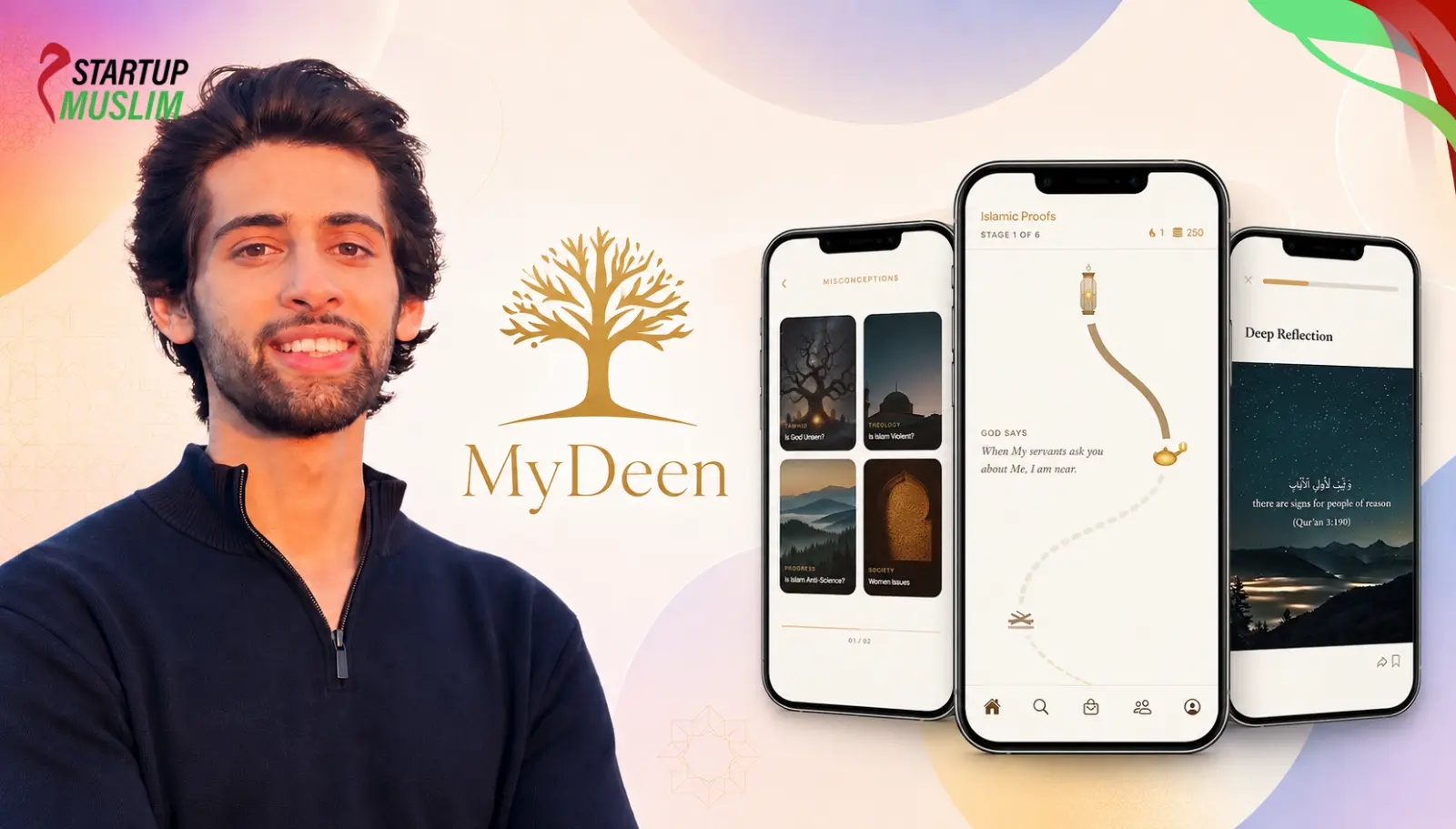
Sami Sabeeh spent eight years watching busy Muslims abandon every lecture and book he recommended. So the former software engineer built MyDeen — a three-minute-lesson app that is quietly posting engagement figures most consumer education startups never see.
The pattern always looked the same. Someone would approach Sami Sabeeh — a student of Islamic knowledge who had taught in his local community and online for eight years — with a question that actually mattered to them. How do you reconcile evolution with the Islamic account of human origins? He would send them a lecture, a book, a series. Weeks later he would check in. They hadn’t gotten through it.
“Not because they didn’t care,” Sabeeh says. “They cared enough to ask me in the first place. It was just too long, or too complex in its explanation.”
The people asking weren’t lazy. They were busy — and they were losing a fight for their own attention against platforms engineered by thousands of the world’s best product minds. The resources Sabeeh recommended were engineered by nobody.
That gap is now his company. MyDeen, the app Sabeeh built and launched last September, compresses a structured Islamic curriculum into three-minute lessons — a Duolingo for the deen, complete with winding lesson paths, streaks, and a gold-coin economy. Since launch, the app has grown roughly 5% week over week with no paid marketing and, so far, no public scholar endorsements. On the strength of those numbers, Sabeeh closed a $100,000 pre-seed round — after his first twenty investor meetings all ended in no.
A $2.6 Trillion Market With A Missing Middle
The market MyDeen is chasing is larger than most Western investors register. Muslim consumer spending reached $2.60 trillion in 2024 and is projected to grow to $3.56 trillion by 2029, according to DinarStandard’s State of the Global Islamic Economy Report 2025/26, with the media and recreation segment alone worth $276 billion in 2024.
Muslim consumer software has already produced one genuine giant. Muslim Pro, the Singapore-built prayer times and Quran app, has surpassed 190 million downloads worldwide — evidence that products serving Muslims can reach a scale most consumer apps only pitch in decks.
But Muslim Pro is a utility. Sabeeh sorts the existing landscape into three categories: utilities like prayer apps and qibla finders, which serve a real purpose but aren’t trying to educate; serious institutional education, which he calls the best of what exists but which demands hours most people won’t give; and quick-learning apps, which solve the time problem while ducking the hard questions.
“They’ll teach the five pillars, or how to make wudu,” he says of the third category. “Meanwhile a nineteen-year-old is wondering whether Islam is even true, and getting hit with questions on LGBT, Islam and science, sectarianism, and politics.”
That nineteen-year-old is MyDeen’s user: the Muslim who already believes, wants to practice, and never had a structured way in. One of the app’s flagship courses is simply titled Islamic Proofs. The curriculum runs at the questions other apps avoid — and at non-Muslims exploring the religion. Sabeeh says seven people have accepted Islam after going through the app’s content.
Duolingo’s Playbook — And A Much Older One
The commercial logic behind bite-size learning is no longer speculative. Duolingo reported 56.5 million daily active users in Q1 2026 and crossed $1 billion in annual revenue for the first time in 2025, and has begun expanding beyond languages into math, music, and chess. What no one has built is the equivalent for religious literacy — for a global Muslim population of roughly two billion.
Sabeeh’s insight was that Duolingo, Calm, Khan Academy, and Canva never invented new categories. They took things that already existed and stripped out the difficulty. He also argues the method has deeper roots than Silicon Valley: Imam Nawawi distilled thousands of narrations into forty for beginners; Imam Ghazali organized the overwhelming knowledge of his era around what hearts actually needed. “Every one of them took existing knowledge and made it shorter, clearer, and better organized, without changing a word of what was true,” he says.
Inside the app, that philosophy is visible in details. Lessons unfold along a candlelit path in muted golds rather than Duolingo’s neon greens, punctuated by Quranic verses. The gold coins earned from learning can be spent in a shop stocked not with power-ups but with causes — gifting a Quran, feeding the hungry, clean water projects — alongside a streak pass and a small garden that grows with the learner.
Sabeeh built the first version himself. A computer science graduate and former software engineer, he leaned on AI coding tools like Claude Code and Cursor, which he says compressed weeks of work into days, while a close friend — Shaheer, a software engineer at Instagram — designed the system architecture that has let the app absorb growth without breaking.
But there is one place AI is not allowed to touch. Every lesson is written and reviewed by students of knowledge and scholars. “We use AI heavily to write code. But we don’t use AI to write the content and lessons on the app,” Sabeeh says. “Software errors you can patch. But the religion is a sacred trust, and so errors should be avoided to the best of our ability.”
The Number That Changed The Room
The early months were unglamorous. “Before you have any big traction or any scholarly backing, people are kind to your face, but then they forget to open the app,” Sabeeh says. Getting the first two hundred users was among the hardest things he has done.
Then the retention data started compounding. At the time of the raise, about 20% of MyDeen’s total user base was active weekly — a figure Sabeeh contrasts with the 4–5% he sees in mature education apps. The growth and engagement figures are the company’s own and have not been independently verified, but they explain a fundraise that flipped from twenty consecutive rejections to a closed round.
“I don’t hold that against them,” he says of the investors who passed. “Islamic consumer apps don’t have a strong track record on revenue, so the honest position is to wait and see more traction.”
The company he raised for barely resembles a company at all. Eight volunteers — most of whom reached out to him — built MyDeen alongside Sabeeh, screened by the simplest filter available: he gave everyone real work and kept the people who delivered. Because the volunteers committed to staying through the next round, a raise he originally scoped at $250,000 to $500,000 closed at $100,000.
Just as telling is what he refuses to build. Users keep requesting advanced lessons. The answer is no. “Advanced students are already well served by the institutions, and if we start building for them we stop being the thing we exist to be.”
The Ghazali Standard
MyDeen remains unmistakably early. It is pre-revenue in a category investors distrust for exactly that reason, dependent on volunteer labor it is only now converting into paid roles, and its first version shipped with flaws users named bluntly — outdated UI, no onboarding, weak gamification. Sabeeh turned every critique into roadmap, but the honest read is that the thesis is still being tested.
The next test has a number on it: 100,000 users by the end of this year with retention intact. Sabeeh says investment firms and angels have told him that milestone would unlock a $1 million next round. Several well-known American scholars are supporting the app and plan to promote it publicly in the coming months — endorsements he deliberately withheld until organic growth proved the product could stand on its own.
Asked where this ends, Sabeeh reaches past Silicon Valley entirely. “The honest answer is that I want MyDeen to do for this generation what Imam Ghazali’s Ihya Uloomuddin did for his,” he says — then translates the ambition into terms any investor can parse.
“I want MyDeen to be to Islamic education what Duolingo is to language learning. The default place a Muslim goes to actually learn their deen.”


