





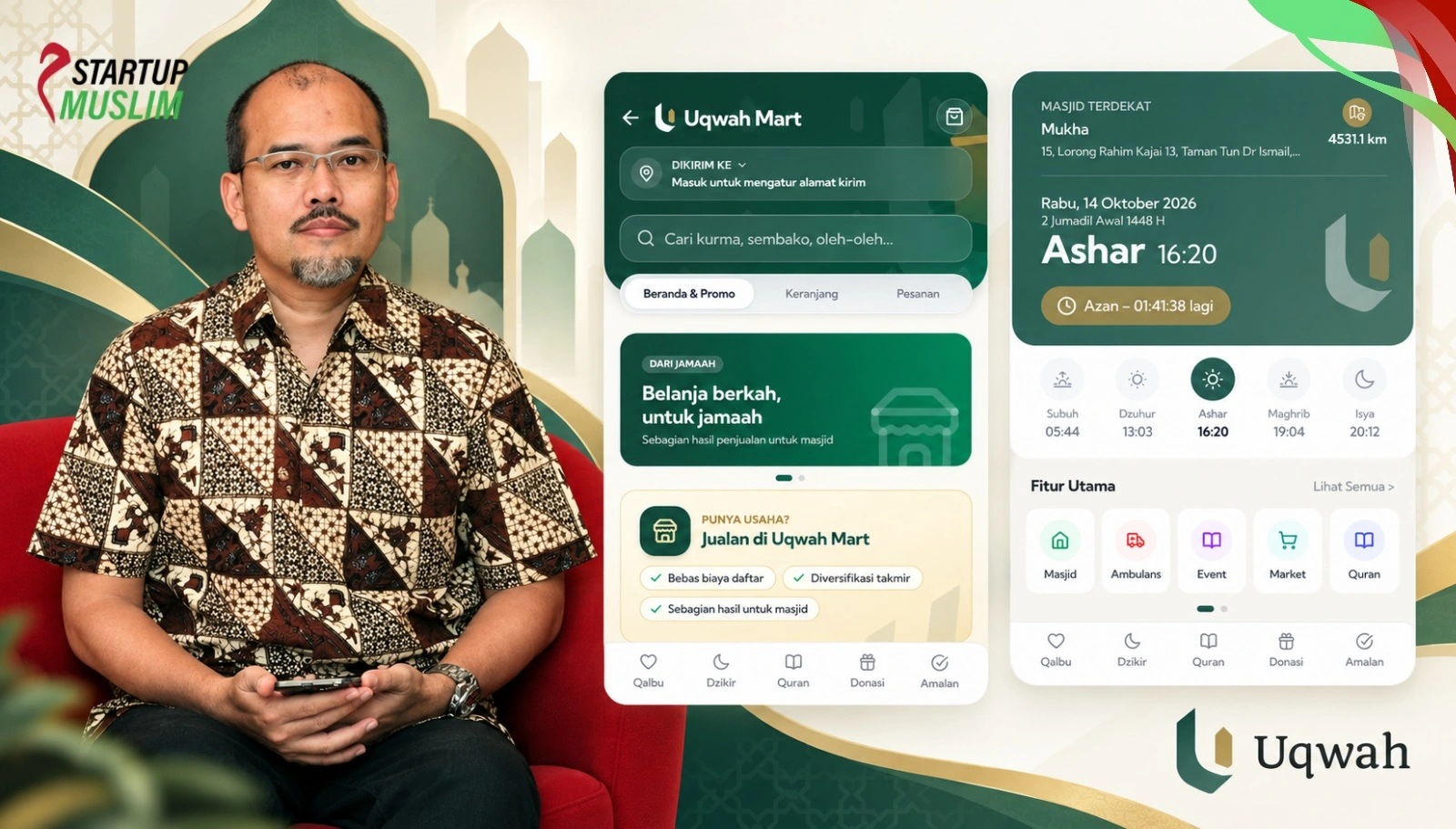
After three decades building technology businesses, the UQWAH founder is working to connect mosques, entrepreneurs and local communities through a shared digital platform.
For Rizanoel Irvin Latif, the next big opportunity in technology may not be another consumer application or enterprise software platform. It may lie in one of Indonesia’s oldest and most trusted community institutions: the mosque. Having spent more than three decades working across information technology, airport systems, digital media and online platforms, Latif has seen how technology can reshape the way people communicate and conduct business. Through UQWAH, his latest venture, he wants to apply that experience to a different challenge: helping mosques become more connected, financially sustainable and capable of supporting the communities around them.
The ambition extends beyond digitizing mosque operations. Latif envisions a network connecting congregations, local businesses, charitable organizations and aspiring entrepreneurs, allowing economic activity and community services to reinforce one another. The opportunity is significant, but so is the challenge of converting that vision into a business people consistently use and are willing to support financially.
From Engineering and Airport Technology to Community Infrastructure
Latif’s entrepreneurial journey began with electronic engineering and information technology. In 1993, he was involved with Indotronix, a Microsoft Solutions Provider, before working through Infocipta on flight information display systems used in airports. He later founded Airporteve, an airport television media network, and Aeroticket, a business-to-business online ticketing platform.
His work also included PocketMuslim, a Muslim-oriented digital application dating back to 2004. Across these ventures, he developed an understanding that technology succeeds not simply because it functions, but because it fits into the way people and organizations actually operate.
That lesson became particularly relevant through his involvement with mosque and community organizations. Latif saw institutions that already possessed something many technology companies struggle to build: established relationships, local presence and the trust of the people they serve. He began to consider how digital tools could strengthen those existing relationships rather than attempt to replace them.
For Latif, the opportunity was to connect technology with trust that already existed.
The Problem UQWAH Wants to Solve Is Fragmentation
Many mosques manage communication, fundraising, events and community services through separate channels, often relying on volunteers and limited resources. Local businesses, meanwhile, need customers, while congregations have everyday needs that extend beyond religious activities. Although these groups are connected through the mosque, their interactions are not always organized into a functioning economic or service network.
Latif identified three priorities: making mosque operations and communication more effective, creating additional ways to finance mosque activities, and connecting local businesses with the communities around them. UQWAH was designed to bring these functions together through a shared digital platform.
Its services span mosque discovery, community events, Quran resources, ambulance and social assistance initiatives, and a marketplace called UQWAHmart. UQWAH TV supports communication through prayer information, announcements, activities and financial reports, while fundraising and asset-monetization features are intended to help participating mosques mobilize resources.
Yet Latif recognizes that putting multiple features into one platform does not automatically create an ecosystem. Mosque administrators need practical reasons to adopt the service, congregations need reasons to return, and businesses need evidence that participation can generate commercial value. For UQWAH, the priority is not simply expanding its feature set, but establishing which services solve real problems and earn regular use.
A Marketplace Designed to Make Commerce Benefit Mosques
UQWAHmart is built around a straightforward proposition: commercial activity within a mosque community should create value for more than one participant. Local businesses can offer products to the community, while an agreed portion of the sales margin can support a participating mosque. UQWAH, in turn, aims to earn revenue for operating the platform.
The distinction between sales revenue and sales margin matters. The amount available to share depends on the commercial arrangement, and the business must retain enough incentive to participate. For the model to work, mosques need to receive meaningful benefits, businesses need viable economics, and UQWAH must cover its operating expenses.
The company has also generated revenue through UQWAH TV, initially from set-top box sales and subsequently through subscriptions for participating mosques. Transaction fees provide another potential revenue stream, while marketplace activity and related services represent opportunities still being developed.
Latif is candid about the difficulty of building a sustainable business around a social mission. Product development, technology infrastructure, customer support and field operations all require funding, and community goodwill cannot substitute indefinitely for revenue. UQWAH must demonstrate that its services create enough recurring value to support the business without compromising its purpose.




446 Mosques Connected, but the Next Test Is Engagement
As of October 2026, UQWAH reported 446 connected mosques, 2,918 onboarded users, three business-to-consumer sellers and 30 consumer-to-consumer sellers. These figures indicate that the company has begun building a network, although its commercial ecosystem remains at an early stage.
Latif is careful not to equate registrations with business performance. An onboarded user may not be active, and a registered seller may not generate repeat orders. He also declined to provide precise transaction-volume and revenue figures without reconciled reporting, emphasizing the importance of presenting financial information that does not mix historical activity, registrations and recurring revenue.
Instead, he wants to track active mosque usage, user engagement, repeat commercial transactions, seller contribution margins and the income or cost savings generated for participating mosques. Another critical measure is whether recurring revenue can eventually cover operating costs and finance continued product development.
This approach reflects a broader challenge for platforms built around community institutions: network growth matters, but it is only the beginning. The more consequential question is whether participation produces measurable benefits that encourage people and organizations to keep using the service.
Entrepreneurship as a Community-Level Economic Opportunity
UQWAH’s ambitions also extend into entrepreneurship. Through a partnership with Gaido Group supporting Indonesia’s Sharia entrepreneurship movement, the initiative has articulated an ambition to contribute to 25,000 new entrepreneurs in its first year. Latif stresses that the target must be defined carefully rather than treated as an outcome already achieved.
Reaching 25,000 people with entrepreneurship education is different from registering 25,000 aspiring entrepreneurs, and both are different from helping 25,000 people establish sustainable businesses. The practical task is to connect interested participants with relevant training, suppliers, customers and business support, using mosque networks and digital tools to make those connections easier.
Latif believes participating mosques could help identify aspiring entrepreneurs and connect them with local markets. Partnerships could contribute networks and expertise, but the initiative will also need clear responsibilities, sufficient resources and a credible implementation plan.
Success, he argues, should be measured through outcomes: how many participants launch businesses, make their first sales, retain customers, continue trading after six or twelve months, and generate income. The 25,000 figure remains an ambition whose credibility will depend on the results the program can demonstrate.
Building a Business Without Losing the Mission
For Latif, commercial sustainability and community impact are not competing objectives. A platform that depends entirely on donations or temporary funding may struggle to support mosques over the long term, while a business focused exclusively on maximizing commercial returns risks losing the purpose that distinguishes it.
That balance must be built into the operating model. Mosques should receive genuine value for the fees they pay, sellers should have a reasonable opportunity to earn profits, and community services should operate with clear processes and transparent financial arrangements. UQWAH must also generate enough income to maintain its technology and improve its services.
His experience in engineering and technology businesses has taught him to test solutions in real operating environments rather than rely on presentations or ambitious product roadmaps. His community involvement has reinforced another lesson: mosque administrators are often volunteers with limited time and budgets, and trust can matter more than an impressive list of features. Training, relationships and ongoing support are therefore as important as the software itself.
Latif’s five-year priority is to establish a repeatable model in Indonesia, with mosques using UQWAH consistently, local businesses generating meaningful activity and participating institutions receiving measurable benefits. Expansion into other countries could follow if that model works, with adaptations for local languages, regulations and community needs.
The ambition is not simply to digitize mosques, but to strengthen their ability to serve the people around them.
UQWAH has not yet demonstrated that its full ecosystem can operate at scale, and Latif does not claim otherwise. Its next chapter will depend on proving that a trusted community institution can become the foundation for useful digital services, viable local commerce and greater economic participation. If the company can establish that connection, its most important achievement may be showing how technology can help existing institutions become more capable, connected and self-reliant.


