


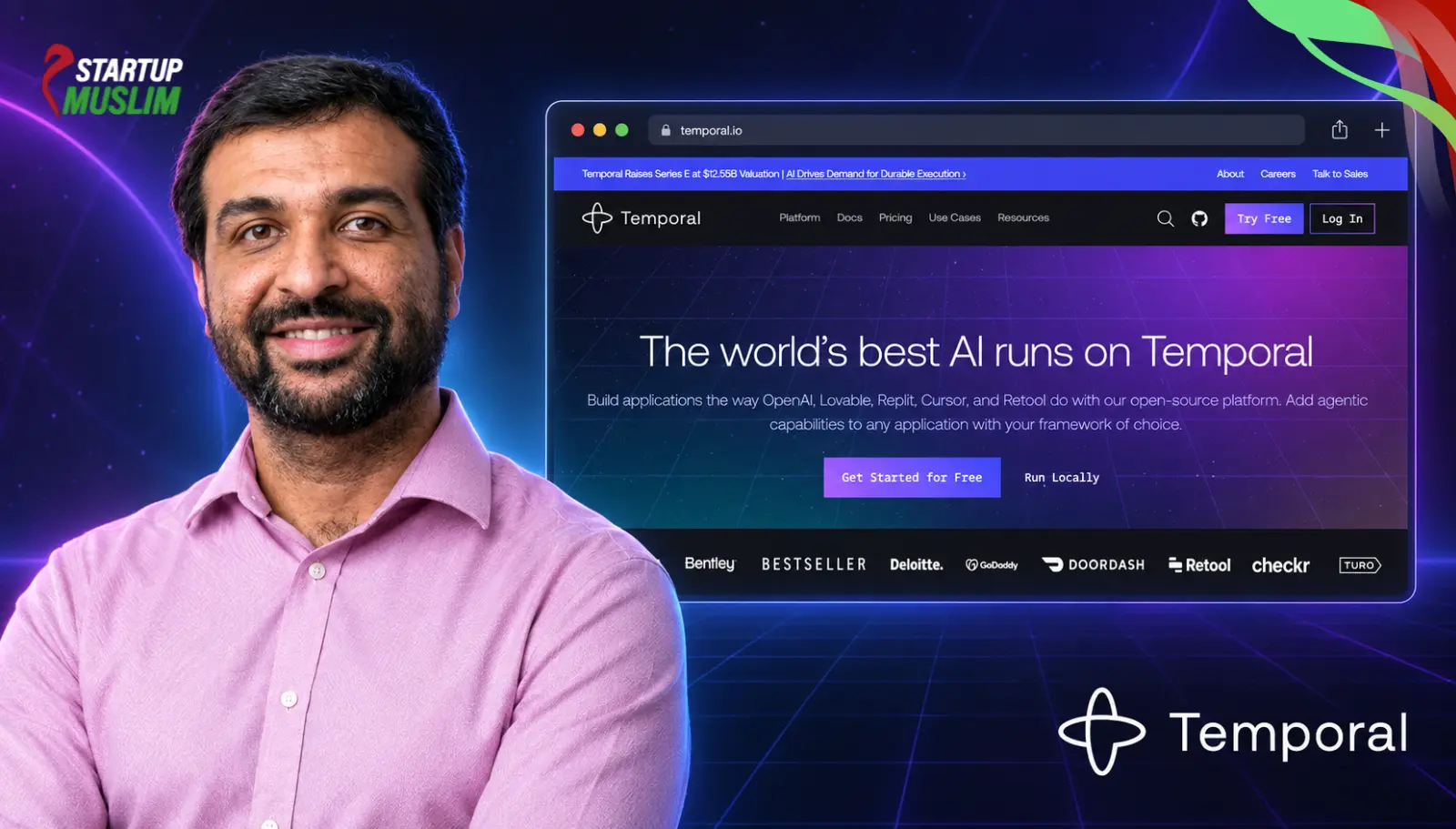
As artificial intelligence moves from generating answers to executing increasingly complex tasks, a new infrastructure problem is emerging: AI systems need to do more than produce a successful demonstration. They need to keep working when networks fail, services go offline, processes take hours or days, and individual steps break somewhere along the way.
Temporal is building its business around that problem. The San Francisco-based open-source platform has raised $550 million in a Series E round at a $12.55 billion valuation, led by Lightspeed, with Wellington Management, Growth Equity at Goldman Sachs Alternatives and Tiger Global serving as co-leads. The round also includes participation from T. Rowe Price and SV Angel, alongside returning investors including Andreessen Horowitz, Sequoia, Index Ventures, GIC, Sapphire Ventures and Amplify.
The financing comes as Temporal’s growth accelerates across both traditional business-critical software and the emerging world of agentic AI.
When AI Moves From Demo to Production
The rise of AI agents is changing the nature of software infrastructure.
A conventional application may execute a relatively predictable sequence of operations. An AI agent, by contrast, can interact with multiple systems, call different tools, make decisions and continue working over extended periods. Every additional step introduces another potential point of failure.
That is where Temporal’s technology comes in. Its open-source platform is designed around Durable Execution, a technology that preserves application state so that work can survive failures and continue rather than forcing the entire process to start again.
“As agents take on more critical work across more systems, every additional step creates another place to fail,” said Samar Abbas, co-founder and CEO of Temporal Technologies. “In production, that work has to survive those failures and finish reliably.”
The company’s thesis is that reliability becomes increasingly important as software takes responsibility for tasks that were previously handled by people or simpler systems.
The Infrastructure Layer Behind Critical Work
Temporal is not an AI model company. It sits further down the technology stack.
Developers can use the platform with their preferred programming language, AI models, tools and infrastructure. The objective is to provide an execution layer that coordinates complex, long-running work while preserving the state required to complete it reliably.
That architecture can apply to a wide range of applications. Temporal says its technology is used for everything from payments and customer operations to long-running AI agents and autonomous-vehicle simulations.
The customer list illustrates the breadth of the opportunity. Companies including OpenAI, NVIDIA, Netflix, JPMorgan Chase, Salesforce, Shopify, DoorDash, Block, Booking.com, Scale AI, Anysphere and Lovable are among the organizations using Temporal.
This puts Temporal in an unusual position within the AI infrastructure market. Its technology can support AI applications, but its potential market extends to critical software systems that existed before the current AI boom.
The Numbers Behind the Expansion
Temporal’s latest financing follows a year of significant growth.
The company says its annualized revenue run rate has surpassed $250 million, representing more than 200% year-over-year growth. Its net dollar retention has remained above 200% since February, indicating that existing customers are significantly expanding their use of the platform.
Temporal Cloud processed more than 1.9 trillion actions in August, an increase of more than 350% year over year. Meanwhile, open-source installations surpassed 43 million in August, up 134% since January 2026.
The company’s paying customer base has also grown beyond 4,300 organizations, including some of the world’s largest technology and financial services companies.
Those metrics point to a business benefiting from two complementary forces: adoption of its open-source technology by developers and expansion of commercial usage through Temporal Cloud.
Why Durable Execution Matters for AI Agents
The emergence of agentic AI makes the underlying infrastructure problem particularly visible.
An AI agent might need to research information, call an external API, update a database, wait for a human approval, execute a payment and then continue with another task. If one component fails halfway through that process, a system needs to know what has already happened and what still needs to happen.
Temporal’s Durable Execution technology is designed around that challenge.
Instead of treating a complex workflow as a single fragile process, Temporal preserves the state of the work so that it can resume after failures. That becomes particularly relevant for AI agents because their workflows can be longer, more dynamic and more dependent on external systems than many traditional software processes.
Lightspeed Partner Anoushka Vaswani described the broader challenge facing AI developers as the gap between demonstrating what AI can do and operating it reliably in production. Her argument is that teams need infrastructure that can work with the systems they already use rather than forcing them into a proprietary technology stack.
That open and pluggable approach is central to Temporal’s positioning.
Open Source as a Growth Engine
One of Temporal’s differentiators is its open-source foundation.
Developers can run Temporal themselves or use Temporal Cloud as a managed service. That model allows teams to experiment with the technology and build applications before potentially expanding into commercial infrastructure.
The company’s open-source installations surpassed 43 million in August, suggesting that developer adoption is becoming an important part of the company’s ecosystem.
The commercial opportunity comes when organizations require managed infrastructure, enterprise capabilities and the operational support associated with running critical workloads at scale.
The model resembles a broader pattern in modern developer infrastructure: open source creates distribution among engineers, while cloud and enterprise products capture value as those projects become increasingly important to the organizations using them.
A $12.55 Billion Bet on the Execution Layer
The new $550 million round gives Temporal substantial capital to expand at a moment when the software industry is moving toward increasingly autonomous systems.
The company plans to deepen platform research and development, expand developer and enterprise go-to-market operations, and scale the teams and infrastructure required to support global demand.
Its workforce has already doubled over the past year to 570 employees, reflecting the pace at which the company has been expanding.
The investor base is also broadening. Alongside long-term supporters such as a16z, Sequoia, Index, GIC and Sapphire Ventures, the new financing brings in institutional investors including Wellington Management, Goldman Sachs Alternatives’ Growth Equity business and T. Rowe Price.
The valuation places Temporal among the increasingly valuable companies building the infrastructure layer beneath the AI economy.
The Software AI Needs to Keep Working
The central idea behind Temporal is relatively straightforward: increasingly capable software is only useful if it can reliably complete the work it starts.
That may be particularly important as AI moves into payments, customer operations, enterprise workflows and other areas where failure is not simply an inconvenience. An agent that produces an incorrect answer can be corrected; an agent responsible for a multi-step business process needs to know what happened, what failed and how to continue safely.
Temporal is betting that this execution layer will become foundational to that future.
The company’s evolution from an open-source workflow platform into infrastructure supporting thousands of businesses reflects a broader shift in software. As applications become more autonomous and increasingly interconnected, the infrastructure responsible for ensuring that work survives failure may become just as important as the intelligence performing the work.
For Temporal, the opportunity is to become that reliability layer: the infrastructure companies depend on to keep critical work running, from payments to agentic AI.
