





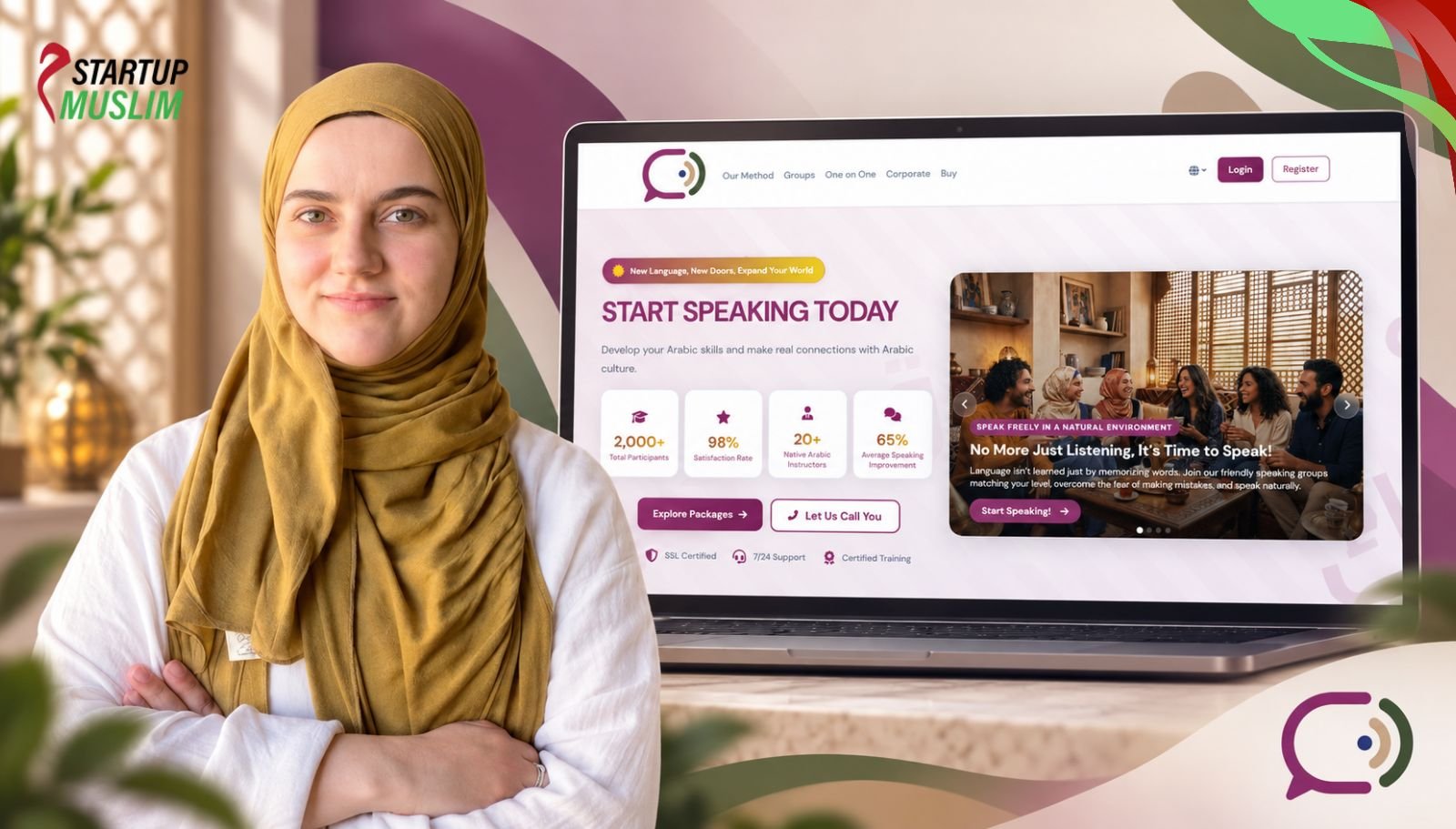
For years, Dilara Sevgili watched people learn Arabic the way many students learn languages: through grammar, vocabulary lists and textbooks. They could understand written passages and explain grammatical rules, yet when it came time to speak, many would hesitate, translate in their heads or simply freeze.
That disconnect became more than an observation. It became the foundation for Arapça Konuşuyoruz, a Turkey-based language education platform built around a simple idea: Arabic should not remain a subject people study. It should become a language they can actually use.
Sevgili’s journey to that insight was shaped by an unusual combination of theology, Islamic history, international experience and entrepreneurship. After graduating from Marmara University’s Faculty of Theology and pursuing a master’s degree in Islamic History, she travelled across Arab countries, studying not only the language but also how it was taught and used in everyday life. What she encountered eventually convinced her that the traditional approach was solving the wrong problem.
The Problem Wasn’t Arabic. It Was the Way People Were Learning It
The deeper Sevgili went into Arabic, the more she noticed a pattern. Students could spend years studying Modern Standard Arabic and mastering grammar, but many struggled to construct even a simple sentence when confronted with a real conversation.
Her international career made that gap even more visible. She worked first in Oman and later in Kuwait, collaborating with Turkish companies and observing how difficult it could be for businesses to find people who could communicate effectively in Arabic in real-world settings. She also discovered something that textbooks often obscure: Arabic is not one uniform conversational experience. Every Arab country has its own dialect, expressions and rhythms, while Modern Standard Arabic remains more suited to formal communication, writing and institutional settings.
When she returned to Turkey, Sevgili looked for a training center that focused specifically on conversational Arabic and regional dialects. She couldn’t find one that addressed the gap she had experienced firsthand. So she decided to build it herself.
From an Empty Market to a New Category
Founding a company was not simply a matter of identifying a market opportunity. Sevgili needed the emotional and financial confidence to take the leap. She credits the encouragement of her family and close friends, particularly one friend whose persistence pushed her to finally start the business. She also used Turkey’s Young Entrepreneur Incentives to establish the company’s initial tax and financial framework.
Then something happened that many founders hope for but few are prepared for: demand arrived almost immediately.
The early surge exposed a different problem. Sevgili was trying to manage a rapidly growing operation largely on her own and quickly realized that building a company required learning to delegate, trust people and assemble a team capable of carrying the vision forward. At the same time, she was introducing a speaking-first philosophy into a language education market accustomed to rote learning and traditional instruction.
The resistance, however, became validation.
As other institutions began adopting conversational approaches, what initially looked like friction started to look like category creation. Sevgili had not simply entered an existing market with another Arabic course. She was challenging the assumptions underlying how Arabic should be taught.
The Psychological Barrier Behind Language Learning
For Sevgili, the biggest obstacle in language education isn’t necessarily a lack of knowledge. It is hesitation. She had repeatedly seen students with extensive vocabularies and strong grammatical knowledge become unable to speak when placed in a real situation. Their minds were busy checking rules, translating sentences and searching for the perfect word. Instead of language becoming instinctive, every sentence became a calculation.
That observation became central to Arapça Konuşuyoruz.
The company’s 3D Reflex Method is designed around continuous exposure three days a week across three dimensions: Foundations, Context and Activation. Students first encounter core structures inside contextual sentences rather than isolated vocabulary lists. They then practise expressions and sentence patterns through role-playing and real-life situations before moving toward spontaneous speaking, where the objective is to transform knowledge into something closer to a reflex. The philosophy is deliberately different from treating Arabic as another academic subject. The goal is not simply to know Arabic. It is to be able to use it.
Building a Business Around Real-World Outcomes
That distinction also shapes how Arapça Konuşuyoruz measures progress.
The platform’s broader community has reached more than 50,000 people across its social media audience, visitors and wider engagement. Nearly 2,000 students have participated in its intensive small-group courses, conversational cohorts, study-abroad programs, events and conferences. For Sevgili, however, the most meaningful indicators are not simply audience size.
Speaking confidence, student feedback, testimonials and especially retention and renewal provide a more tangible signal of whether the methodology is working.
The platform also relies exclusively on native Arabic-speaking instructors who do not depend on Turkish during classes, creating an environment where students have to engage directly with the language. That immersive model reflects Sevgili’s belief that speaking confidence cannot be built entirely through theoretical instruction.
The same philosophy extends into corporate education, where the company moves away from generic language courses and designs curricula around an employee’s actual professional environment. An NGO social worker may need field communication, while a banking professional may need financial terminology and client-facing conversations. The objective is to remove irrelevant theory and give professionals the Arabic they need to perform their jobs.
Arabic Is Not One Market, and Sevgili Treats It That Way
One of the most interesting aspects of Arapça Konuşuyoruz is its approach to Arabic’s enormous linguistic diversity. When a student joins the platform, the first question is not which course they should buy. It is why they want to learn Arabic and what they ultimately want to accomplish. Someone doing business in Saudi Arabia may be directed toward Gulf Arabic, while an academic or media professional may need Modern Standard Arabic or Levantine Arabic.
That distinction turns dialect diversity from a problem into an opportunity. For Sevgili, the Arab world’s linguistic variety is part of the ecosystem’s richness. Her network of instructors from across the region allows students to develop language skills that correspond to different professional, commercial and cultural environments.
Study abroad remains another important part of her philosophy. Sevgili believes living in an Arabic-speaking country provides an intensity of exposure that classrooms cannot fully reproduce. But she also recognizes that such experiences are temporary, which is why the company’s online platform is designed to help students maintain and develop those skills after returning home.
A Young Founder Who Refused to Walk Away
The entrepreneurial journey has not been easy. As a young female founder building an education company without outside capital, Sevgili faced financial uncertainty, conservative resistance and the interpersonal challenges that come with building a team and asserting herself in an established ecosystem. There were moments when she questioned whether she could continue and came close to giving up.
What kept her moving was not a single business metric. It was conviction. She wanted to prove that women could build meaningful businesses in the regional ecosystem, had the support of people close to her and, most importantly, believed deeply in the problem she was solving. That resilience is rooted partly in her own background. Arabic initially felt to her like an abstract academic discipline until studying in Jordan transformed it into something living and dynamic. Her ability to mimic accents, fascination with Arab culture and history, and entrepreneurial family background eventually converged into one company.
What began as a personal discovery became a professional mission.
From Language School to a Bridge Between Worlds
Sevgili does not see Arapça Konuşuyoruz as simply another language-learning company. Her ambition is considerably larger: to transform Arabic from a passive qualification on a résumé into an active capability for young professionals and students. Over the next five to ten years, she wants to build a regional hub that connects Turkey, the Arab world and the global Muslim diaspora through language, technology, education and career opportunities.
That vision changes the meaning of language education. A language can open a conversation, but a conversation can open a relationship. A relationship can open a business opportunity, an academic collaboration, a career or a deeper cultural understanding.
For Sevgili, that is ultimately what Arabic represents: not merely a language to be memorized, but infrastructure for connection. And if Arapça Konuşuyoruz succeeds in turning that belief into a scalable platform, its most important contribution may not be helping people speak Arabic better. It may be helping more people speak to one another at all.


