





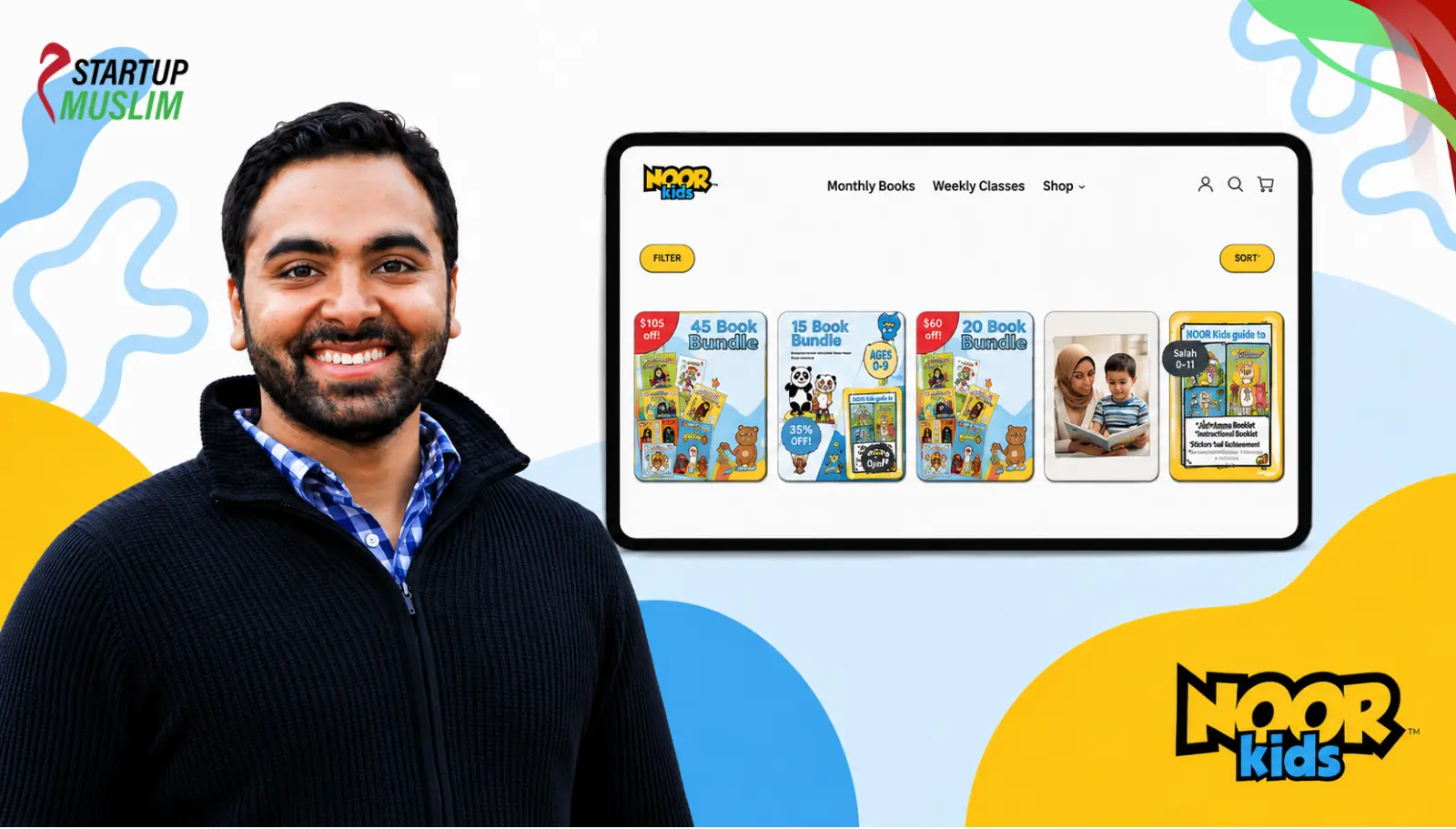
Noor Kids founder Amin Aaser turned a childhood struggle with belonging into a global Islamic education platform. According to the company, its programs served nearly 1.7 million families worldwide in 2024.
By Amina Mirza
Amin Aaser loved baseball. His mother came to his games wearing her hijab, cheering him from the stands. But when it was time to leave, he sometimes asked her to pick him up 15 minutes after the game ended, worried that his classmates might see her.
“I didn’t want to stand out,” Aaser told Startup Muslim. “I just wanted to fit in.”
That moment captured a tension he carried while growing up as the son of Pakistani immigrants in Minnesota: how visibly Muslim was he willing to be in front of the people around him?
Years later, that tension would help shape Noor Kids, the Harvard-supported educational platform Aaser now leads. According to the company, its programs served nearly 1.7 million families worldwide in 2024. But getting there required a corporate career, a devastating personal loss and more than a decade of learning that sincerity is not the same thing as building a good product.
Growing Up Between Two Worlds
Aaser grew up in the familiar in-between of second-generation American life. As he got older, he began asking deeper questions about faith. He did not want Islam to remain something he had simply inherited from his parents; he wanted to understand why he believed what he believed and whether he wanted to build his life around it.
Professionally, he initially followed a conventional path: a business education followed by a corporate career spanning strategy, finance and marketing at companies including 3M, Target and General Mills.
The work became a practical education in understanding customers, developing products, managing teams and turning ideas into sustainable organizations. Those lessons would later become essential to Noor Kids.
The company began underneath that career rather than instead of it. For years, Noor Kids was a nights-and-weekends project without a clear endpoint.
Then Aaser’s mother died at 52.
Her death forced a question he could no longer postpone: What did he want to do with whatever time Allah had given him? Eventually, he left corporate America to build Noor Kids full-time.
“In many ways, Noor Kids is the resource I needed when I was young,” he said. “I wanted Muslim children to grow up feeling comfortable in their own skin, understanding their faith, and knowing that Islam is not something they need to hide.”
Building Noor Kids, the “Sesame Street” for Muslim Children
Aaser remembers childhood Islamic education as something beneficial but rarely enjoyable.
“When I was young, learning about Islam often felt like drinking cough syrup,” he said. “It was good for you. Your parents insisted that you take it. But it wasn’t necessarily something you looked forward to.”
When Noor Kids began, there was no shortage of sincere people producing Islamic resources. But much of that material, Aaser believed, focused on what adults wanted children to know rather than what children genuinely enjoyed.
That distinction became the premise Noor Kids was built to address.
Children are not empty containers waiting for adults to pour information into them. They are curious, emotional and imaginative. They want humor, memorable characters and stories that resemble the lives they are already living.
Aaser’s ambition to build the “Sesame Street” for Muslim kids is therefore not simply about creating more Islamic content. It is about building an entire world that Muslim children choose to enter: one filled with excellent storytelling, recognizable characters, music, humor, learning and community.
“Muslim parents should not have to choose between content that is entertaining and content that reflects their values,” Aaser said. “Our children deserve both.”
Related: Mustafa Khan on Building a 350M-View LinkedIn Ghostwriting Agency
From Harvard Support to a Global Curriculum
The idea took shape in 2011, when the early Noor Kids team pitched the concept to Harvard Business School and was selected for support. The ambition was substantial. The team’s experience producing children’s media was not.
Aaser still remembers sharing an early manuscript with a colleague and receiving blunt feedback: the lesson might be important, but the story was boring.
That criticism reshaped how the team approached its work.
“We realized that fun could not be treated as decoration,” Aaser said. “It had to be part of the educational methodology. If a child is not emotionally engaged, the lesson will not reach their heart.”
Out of that shift came a structured curriculum built around 36 themes spanning Islamic character, beliefs and citizenship. Four recurring characters—Amin, Shireen, Asad and Amira—encounter questions and challenges designed to reflect the everyday lives of Muslim children.
What began with books has since developed into two principal offerings. Through the Character-Building Program, families receive a new children’s graphic novel in the mail each month. The Muslim Treehouse offers weekly live classes to a global community of nearly 10,000 children through what Noor Kids calls a “kid-tested, Shaykh-approved” approach.
The format has expanded into live programs, digital experiences, courses and camps. The mission—partnering with families to raise Muslims who build a better world—has remained consistent.
The Parent Is the Customer. The Child Is the User.
The central business challenge is that Noor Kids must win the confidence of two audiences simultaneously, with no room to sacrifice either one.
“The parent may be the customer, but the child is the user,” Aaser said. “If the parent loves our work and the child does not, we have failed.”
“Children must genuinely enjoy the experience. Parents must trust its religious integrity. Losing either audience breaks the model.”
That means translating serious theological questions—Where is Allah? Why do bad things happen? Why should I pray? What happens when we die?—into language a child can understand without watering down the underlying concepts or using fear as the primary teaching tool.
Aaser is candid that Noor Kids does not try to answer those questions alone. The company works with Islamic scholars, educators, mental-health professionals and creative experts, recognizing the limits of its own expertise while trying to give children thoughtful, age-appropriate answers.
It also means taking children seriously as users. Noor Kids invests heavily in storytelling, humor and design because parental approval alone cannot create a product children love. Aaser says families regularly report that their children wait by the mailbox for new books, reread the stories and refer to Noor Kids characters when facing challenges in their own lives.
For children who may be the only Muslim in their classroom—or even their town—the platform also provides something less tangible but equally important: belonging. They encounter other children who pray as they do, celebrate as they do and wrestle with similar questions.
“Fun gets a child through the door,” Aaser said. “Trust allows the family to stay.”
Faith as an Amanah
Aaser describes running Noor Kids less as ownership and more as an amanah—a trust held on behalf of the children, families and team members connected to the organization.
That framing does not make commercial discipline less important. It raises the standard.
“Good intentions are not enough,” he said. “We have to work with excellence.”
Noor Kids still studies data, measures performance, develops budgets and makes difficult business decisions. But Aaser also asks whether a decision is beneficial, honest and fair—and whether growth is genuinely serving the mission.
“Faith does not replace strategy,” he said. “It disciplines strategy.”
The principle also shapes how he builds his team. Competence matters, but so do humility, curiosity, character and a willingness to receive feedback. When the company reaches the boundaries of its knowledge, it seeks guidance from specialists in theology, education, child development and creative media.
Faith also changes how Aaser handles uncertainty. He believes he is responsible for the quality of his effort, not for controlling every outcome: plan carefully, work hard, consult others, pray for guidance and then place trust in Allah.
Advice for Muslim Founders Building With Purpose
Asked what he would tell Muslim entrepreneurs trying to build mission-driven companies at scale, Aaser’s answer begins with the problem itself.
Do not start with an idea simply because it sounds exciting. Start with a problem the founder has personally experienced, witnessed or deeply understands. That proximity creates empathy and can provide the patience required to continue when building becomes difficult.
Next, listen to the people being served. Sincere intentions do not guarantee that a product is useful. Founders must speak with customers, study their behavior and invite criticism—even when the feedback is painful.
Mission must never become an excuse for weak execution.
“The Ummah deserves our best,” Aaser said. “Your branding should be excellent. Your customer service should be excellent. Your technology, storytelling, operations, and financial management should be excellent.”
“That standard also requires a sustainable business model. An organization that cannot survive cannot hire strong people, improve its product or serve its community over time.”
“Revenue is not the purpose,” he said, “but it is oxygen.”
Finally, founders must protect their intentions. Success can quietly change what an entrepreneur optimizes for, replacing service with attention, recognition or growth for its own sake. Aaser advises founders to return to the mission often, surround themselves with people willing to tell them the truth and ask Allah to place barakah in the work.
Helping Muslim Children Belong Without Hiding
More than a decade after Noor Kids began, its growth points to a need much larger than books or online classes.
Busy Muslim parents are searching for trusted partners. Children are looking for stories that respect their intelligence and reflect their lives. Families in communities with few other Muslims are seeking connection. Meanwhile, global entertainment platforms compete relentlessly for children’s attention.
Noor Kids is attempting to meet all of those needs at once.
Years after worrying that his classmates might see his hijabi mother pick him up, Aaser is building the resource he once needed—one designed to help Muslim children understand that belonging does not require hiding who they are.


