


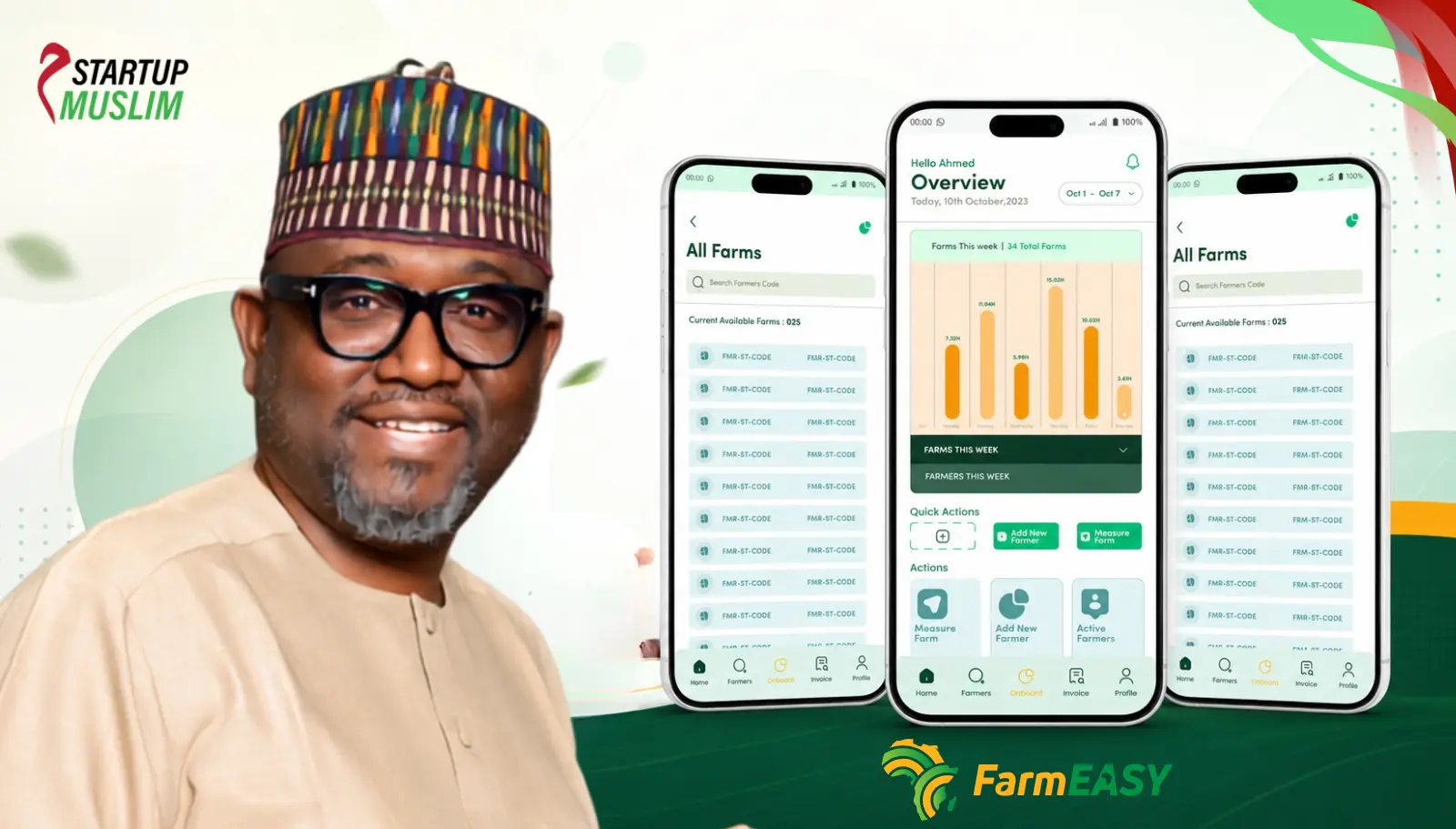
After pioneering Nigeria’s largest online livestock marketplace, the founder of FarmEASY is tackling one of Africa’s biggest challenges—improving the productivity of millions of smallholder farmers through technology, training, and digital transformation.
Africa possesses one of the world’s greatest agricultural advantages. The continent is home to more than 65% of the world’s uncultivated arable land, yet it continues to import over US$100 billion worth of food every year. For many observers, this contradiction reflects the complexity of agriculture across Africa. For Ibrahim Maigari, Founder and CEO of FarmEASY Technologies, it represents one of the continent’s greatest opportunities.
“Africa should be feeding itself,” he says. “And beyond that, Africa should be helping feed the world.”
That conviction has shaped nearly two decades of Ibrahim’s career, one dedicated to applying technology to agriculture—not as an end in itself, but as a practical tool to improve productivity, increase farmer incomes, and strengthen food security across the continent.
From Law to Agricultural Innovation
Unlike many agritech founders, Ibrahim’s journey did not begin on a farm or in an engineering laboratory. He trained as a lawyer and later studied Business Management before spending more than a decade in the corporate sector. Yet entrepreneurship—and the opportunity to solve meaningful problems—proved too compelling to ignore.
“I am a lawyer by training and a serial technology entrepreneur by profession,” he explains. “For nearly two decades, I have worked at the intersection of technology and agriculture, using innovation to address some of Africa’s most pressing development challenges.”
One of his earliest successes was Livestock247.com, Nigeria’s largest online livestock marketplace, which helped digitize an industry that had long relied on traditional trading methods. The experience gave Ibrahim a deeper understanding of the structural challenges facing African agriculture and reinforced his belief that technology could play a transformative role if designed around the realities of farmers.
Those lessons eventually led to the creation of RiceAfrika, which later evolved into FarmEASY—a broader platform with an ambitious mission to improve agricultural productivity across Africa.
Solving the Productivity Problem
For Ibrahim, Africa’s food insecurity is often misunderstood. He argues that the continent does not suffer from a shortage of farmers. Instead, the real challenge is that millions of smallholder farmers—the people who produce more than 80% of Africa’s food—continue to operate with limited access to knowledge, technology, quality inputs, and modern management systems.
“Our research consistently showed that the root cause of food insecurity is not a lack of farmers,” he explains. “It’s the low productivity of the millions of smallholder farmers who feed the continent.”
Rather than treating individual symptoms, FarmEASY focuses on the underlying issues that suppress productivity. These include poor agronomic practices, inadequate access to certified inputs, weak project management, limited agricultural data, and slow adoption of digital technologies. By addressing these interconnected challenges simultaneously, the company aims to help farmers produce more with the resources they already possess.
Building Both People and Technology
FarmEASY’s approach is distinctive because it recognizes that technology alone cannot transform agriculture. The company operates through two complementary pillars: capacity building and digital innovation.
The first focuses on developing human capital. FarmEASY delivers professional training programs covering food security development, climate-smart agriculture, and digital transformation for governments, cooperatives, extension workers, agribusinesses, NGOs, and development agencies. These programs have already been delivered across Nigeria, Tanzania, Rwanda, and Somaliland, equipping agricultural professionals with the knowledge needed to support farmers more effectively.
The second pillar is FarmEASY OS, the company’s agricultural operating system. Designed for organizations managing agricultural projects, the platform enables users to plan, monitor, manage, and optimize farming operations through data-driven decision-making. By combining digital tools with professional training, FarmEASY empowers organizations to improve productivity at scale while helping farmers achieve better yields and stronger livelihoods.
Creating Measurable Impact Across Africa
Since its founding, FarmEASY has steadily built credibility across the African agricultural ecosystem. One of its proudest achievements has been supporting the harvesting of nearly 7,000 hectares of smallholder farmland, while helping prevent approximately 17 million kilograms of grain from post-harvest losses—equivalent to millions of additional meals reaching communities rather than being wasted.
Technology has also generated significant operational efficiencies. The company estimates that its solutions have saved more than 170,000 labor hours, enabling agricultural organizations to operate more effectively while reducing costs. Beyond field-level impact, FarmEASY has earned international recognition for its innovation, including selection into the World Economic Forum’s Circular Accelerator Programme, the Technology for Humanity Award at LEAP 2023 in Saudi Arabia, and the Driving Growth in Agriculture through Technology Award at the Nigerian Innovation Summit.
“Alhamdulillah,” Ibrahim reflects, “these milestones continue to inspire us. But we believe they are only the beginning of what is possible.”
Technology Must Fit the Farmer—Not the Other Way Around
One principle has guided FarmEASY since its inception: technology should adapt to farmers, not expect farmers to adapt to technology.
“Our greatest strength is that we build solutions from the ground up rather than from the top down,” Ibrahim says. “We spend time understanding the realities of smallholder farmers, their cultures, their constraints, and the environments in which they operate.”
That philosophy stands in contrast to many technology companies that design products far removed from the communities they intend to serve. FarmEASY instead prioritizes local context, recognizing that successful innovation requires understanding people before building software. As Ibrahim likes to remind his team, quoting the famous management principle, “Culture eats strategy for breakfast.”
He also emphasizes that farmers are not interested in technology for its own sake. They care about practical outcomes: producing more food, earning higher incomes, and becoming more resilient to climate and economic shocks. Technology is simply the means to achieve those goals.
The Road Ahead
While FarmEASY has already expanded into several African markets, Ibrahim sees the next phase of growth centered on knowledge sharing. One of the company’s immediate priorities is launching its digital learning platform through FarmEasy.io, making its food security development courses accessible to professionals, governments, development agencies, and agricultural organizations across Africa and the Global South.
The company is also pursuing partnerships with major continental institutions while planning executive masterclasses in key African cities to develop the next generation of agricultural leaders. These initiatives build on the strong demand generated by FarmEASY’s earlier training programs and reflect Ibrahim’s belief that scaling knowledge is just as important as scaling technology.
Feeding Africa—and the World
Access to growth capital remains one of the biggest obstacles facing African agritech startups, Ibrahim admits. Agriculture requires patient investment, yet many investors continue to seek rapid returns that rarely align with agricultural development cycles. Despite these challenges, his long-term vision remains remarkably clear.
“Our vision is simple yet ambitious,” he says. “To help build an Africa that can feed itself and, Insha’Allah, help feed the world.”
For Ibrahim, success is ultimately measured by one outcome: improving farmer productivity. Solve that single challenge, he believes, and many others—including food security, rural incomes, economic resilience, and community prosperity—begin to solve themselves.
In a continent blessed with extraordinary natural resources and entrepreneurial talent, FarmEASY is betting that the future of African agriculture will not be determined by the amount of land available, but by how intelligently that land is cultivated. By combining technology, education, and deep local understanding, Ibrahim Maigari is building more than an agritech company—he is helping lay the foundation for a more food-secure Africa.
Recognition That Extends Beyond Awards
Over the past six years, FarmEASY has quietly evolved from a promising agritech startup into one of Africa’s emerging agricultural innovation platforms. While Ibrahim measures success by the impact on farmers rather than the number of accolades received, international recognition has validated the company’s approach and reinforced its credibility across the agricultural ecosystem.
One of FarmEASY’s most significant milestones came when it was selected into the World Economic Forum’s Circular Accelerator Programme, placing the company among a select group of startups developing solutions to global sustainability challenges. The company also received the Technology for Humanity Award at the LEAP Global Tech Conference 2023 in Riyadh, Saudi Arabia, recognizing its contribution to solving food security through innovation. In the same year, FarmEASY was honored with the Driving Growth in Agriculture through Technology Award at the Nigerian Innovation Summit, further cementing its reputation as one of Africa’s leading agritech innovators.
For Ibrahim, however, awards are meaningful only because they reflect real-world impact. “While these milestones are significant,” he says, “we believe they are only the beginning of what is possible.” The true measure of success, he believes, lies not in trophies but in helping farmers harvest more food, reduce waste, and build more resilient livelihoods.
Scaling Impact Across the Continent
The numbers behind FarmEASY’s work illustrate the scale of that impact. Through its technology platforms and agricultural programmes, the company has supported the harvesting of nearly 7,000 hectares of smallholder farmland across multiple African countries. More importantly, it has helped prevent approximately 17 million kilograms of grain from being lost after harvest—food that would otherwise never reach markets or consumers. For a continent where post-harvest losses remain one of the largest contributors to food insecurity, those gains represent millions of additional meals and significant improvements in farmer incomes.
Technology has also transformed operational efficiency. FarmEASY estimates that its digital solutions have saved more than 170,000 labour hours, enabling governments, NGOs, cooperatives, and agribusinesses to manage agricultural projects more effectively. Better planning, stronger monitoring, and improved access to field data allow organizations to support farmers at scale while reducing operational costs and improving decision-making.
These results reinforce Ibrahim’s belief that improving agricultural productivity is not simply about introducing new technologies. It is about building systems that enable farmers, extension workers, and agricultural institutions to make better decisions every day.
Building Technology Around Farmers, Not the Other Way Around
One of the biggest mistakes Ibrahim sees across the technology industry is designing products far removed from the realities of the people expected to use them. Too often, solutions are conceived in urban offices and later introduced into rural communities with the expectation that farmers will simply adapt. FarmEASY deliberately follows the opposite philosophy.
“Our greatest strength is that we build solutions from the ground up rather than from the top down,” Ibrahim explains. “We spend time understanding the realities of smallholder farmers, their cultures, their constraints, and the environments in which they operate.”
That philosophy has shaped every aspect of the company’s product development. Rather than chasing sophisticated technologies for their own sake, FarmEASY focuses on practical solutions that solve everyday challenges facing farmers. Whether improving project management, strengthening extension services, or providing digital tools that work in low-connectivity environments, the emphasis remains on usability rather than complexity.
Ibrahim often summarizes this philosophy with a well-known management principle: “Culture eats strategy for breakfast.” In agriculture, he believes understanding people, local traditions, and farming realities is far more valuable than building technically impressive products that fail to gain adoption. Technology should fit the farmer—not require the farmer to change.
Technology as an Enabler, Not the Destination
Despite leading a technology company, Ibrahim is careful not to portray digital innovation as a silver bullet. In his view, technology is valuable only when it helps farmers solve tangible problems.
“Technology is an enabler—it is not the end goal,” he says. “Most smallholder farmers are not interested in adopting technology for its own sake. They simply want practical solutions that help them produce more, earn more, and become more resilient.”
He believes enormous opportunities still exist across African agriculture. Smarter irrigation systems, weather intelligence, soil health management, pest and disease surveillance, mechanization, post-harvest storage, agricultural finance, and digital extension services all remain areas where innovation can dramatically improve productivity. However, the greatest opportunity lies in developing technologies that are affordable, context-specific, and designed around the realities of rural African communities rather than imported assumptions.
For Ibrahim, successful innovation begins with empathy. Only by understanding the daily challenges farmers face can technology create meaningful and lasting change.
The Biggest Challenge: Finding Patient Capital
Despite FarmEASY’s growing impact and international recognition, Ibrahim believes the company’s biggest obstacle is one shared by many African agritech startups: access to patient capital.
“Agriculture is an impact-driven sector that requires long-term investment,” he explains. “Unfortunately, many commercial investors seek quick returns that simply don’t align with agricultural development cycles.”
Unlike software businesses that can scale rapidly with minimal physical infrastructure, agriculture demands time. Farmers work within seasonal cycles, climate conditions, and biological processes that cannot be accelerated. Building trust with rural communities, demonstrating measurable improvements in productivity, and expanding across multiple countries all require investors who understand that meaningful agricultural transformation is a long-term journey rather than a short-term financial play.
For Ibrahim, Africa needs more investors who recognize that supporting agricultural innovation is not merely a philanthropic exercise—it is an investment in food security, economic resilience, rural development, and the continent’s long-term prosperity. As climate change and global supply chain disruptions continue to reshape food systems, technologies that improve agricultural productivity will become increasingly valuable, making patient investment both socially impactful and commercially rewarding.
Democratizing Agricultural Knowledge
While FarmEASY has already trained agricultural professionals across several African countries, Ibrahim believes the next stage of growth lies in making that knowledge accessible to anyone, anywhere.
One of the company’s biggest priorities over the next two years is launching its digital learning platform through FarmEasy.io. The platform will offer specialized courses on food security development, climate-smart agriculture, digital transformation, and agricultural project management, enabling professionals, governments, NGOs, cooperatives, and development practitioners across Africa and the Global South to access world-class training without geographical limitations.
The initiative was inspired by the overwhelming response to FarmEASY’s previous training programs. Participants from Nigeria, Tanzania, Rwanda, Somaliland, and other countries consistently expressed a desire for continued learning beyond classroom sessions. Rather than limiting its impact to physical workshops, FarmEASY is now building a platform capable of reaching thousands of agricultural professionals simultaneously.
Alongside the online academy, the company is actively pursuing partnerships with leading continental institutions while planning executive masterclasses in major African cities. Ibrahim believes strengthening human capacity is every bit as important as developing new technology. Farmers need better support systems, and those support systems begin with better-trained professionals.
A Vision Beyond Technology
When Ibrahim speaks about the future, he rarely starts with software features or product roadmaps. Instead, he talks about Africa.
“Our long-term vision is simple yet ambitious,” he says. “To help build an Africa that can feed itself and, Insha’Allah, help feed the world.”
It is a vision rooted in optimism rather than scarcity. Ibrahim sees a continent blessed with fertile land, abundant water resources, a young and entrepreneurial population, and enormous untapped agricultural potential. In his view, Africa should not be known for importing food—it should be recognized as one of the world’s great food producers.
He also hopes to inspire a new generation of innovators to view agriculture differently. For decades, many young Africans have seen farming as an industry of necessity rather than opportunity. Ibrahim believes technology can fundamentally change that perception by making agriculture smarter, more profitable, and more attractive to entrepreneurs, engineers, and technology professionals.
One Problem Worth Solving
When asked what single challenge he would solve if given the opportunity to help every farmer in Africa, Ibrahim doesn’t hesitate.
“I would solve everything that limits a farmer’s productivity.”
For him, productivity is the foundation upon which every other agricultural challenge rests. When farmers consistently produce more, their incomes rise. Higher incomes improve household welfare, strengthen rural economies, increase food availability, and make communities more resilient to climate shocks and economic uncertainty. Rather than treating the symptoms of food insecurity, Ibrahim believes solving productivity addresses its root cause.
That philosophy has shaped FarmEASY from the very beginning. Every training program, every digital tool, and every partnership ultimately serves one objective: enabling farmers to produce more with the resources they already have.
Building Africa’s Agricultural Future
The story of FarmEASY is ultimately about much more than technology. It is about reimagining what African agriculture can become when innovation is combined with deep local understanding, practical education, and a long-term commitment to solving real problems.
Over nearly two decades, Ibrahim Maigari has consistently demonstrated that meaningful innovation begins by listening to the people it intends to serve. Whether building Nigeria’s largest online livestock marketplace or developing digital operating systems for agricultural organizations, his focus has remained remarkably consistent: empowering farmers rather than replacing them.
As Africa’s population continues to grow and global demand for food rises, the continent’s agricultural future will depend not simply on cultivating more land, but on cultivating it more intelligently. Through FarmEASY, Ibrahim is helping build that future—one where technology strengthens rural communities, knowledge becomes widely accessible, and millions of smallholder farmers are equipped to unlock the extraordinary potential of African agriculture.
If his vision succeeds, FarmEASY will not simply become one of Africa’s leading agritech companies. It will help prove that the continent’s greatest agricultural resource has never been its land alone—it has always been the people who cultivate it.
