


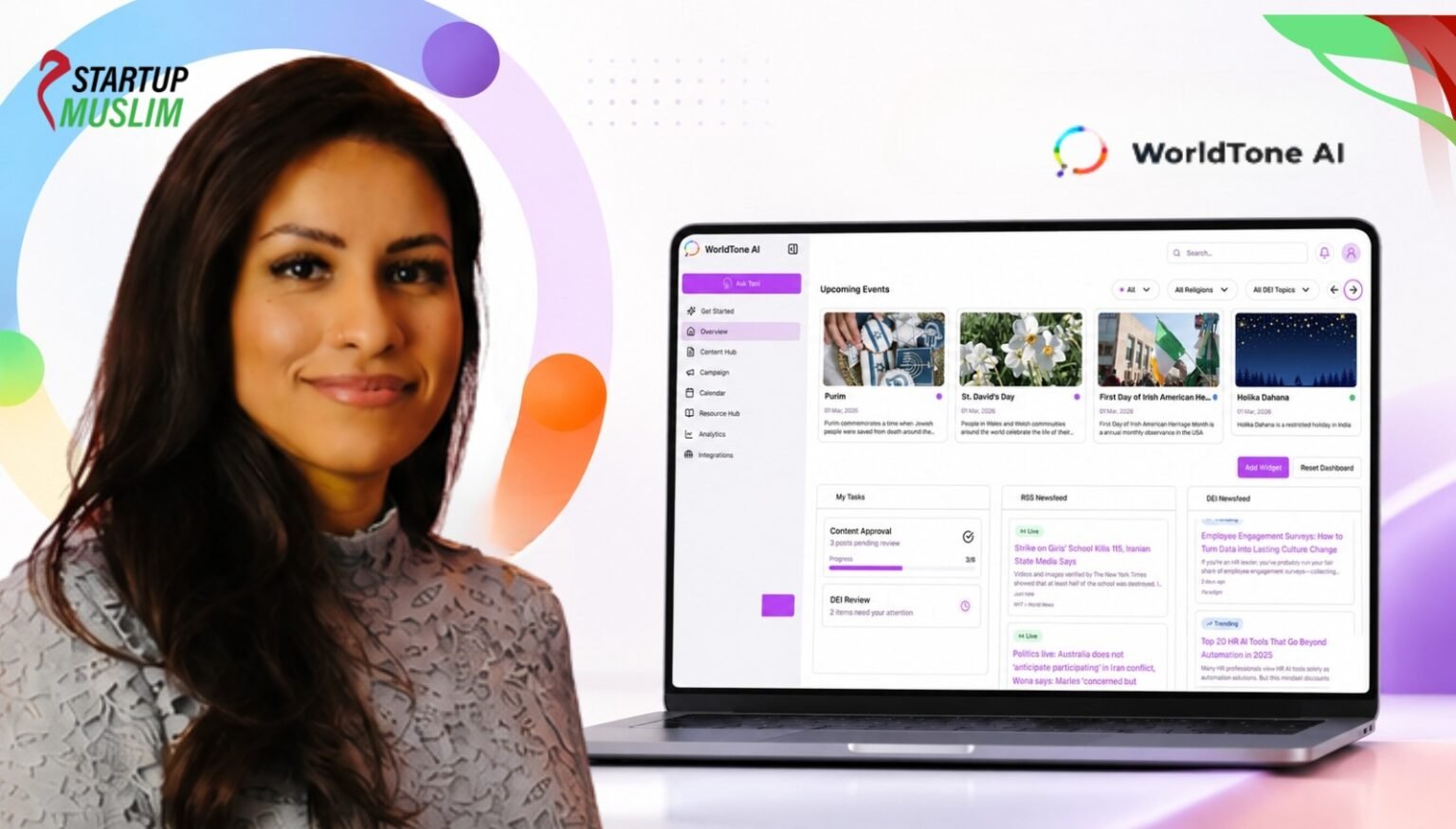
For many entrepreneurs, the inspiration for a startup comes from identifying a market gap. For Heera Rehman, Founder and CEO of WorldTone AI, the inspiration came from something far more personal: years of feeling unseen in the workplace.
After spending more than a decade working in internal communications across global organizations, Rehman experienced firsthand the challenges many employees from underrepresented backgrounds face. Despite consistently delivering results, taking on global responsibilities, and operating at a senior level, she often found herself overlooked for promotions and opportunities. As a Muslim woman working in multinational environments, she became increasingly aware of how workplace cultures often failed to recognize or accommodate the diverse identities of their employees.
The turning point came when she was made redundant during pregnancy. Rather than viewing the setback as the end of a chapter, Rehman saw it as an opportunity to build something she wished had existed throughout her corporate career.
That decision ultimately led to the creation of WorldTone AI, a platform designed to help organizations communicate more inclusively with their employees through the power of artificial intelligence.
From Corporate Communications to Entrepreneurship
Rehman’s professional journey did not begin in technology. She initially started her career in marketing before transitioning into internal communications, a field that immediately resonated with her. Over the years, she worked across industries, regions, and cultures, helping organizations communicate effectively with employees spread across multiple countries.
While the work was rewarding, she repeatedly noticed the same pattern. Workplace communications often failed to reflect the diversity of the workforce they were intended to serve. Important cultural and religious moments were overlooked, while employee engagement strategies frequently adopted a one-size-fits-all approach.
As someone who had personally experienced this disconnect, Rehman understood the consequences. Employees who do not feel represented eventually disengage. Organizations that fail to understand cultural nuance risk alienating the very people they hope to support.
The experience convinced her that workplace inclusion was not merely a human resources issue. It was a communication challenge, a leadership challenge, and ultimately a business challenge.
The Problem Hidden Inside Workplace Communications
Today’s organizations are more diverse than at any point in history. Global companies employ people from different cultures, religions, languages, generations, and backgrounds. Yet many internal communications teams remain overstretched and under-resourced, making it difficult to create messaging that genuinely resonates across such diverse audiences.
According to Rehman, many organizations have good intentions but lack the tools needed to consistently communicate in a culturally intelligent manner.
The result is often generic messaging that fails to acknowledge the unique experiences and identities of employees. Religious observances such as Ramadan and Eid may go unrecognized, while communications created in one market may unintentionally feel disconnected or inappropriate in another.
WorldTone AI was built to solve precisely this challenge. The platform enables organizations to draft communications that incorporate inclusive language, cultural context, regional sensitivities, and organizational tone of voice. Rather than relying solely on artificial intelligence, the system combines AI-generated recommendations with expert oversight, ensuring communications remain both efficient and culturally appropriate.
For Rehman, that balance between technology and human expertise is critical, particularly when dealing with issues related to identity, faith, and belonging.
Why Inclusion Is More Than a Diversity Initiative
Many AI startups focus on productivity, automation, and operational efficiency. WorldTone AI takes a different approach by focusing on inclusion, belonging, and workplace culture.
However, Rehman argues that these issues are far more connected to business performance than many leaders realize. In her view, inclusion is fundamentally a productivity issue. Employees who feel valued, respected, and represented are more engaged, more productive, and more likely to remain with an organization. Conversely, workplaces that fail to foster belonging often experience higher turnover, lower engagement, and difficulty attracting talent.
This challenge becomes even more significant when considering younger generations entering the workforce. Studies consistently show that diversity, equity, and inclusion are important factors influencing where employees choose to work.
For organizations competing for talent in an increasingly global economy, inclusive communication is rapidly becoming a strategic necessity rather than a nice-to-have initiative.
Building an AI Platform with Limited Resources
Like many early-stage founders, Rehman has built WorldTone AI under challenging circumstances. The company remains bootstrapped and is currently in its final pre-launch stage. Over the past eighteen months, she has focused on developing and refining the platform while working closely with experts from internal communications, HR, workplace culture, and diversity and inclusion disciplines.
Today, more than twenty global experts are actively using and evaluating the platform, with several pilot projects already underway. The company expects to move toward a broader commercial launch before the end of the year.
What makes the achievement particularly remarkable is that Rehman has built the company while homeschooling and raising two young children. Much of the work has taken place during early mornings, late evenings, and weekends.
Rather than viewing family responsibilities as obstacles, she has structured her entrepreneurial journey around the priorities that matter most to her.
This approach reflects a growing movement among Muslim entrepreneurs who seek to build successful businesses without compromising their family values or personal commitments.
Overcoming the Challenges of Inclusive AI
Developing an AI platform focused on inclusion presents unique technical challenges. Most large language models are trained primarily on datasets that reflect Western cultural assumptions and communication norms.
For WorldTone AI, this creates a significant hurdle. The platform must be capable of understanding and representing a wide range of cultures, faiths, traditions, and communication styles without reinforcing existing biases.
Addressing this issue requires ongoing refinement, expert validation, and careful product development. Rehman believes this challenge is one of the company’s greatest opportunities. While many AI tools generate content quickly, few are designed to ensure that content genuinely reflects the diversity of modern workplaces.
As organizations become increasingly global, the demand for culturally intelligent communication tools is likely to grow significantly.
The Road Ahead
WorldTone AI operates on a SaaS business model, offering both standard and enterprise packages. While the company is initially focusing on customers in the United Kingdom and Europe, international expansion is already part of the roadmap.
The UAE represents one particularly attractive market. Home to one of the world’s most diverse workforces, the region presents unique communication challenges for employers seeking to engage employees from dozens of different cultural and religious backgrounds.
Rehman also sees significant opportunities in North America and Canada, where organizations continue investing heavily in employee experience and workplace culture initiatives.
Beyond communications, the company plans to expand into broader employee engagement and workplace infrastructure solutions. Future offerings may include inclusive intranet platforms, employee storytelling features, cultural and faith-based recognition programs, and digital workplace experiences designed around belonging.
The vision is ambitious: to create not just an AI communications tool, but a comprehensive platform that helps organizations build workplaces where every employee feels represented.
A Vision Rooted in Purpose
When asked about the legacy she hopes to create, Rehman speaks less about technology and more about people. Her long-term goal is for WorldTone AI to become the global standard for inclusive workplace communication, as recognizable and indispensable as platforms like Zoom or Slack. More importantly, she hopes the company helps create environments where employees feel genuine belonging rather than performative inclusion.
The mission is deeply personal. The very experiences that once made her feel excluded became the foundation for a company dedicated to ensuring others feel seen.
For Rehman, WorldTone AI is more than a startup. It is a response to a problem she lived through, a solution informed by years of professional experience, and a vision for a future where workplace communication reflects the diversity of the people it serves.
In a world increasingly shaped by artificial intelligence, WorldTone AI is betting that the most powerful technology will not simply make communication faster. It will make it more human.
