





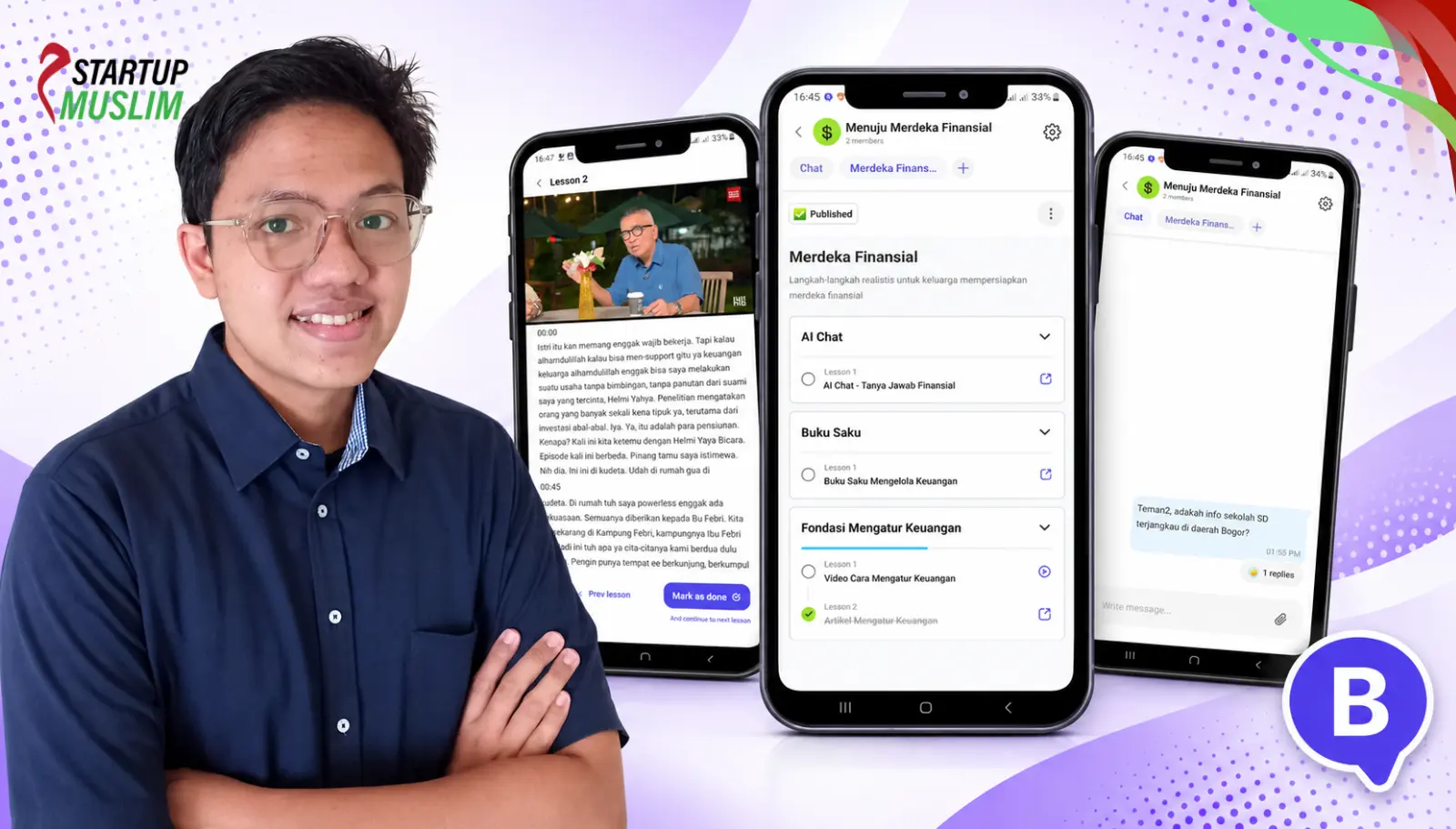
For more than a decade, messaging apps have trained billions of people to communicate in essentially the same way: open a group, send a message, scroll through hundreds of replies, search for something you remember seeing three months ago, and hope nobody missed an important update. WhatsApp made group communication remarkably simple. Telegram expanded what communities could do with larger groups, channels and bots. But as artificial intelligence moves from answering questions to actually performing tasks, Riza Herzego believes messaging needs to evolve again.
Herzego, an Indonesian product leader and entrepreneur, is building Binder, a messaging platform designed not only for people to communicate with one another, but also for AI agents to participate in those conversations. The ambition is bigger than creating another WhatsApp or Telegram alternative. Herzego wants Binder to become a shared digital space where humans and AI agents can communicate, access knowledge, coordinate work and ultimately get things done.
From Flip To Akal: Learning How People Really Use Products
Herzego’s approach to Binder has been shaped by years of building consumer technology. Before becoming a founder, he worked in product management and experienced the rapid growth of Indonesian fintech company Flip, where he watched a small product organisation evolve into multiple teams and squads. The experience taught him that product building is not simply about adding features. It requires understanding users, creating clarity inside a team and deciding what deserves attention when there are more possible improvements than resources to pursue them. One lesson in particular stayed with him: sometimes the most powerful product strategy is having one simple reason for people to care.
For years, Flip’s message was straightforward free interbank transfers. The company could eventually offer many other benefits, but that single proposition gave people a reason to try the product. That thinking followed Herzego into entrepreneurship. He wanted to move beyond owning one piece of a product and instead take responsibility for an entire problem, the team and the outcome. His next venture, Akal, a marketplace for courses and digital products, brought him closer to another problem: communities.
When WhatsApp Becomes the Operating System
Herzego noticed that successful creators often cared deeply about their communities. They built trust, produced content and maintained relationships with their members. But many were trying to run increasingly sophisticated communities entirely through WhatsApp. That works when a community is small. As it grows, however, the limitations become obvious. WhatsApp groups have a member limit, forcing large communities to split into multiple groups, while important conversations, files, knowledge and decisions can become difficult to organise and retrieve.
The problem, Herzego realised, wasn’t that WhatsApp was a bad messaging product. It was that people were asking a messaging app to perform the job of an entire community operating system. Binder starts with a different premise: the group itself should become more intelligent. Instead of simply giving people another place to send messages, Binder is designed to allow communities to bring AI agents directly into their conversations.
The Difference: AI Agents Inside The Conversation
The most important distinction between Binder and traditional messaging platforms is what happens when an AI agent becomes part of a group. A Binder user can connect an AI agent they have already built using tools such as OpenClaw or Hermes. Alternatively, they can configure an agent through Binder’s dashboard. Once connected, the agent can be invited into a group just like another participant. That opens up use cases that are difficult to replicate in an ordinary chat group.
Imagine a university lecturer creating an AI tutor for a class. Students could ask questions directly inside the group, while the agent uses the course materials and other approved resources as context.
An engineering team could invite a coding agent into its project group. A community could create an assistant that answers questions using its own documents, previous discussions and knowledge base. The underlying idea is simple: build an AI agent anywhere, bring it into the community and give it the context it needs to be useful. This is also where Binder takes a fundamentally different approach from conventional messaging platforms.
Why AI In WhatsApp Isn’t Enough
At first glance, someone might ask: why build Binder when AI can already be accessed through messaging apps? Herzego’s answer comes down to control and openness. Platforms such as WhatsApp have rules governing how third-party AI agents can operate through their systems. Developers generally have to work through official APIs and associated commercial constraints. For a company trying to create an open ecosystem where anyone can build and bring their own agents, those limitations can become significant.
Binder is being designed around the assumption that AI agents will become normal participants in digital conversations. But simply putting an AI bot into a group isn’t enough. Too many uncontrolled AI responses could make group conversations even more chaotic than they already are. Binder therefore treats permissions and context as core parts of the product. Administrators can determine what an AI agent can access and what it can do. They can also control which members are allowed to call particular agents. Responses can appear inside threads rather than interrupting the main conversation, allowing an agent to provide detailed information without flooding the entire group. The objective is to make AI useful without making the conversation noisy.
The Early Users Aren’t Who Herzego Expected
Interestingly, Binder’s strongest early response has not come exclusively from AI engineers or technology founders. Small communities, teachers and families have shown some of the strongest interest. For these users, the appeal isn’t necessarily the technical architecture behind AI agents. It is the immediate feeling that their existing conversations can become more useful. A family might have an AI assistant available to help answer questions. A teacher can bring an AI tutor into a learning group. A community can give its members an assistant that understands the group’s own resources. That simplicity matters.
Binder currently has more than 40 communities and over 1,500 users, but Herzego says the company is deliberately focused on learning rather than chasing headline user numbers. The team is studying which workflows make people return and where Binder can create lasting value. The company has also found a natural distribution channel through Akal. Creators using the marketplace can connect their courses and paid communities to Binder, giving them a reason to introduce the platform to audiences they already have.
From Chatting To Getting Things Done
Herzego’s five-year vision goes well beyond replacing WhatsApp or Telegram. He believes messaging itself is due for a fundamental change. Today’s communication platforms often create more work. Notifications accumulate, people repeat information, tasks are coordinated manually and important decisions disappear into endless streams of messages. Slack can be powerful for teams, but it can also become another source of notification fatigue. Binder is attempting to turn that model around.
Instead of conversations ending with someone saying, “I’ll take care of it,” an AI agent could potentially take the next step. Instead of repeatedly answering the same question, a community could have an agent that handles it. Instead of searching through old documents, members could ask the group’s AI to find the relevant information. The long-term vision is a new category of communication where conversation becomes an interface for action.
That could make Binder particularly interesting as AI agents become increasingly capable. The winning messaging platform of the future may not simply be the one that lets people communicate fastest, but the one that can turn those conversations into useful outcomes. Herzego isn’t positioning Binder as merely a better chat app. He is betting that the next generation of messaging will not be human-to-human at all. It will be human-to-human, human-to-AI and AI-to-AI—and the most valuable conversations will be the ones that actually get something done.


