


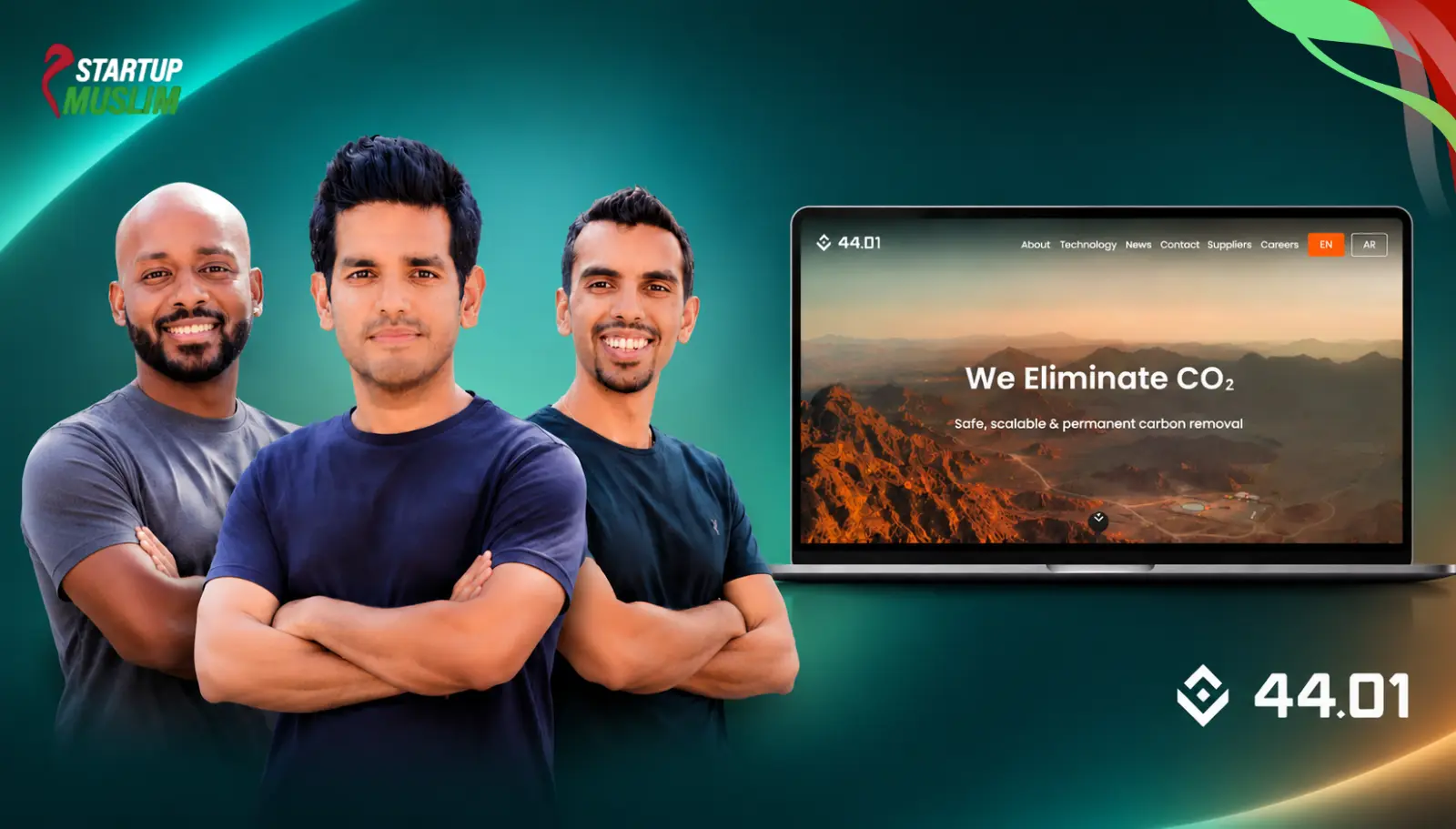
Oman-based climate technology company 44.01 has secured strategic investments from Swiss building materials group Holcim and Japanese energy company JERA as it moves towards scaling its carbon mineralisation technology and expanding into international markets. The investment brings two major industrial players into the company’s investor base, strengthening its position in the growing market for permanent carbon storage.
Founded in Muscat in 2020 by Talal Hasan, Karan Khimji and Ehab Tasfai, 44.01 was built around a different approach to tackling carbon emissions: turning captured carbon dioxide into rock. The company uses naturally occurring geological processes to convert CO₂ into stable minerals underground, offering an alternative to conventional carbon storage methods.
The latest investments build on the company’s earlier fundraising and industrial partnerships. Existing investors, including Air Liquide’s venture capital arm ALIAD and Climate Investment, have also provided additional funding. The investment amounts and equity stakes have not been disclosed.
The Founders Behind Oman’s Carbon Mineralisation Startup
44.01 was established by Talal Hasan, Karan Khimji and Ehab Tasfai, who set out to develop a technology that could use natural geological processes to permanently store carbon dioxide. The company’s name comes from the molecular mass of carbon dioxide, reflecting the problem its founders set out to address.
Oman provided a particularly relevant environment for developing this approach. The country is home to extensive formations of peridotite, an ultramafic rock that naturally reacts with carbon dioxide. The founders saw an opportunity to accelerate this natural process and develop a practical method for storing captured emissions underground.
Rather than simply trapping carbon dioxide in geological reservoirs, 44.01‘s technology aims to convert it into solid carbonate minerals. The process involves mixing captured CO₂ with water and injecting it into suitable underground rock formations, where it reacts with naturally occurring minerals.
The company has since worked to move this concept beyond its initial development stages, testing the technology through pilot projects and building relationships with industrial partners. Its work has attracted attention from investors and companies looking for ways to address emissions from hard-to-abate industries.
Holcim and JERA Join as Strategic Investors
The latest investment brings together two companies with significant positions in industrial and energy markets. Holcim, one of the world’s leading building materials groups, has already been working with 44.01 on a carbon storage pilot at its Fujairah cement plant in the United Arab Emirates.
For Holcim, the investment builds on an existing relationship and its broader efforts to reduce emissions from cement production. Cement manufacturing is a major source of industrial carbon emissions, making technologies that can permanently store captured CO₂ relevant to the sector’s decarbonisation efforts.
JERA, Japan’s largest power generator, is making its first investment in 44.01. The company sees potential applications for the technology in the power sector, where reducing emissions from electricity generation remains a significant challenge.
The participation of both companies provides 44.01 with strategic relationships across two major industrial sectors. Holcim brings experience in building materials and cement production, while JERA offers a connection to the energy industry and potential opportunities in Japan and other international markets.
The investment will support 44.01‘s expansion, the development of commercial-scale projects and continued improvement of its technology as it works to establish carbon mineralisation as a commercially viable storage solution.
How 44.01 Turns Carbon Dioxide into Rock
The company’s approach is based on a natural process known as carbon mineralisation. Certain types of underground rock contain minerals that react with carbon dioxide, gradually converting it into solid carbonate minerals. This process occurs naturally, but 44.01 has developed a method to accelerate it.
The technology involves capturing carbon dioxide, mixing it with water and injecting the mixture into suitable underground formations. Once underground, the CO₂ reacts with the surrounding rock and becomes part of its mineral structure. This means the carbon is stored in solid form rather than remaining as a gas.
The approach differs from conventional geological carbon storage, which generally involves injecting carbon dioxide into underground reservoirs and keeping it trapped in its original form. Mineralisation aims to convert the carbon into a stable mineral structure, providing another pathway for long-term storage.
The technology has potential applications in both industrial carbon capture and carbon removal projects. However, its deployment depends on several factors, including suitable geological formations, access to captured CO₂ and the infrastructure needed to transport and inject it.
Oman’s geology has provided an important foundation for the company’s development, but 44.01 is also exploring opportunities in other markets where similar geological conditions exist.
From Early Pilots to Industrial Applications
44.01 has spent several years developing and testing its technology through projects in Oman and the UAE. Its early pilot work demonstrated that captured carbon dioxide could be injected into suitable rock formations and mineralised underground, helping the company build the technical experience needed for larger applications.
The company gained wider international recognition in 2022 when it won the Earthshot Prize in the Clean Our Air category. The recognition brought greater attention to its approach to permanent carbon storage and its potential applications beyond the Middle East.
In the UAE, 44.01 has moved towards industrial applications through its partnership with Holcim. Since July 2026, the two companies have been operating a pilot under live industrial conditions at Holcim’s Fujairah cement plant.
The project involves capturing carbon dioxide from the cement facility, transporting it to a nearby injection site and storing it underground through mineralisation. It connects industrial carbon capture with geological storage, providing operational experience that could inform future commercial projects.
Testing the technology in an actual industrial environment is an important step for 44.01. Beyond demonstrating that the process works, the companies need to understand its operational requirements, costs and ability to handle larger volumes of captured emissions.
Previous $37 Million Series A and Growing Investor Base
The latest strategic investments build on 44.01‘s earlier fundraising activity. In July 2024, the company closed a $37 million Series A round led by Equinor Ventures and Shorooq Partners, with participation from other investors.
Its investor base includes organisations with interests in energy, industrial technology and climate solutions. These relationships are particularly relevant because deploying carbon mineralisation requires cooperation between carbon emitters, energy producers, infrastructure operators and geological specialists.
The company has also secured a commercial milestone through an agreement with Frontier, a coalition that supports the development of carbon removal markets. In October 2026, Frontier announced an $11.7 million carbon removal purchase agreement with 44.01, covering approximately 21,000 tonnes of carbon removal between 2028 and 2031.
The agreement represents a purchase commitment for future carbon removal rather than an equity investment or another funding round. Nevertheless, it provides an important commercial signal by connecting 44.01‘s technology with buyers willing to support emerging carbon removal solutions.
Together, its previous fundraising, strategic industrial investments and carbon removal purchase agreement reflect a company progressing from technology development towards commercial deployment.
Expanding Beyond Oman into International Markets
44.01 is expanding its work beyond Oman and the UAE, exploring opportunities in Europe and other international markets. The company is targeting locations where suitable rock formations and access to industrial carbon sources could make
