


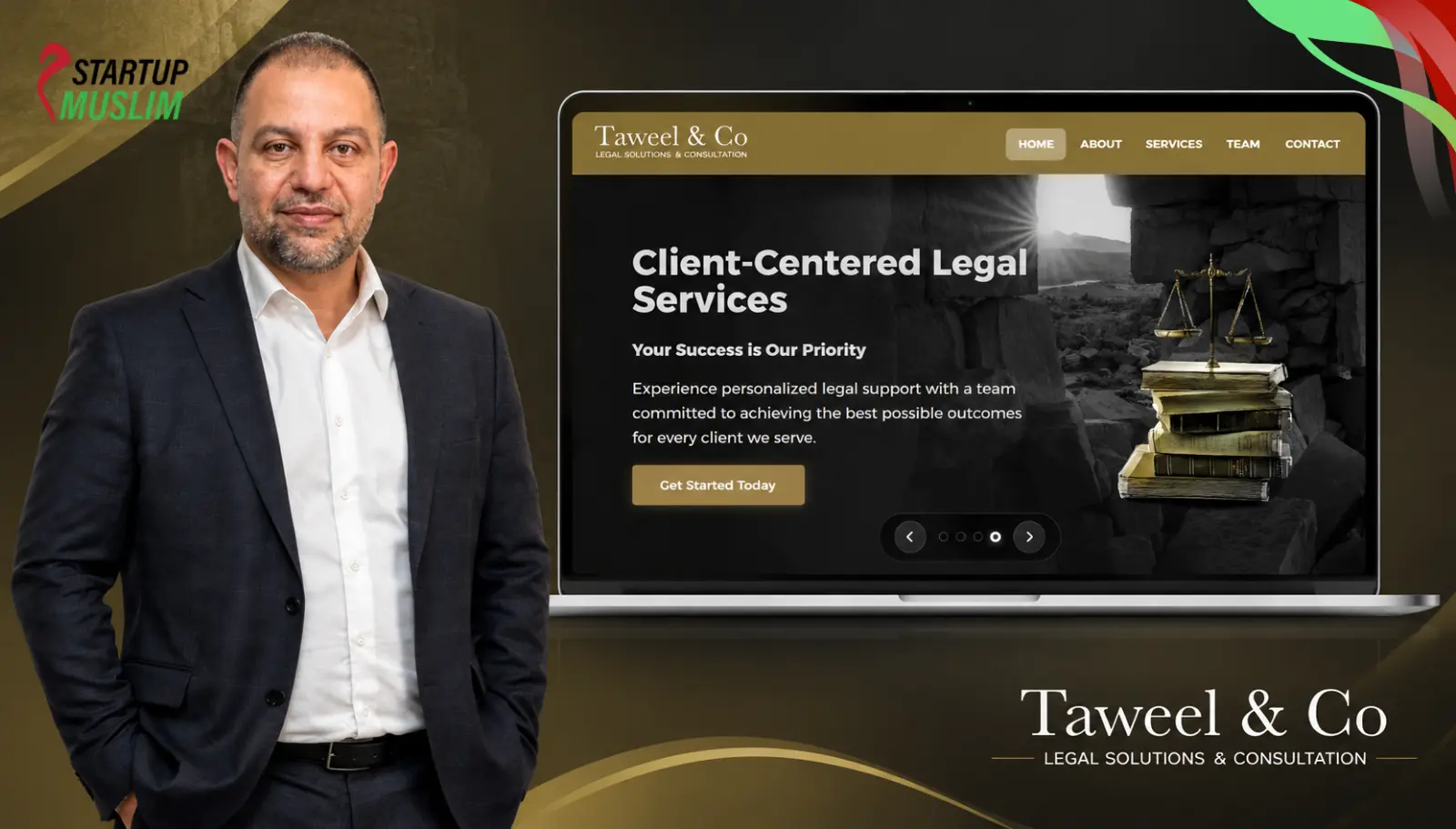
For many startup founders, legal advice becomes a priority only when something goes wrong. A disagreement between co-founders, an investor reviewing company documents, or an intellectual property dispute can suddenly turn legal matters into urgent business challenges.
Jordanian lawyer Omar Taweel believes founders should approach things differently. Legal thinking, in his view, should be part of building a business from the beginning, not something brought in only when a problem appears.
His professional journey has been shaped by an interest in understanding how things work, questioning established practices, and helping people find the confidence to speak. Over the years, this approach has taken him beyond traditional legal practice and into the world of entrepreneurship, technology communities, and startup development.
As a co-founder of Taweel Law, established in 2006 with his sister, Omar has built a legal practice that works with established companies as well as entrepreneurs developing new products, services, and business models. His work has also connected him with startup communities and business activity across several markets.
But his contribution to the startup ecosystem goes beyond advising companies on legal matters. He wants to help develop a generation of lawyers who understand how startups operate and can support founders throughout their business journey.
A Journey Shaped by Family and the Desire to Be Heard
Omar’s interest in law began long before he entered law school. His father had always dreamed of becoming a lawyer and admired the profession for its ability to understand the foundations of complex matters. He often repeated a phrase that stayed with Omar: lawyers “know the roots of everything.”
His older sister also influenced his journey. After initially studying fine arts in Russia, she returned to Jordan and eventually pursued law at the University of Jordan. Today, she is his partner at Taweel Law.
There was also a personal reason behind his decision. Omar describes himself as someone who has always been a good listener. He found it difficult to remain silent when people were afraid to express themselves or worried about being judged.
These experiences shaped his understanding of the legal profession. For him, law was not only about interpreting rules or resolving disputes. It was also about understanding people, identifying the roots of their problems, and helping them find a way forward.
From Legal Practice to Jordan’s Startup Community
Omar’s involvement in entrepreneurship developed through curiosity rather than a planned career transition.
While advising established companies, he became increasingly interested in questioning conventional corporate structures and finding solutions beyond excessive procedures. He also wanted to engage with communities where lawyers had not traditionally played an active role.
That curiosity led him to a growing group of technology enthusiasts and professionals connected through Twitter, now X. The community brought together people from Jordan’s technology scene and the wider international network.
Alongside others, Omar co-founded Amman Tech Tuesdays, an informal gathering where technology professionals could meet, exchange ideas, share experiences, and learn from one another.
It became his introduction to entrepreneurship.
At the time, few lawyers in Jordan were actively involved in the startup ecosystem. Omar began attending technology events, listening to founders and developers, and learning about venture capital, investment, innovation, and business growth.
What started as professional curiosity eventually became a conviction: entrepreneurship could create opportunities for people and communities overlooked by conventional economic structures.
Today, he believes startup lawyers should grow alongside the businesses they advise, rather than appearing only when a legal problem arises.
Building a Law Firm Around Business Understanding
Taweel Law was established in 2006 by Omar and his sister. Their different professional perspectives became an important part of the firm’s foundation.
His sister brought a strong focus on legal fundamentals, while Omar was drawn towards new industries, ideas, and opportunities. Together, they built a practice that combines traditional legal knowledge with an understanding of evolving business needs.
The firm began as a family law practice and gradually developed a wider team, including lawyers who have remained with it since its early years.
Its work now covers corporate and commercial law, contracts, investment transactions, regulatory matters, dispute resolution, and legal support for startups and growing businesses.
The firm’s experience also extends beyond Jordan, with matters and clients connected to the UAE, Saudi Arabia, Egypt, Lebanon, Europe, the United Kingdom, Pakistan, China, and other markets.
Omar’s approach is straightforward: understand the business before advising on the law. He believes legal advice should give companies the confidence to move forward without making business unnecessarily complicated or expensive.
The Legal Mistakes That Can Hold Startups Back
One of Omar’s strongest messages to founders is that building a startup does not mean operating without rules. Starting a company is a serious commitment, and the decisions made in its early stages can have consequences much later.
He encourages founders to think about their legal journey in three stages.
Before registration, founders should put their agreements in writing. Understandings between co-founders, even close friends, should clearly explain responsibilities, ownership, investment terms, and expectations. Intellectual property should also be investigated early to establish what the company owns and what it can legally use.
During registration, founders should choose their jurisdiction based on their business model and future plans, rather than convenience or what other entrepreneurs are doing. The location of customers, opportunities for expansion, and potential investment requirements all matter.
After registration, companies need to maintain proper records, use clear contracts, meet tax obligations, keep registrations in good standing, and develop sound governance practices.
Omar also highlights the importance of corporate documentation when a company seeks investment or considers an acquisition. He estimates, based on his professional judgment, that as much as 60% of a successful exit can depend on the quality of governance, documentation, and corporate history. He clarifies that this is not a statistical formula, but a way of emphasising the importance of these matters.
His advice is to build a company from day one as though someone might eventually want to buy it.
Co-Founder Agreements, Intellectual Property and Investor Readiness
For early-stage founders working with limited budgets, legal support can feel like an expense they cannot afford. Omar approaches this challenge by first looking at what founders can contribute.
He recalls asking founders with little money whether they could barter: he would provide legal advice, and they could offer their product or services in return.
But before discussing legal documents, he wants founders to understand their business. They should have a clear product or service, or a realistic plan to bring one to market. An idea alone is not a business.
He then encourages co-founders to define their individual roles. Who leads the company? Who manages technology, people, finances, and operations? These responsibilities and decision-making powers should be documented before disagreements arise.
A founders’ agreement should also explain ownership, contributions, important decisions, and what happens if someone leaves. Intellectual property developed for the business must be properly assigned or licensed to the company.
When investment becomes possible, founders need to understand the terms they are accepting, including equity, convertible instruments, control rights, and future funding obligations.
For Omar, the principle is simple: before founders agree on how they will share success, they must agree on how they will share responsibility.
Why AI Cannot Replace Legal Judgment
As AI tools become more accessible, founders are increasingly able to generate contracts, research legal terminology, and prepare business documents without immediately consulting a lawyer.
Omar believes these tools should be embraced, but with clear limits.
He encourages founders to use AI to understand unfamiliar concepts, organise information, and prepare better questions before meeting legal professionals. Lawyers, too, can use AI to improve research, drafting, and efficiency.
However, he draws an important distinction between generating a legal document and understanding whether it can withstand a real dispute.
A contract may look professional and contain impressive language, but that does not mean its provisions are appropriate for the business, enforceable in the relevant jurisdiction, or suitable for the situation.
Even lawyers must verify AI-generated information, review every clause, adapt documents to the applicable law, and take responsibility for their advice.
His recommendation is that AI should strengthen professional judgment, not replace it.
Don’t create something you cannot defend.
Building a Stronger Ecosystem Around Startups
Beyond his legal practice, Omar is interested in developing social entrepreneurship in Jordan and exploring more effective ways to resolve disputes between startups and investors.
He believes startup disputes require mechanisms that understand the realities of early-stage businesses. These should be more accessible and agile, while helping preserve business relationships where possible.
His broader ambition is to see a startup ecosystem that includes more than entrepreneurs and investors. Lawyers, accountants, technology professionals, financial advisers, and mentors should all have a role in helping businesses grow.
He also wants to see knowledge passed between generations of professionals. Experienced people can help younger lawyers and advisers develop the skills to support entrepreneurs much earlier in their careers.
For Omar, a successful startup ecosystem should not be measured only by the number of companies it creates. It should also be measured by how many people and professions it brings into the process of building them.
His journey reflects a belief that legal practice can be more than a service businesses turn to when problems arise. It can be an active part of building stronger companies, supporting new ideas, and creating opportunities for the wider community.
