


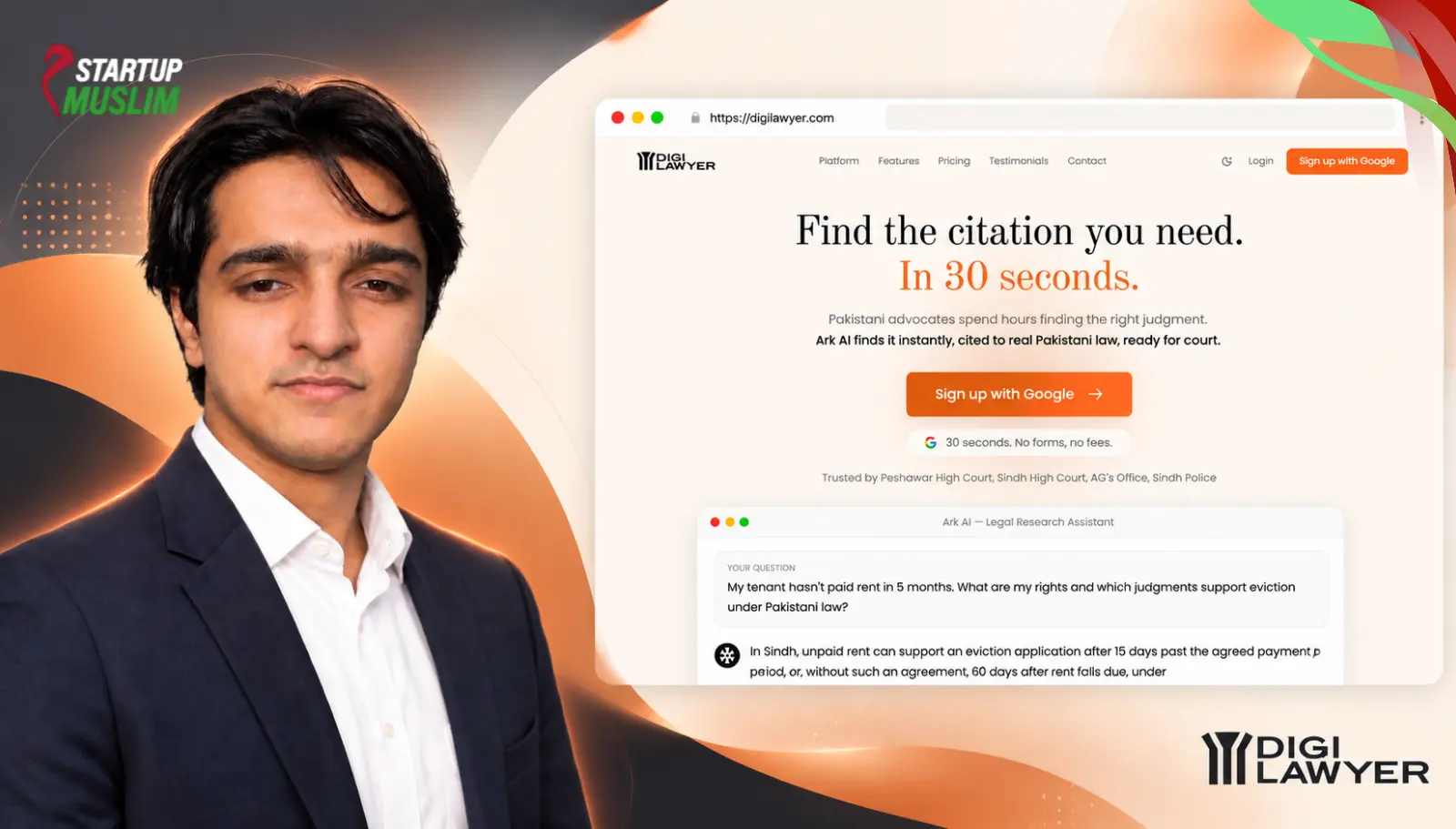
For Muhammad Danish Ghaffar, the idea behind DigiLawyer did not begin in a technology lab or a meeting with investors. It began much closer to home, watching his father spend long hours practising law. For three decades, his father had worked through towering files, lengthy law reports and court judgments, often searching for a single legal precedent that could make a difference to a case. Years later, those familiar scenes would help inspire a startup trying to change how lawyers across Pakistan research the law.
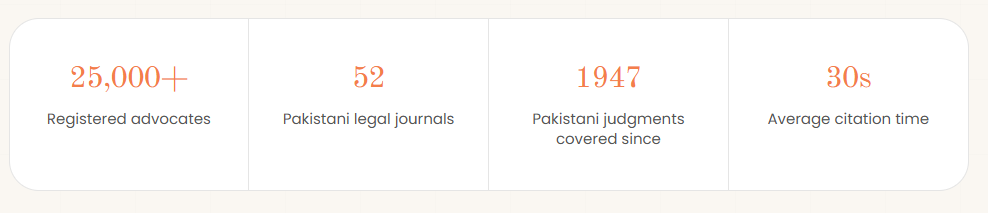
But the story behind these numbers is not simply about introducing artificial intelligence to a traditional profession. It is about understanding a problem that lawyers have faced for years, earning the trust of a cautious market and learning that even useful technology must prove its value before people are willing to pay for it.
From a Family Conversation to a Different Business
Danish was not initially planning to build a legal technology company. While studying computer science at UET Lahore, he and his team were working on an artificial intelligence fashion app that allowed users to try on clothes virtually. When they approached his father for advice on patenting the idea, the conversation took an unexpected turn.
His father asked a question that would change the direction of the business: did they understand what was happening in Pakistan’s legal system?
The question led Danish to meet lawyers and learn about their daily challenges. One lawyer suggested building a case management system, but Danish wanted to understand the problem more deeply before committing his team to a solution. He travelled daily on the Lahore Metro Bus to the University of Engineering and Technology (UET), where he studied, and regularly spoke with lawyers heading to the High Court.
Those conversations revealed that managing cases was not necessarily their most pressing concern. Finding the right judgment was often slow, expensive and frustrating. A lawyer could spend hours searching through reports and court records for a precedent relevant to a single legal question.
Danish decided to put the fashion app aside and focus on legal research. It was a decision based not on a market trend, but on a problem he had seen up close and then confirmed through conversations with the people experiencing it.
Building Credibility in a Profession Built on Trust
Starting a company at 21 brought challenges that went beyond writing software. Danish was a young computer science student asking senior advocates, experienced lawyers and legal professionals to reconsider a process they had followed for years. Convincing them that software could improve their research was not easy.
He learned that arguments about technology were rarely enough. The most effective way to gain trust was to demonstrate the product using a lawyer’s own case and show what it could actually accomplish.
Access to legal information presented another major obstacle. The first prototype contained statutes, but lawyers quickly pointed out that legislation alone was not enough. Understanding how courts interpret the law requires access to judgments, and those records were scattered across court websites and dozens of law reports, often stored in formats that were difficult for software to process.
Danish and his team built their own systems to collect and organise this information. DigiLawyer now covers 52 Pakistani law journals, alongside judgments collected from the country’s superior courts. The work helped establish the legal database that supports the company’s research tools today.
Money was also tight, and his family initially worried about his decision to pursue a startup instead of a more secure career. Winning third place at the Entrepreneurs’ Organization’s Global Student Entrepreneur Awards helped change that situation. Through the competition, Danish met Barrister Ahmed Uzair, who became his mentor and first investor and offered him a desk in his chambers, placing the young founder close to working litigators. At UET, Professor Dr Awais Hassan also encouraged him to focus on solving problems that mattered.
Shark Tank Pakistan Put DigiLawyer on the Map
DigiLawyer’s appearance on Shark Tank Pakistan gave the company something that is often difficult for an early-stage startup to obtain: national visibility. Lawyers who had never heard of the platform became aware of it, while institutions that might previously have been reluctant to meet the team began responding to its calls.
The company also secured investment on the show at a valuation of PKR 70 crore, with Faisal Aftab joining as the lead investor. For Danish, however, the impact extended beyond funding. Having a recognised investor behind the business changed how potential customers and partners viewed a young founder building technology for one of the country’s most established professions.
The attention also raised expectations. DigiLawyer could no longer be treated simply as a promising student project. It had to demonstrate that it could deliver a dependable product, serve real customers and build a sustainable business.
That shift became especially important as the team confronted a difficult commercial question: how could it turn widespread interest in legal research technology into a business that people would actually pay for?
Why a Better Product Was Not Enough
DigiLawyer attracted thousands of lawyers each month, yet relatively few converted into paying customers. The experience challenged an assumption common among technology founders: that if a product is good enough, customers will eventually pay for it.
Danish initially looked at successful legal technology companies in Western markets and assumed Pakistani law firms would purchase enterprise subscriptions. The team invested time and money in developing features, pricing plans and a sales approach around that expectation. When it approached firms directly, however, it discovered that many local practices were small or mid-sized businesses without the structure or budgets to buy enterprise AI.
The company had built its commercial strategy around a customer that was much harder to reach than expected.
DigiLawyer responded by shifting its attention towards individual lawyers, a larger and more accessible market. It replaced fixed, enterprise-style pricing with individual plans, introduced a free tier and adopted a credit system that charges users according to the depth of research they need. A lawyer conducting a quick search could use fewer credits than someone seeking a detailed research memo.
The team also sharpened its message around a clear promise: finding a judgment in 30 seconds. Campaigns ran across Lahore, Islamabad and Karachi, while the company rebuilt the platform around its artificial intelligence capabilities. Conversion is now a central measure of the team’s performance, and the business reports operating at breakeven, with spending tracking revenue.
Inside Ark AI and the Push for Reliable Legal Research
Traditional legal research tools can help lawyers locate documents, but finding a result is only the beginning. Lawyers must still read judgments, identify the relevant passages and determine whether later decisions have followed, distinguished or overturned an earlier ruling.
DigiLawyer’s second version places AI at the centre of this process through Ark, its legal research assistant. Users can ask questions in plain language, and Ark identifies relevant judgments, explains their findings and provides citations. Clicking a citation opens the underlying judgment alongside the answer, taking the lawyer to the exact paragraph used to support the response.
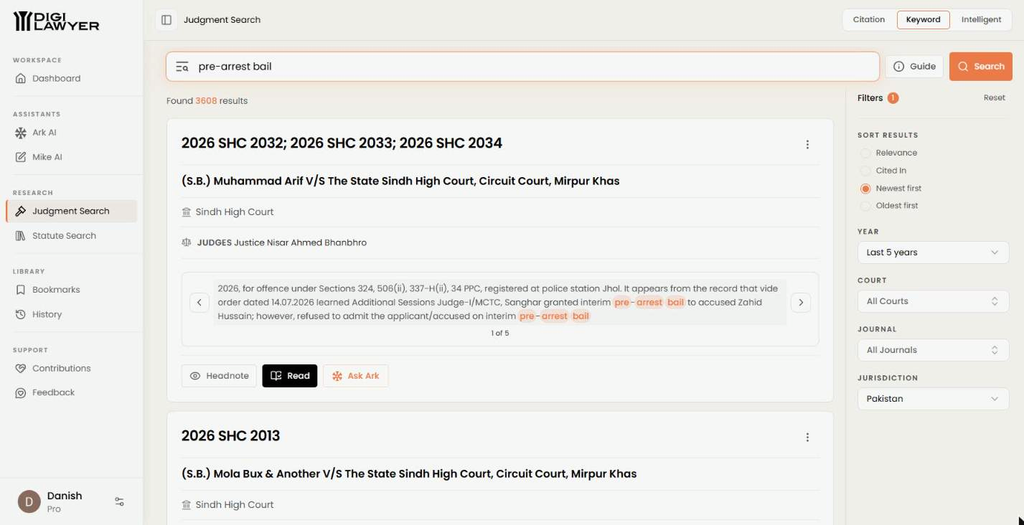
DigiLawyer also tracks how judgments have been treated by later courts through an algorithm the company says is its own intellectual property. Its drafting assistant, Mike, helps turn research into legal documents, allowing lawyers to fill in details and use their own templates.
Yet legal AI presents a risk that ordinary productivity software does not: a wrong citation or an inaccurate statement of law can have serious consequences. DigiLawyer says Ark answers using real judgments from its own database and links its claims to the specific passages supporting them. The company is also developing a formal evaluation system in which practising lawyers prepare benchmark questions and correct answers, testing both whether the system finds the right judgments and whether its explanations accurately reflect those decisions.
The distinction matters to Danish. AI can speed up research, but the lawyer remains responsible for making the legal argument.
A Courtroom Success Story and Institutional Trust
One example Danish recalls involves a judge in Pakpattan dealing with a case that had remained pending for a year because of an unresolved legal question. The judge entered the question into DigiLawyer, and Ark returned relevant legal authority with citations to the exact paragraphs. At the next hearing, the judge decided the case.
For the people waiting on that decision, the value was measured in more than saved research hours.
The example reflects the broader problem DigiLawyer is trying to address in Pakistan, where millions of cases remain pending. Faster access to relevant judgments cannot resolve every reason for court delays, but it can help judges and lawyers spend less time searching for legal material and more time working through the issues before them.
Institutional adoption has become an important part of that effort. DigiLawyer’s users include the Peshawar High Court, the Sindh High Court, Advocate General offices, Sindh Police and DRAP. The Peshawar High Court operates under an enterprise plan with unlimited users across the court, while the company is developing a dedicated version for the judiciary with its High Court partners.
On 21 October 2026, DigiLawyer signed an MoU with the Pakistan Bar Council, marking its latest milestone in building relationships across Pakistan’s legal community. The agreement follows a lesson Danish says he learned through experience: in Pakistan, institutional decisions often require direct engagement with senior leadership.
For the company, such relationships offer more than recognition. They create opportunities to bring legal research technology into institutions where accuracy, trust and consistency are essential.
From Pakistan to a Wider Legal Technology Market
Danish’s ambition is to make DigiLawyer the default way legal research is conducted in Pakistan, serving lawyers, judges and law students. The company’s plans include a dedicated judiciary edition, enterprise products for in-house legal teams, specialised tools for areas such as tax law and licences for universities studying Pakistani law, including institutions abroad.
Beyond Pakistan, the company is exploring markets with similar legal systems and research challenges. Bangladesh and the Gulf are among its areas of interest, and its participation in LEAP in Riyadh has helped it explore opportunities in Saudi Arabia and the wider region. DigiLawyer has also added Indian Supreme Court judgments for lawyers who rely on comparative legal authority.
For Danish, the next stage will require the same discipline that shaped the company’s early development: understanding the market before building for it, proving value to users and earning trust through consistent results. He advises aspiring Muslim entrepreneurs to begin with a problem they have witnessed firsthand, speak to a hundred users before writing serious code and avoid waiting for the perfect moment to start.
His own journey began with a conversation at home and a question about the legal system. The answer became a company built around a simple idea: legal knowledge is more useful when the people who need it can find it.
DigiLawyer’s larger test now is whether it can make that promise dependable, accessible and sustainable at scale, first across Pakistan and eventually beyond it.
