


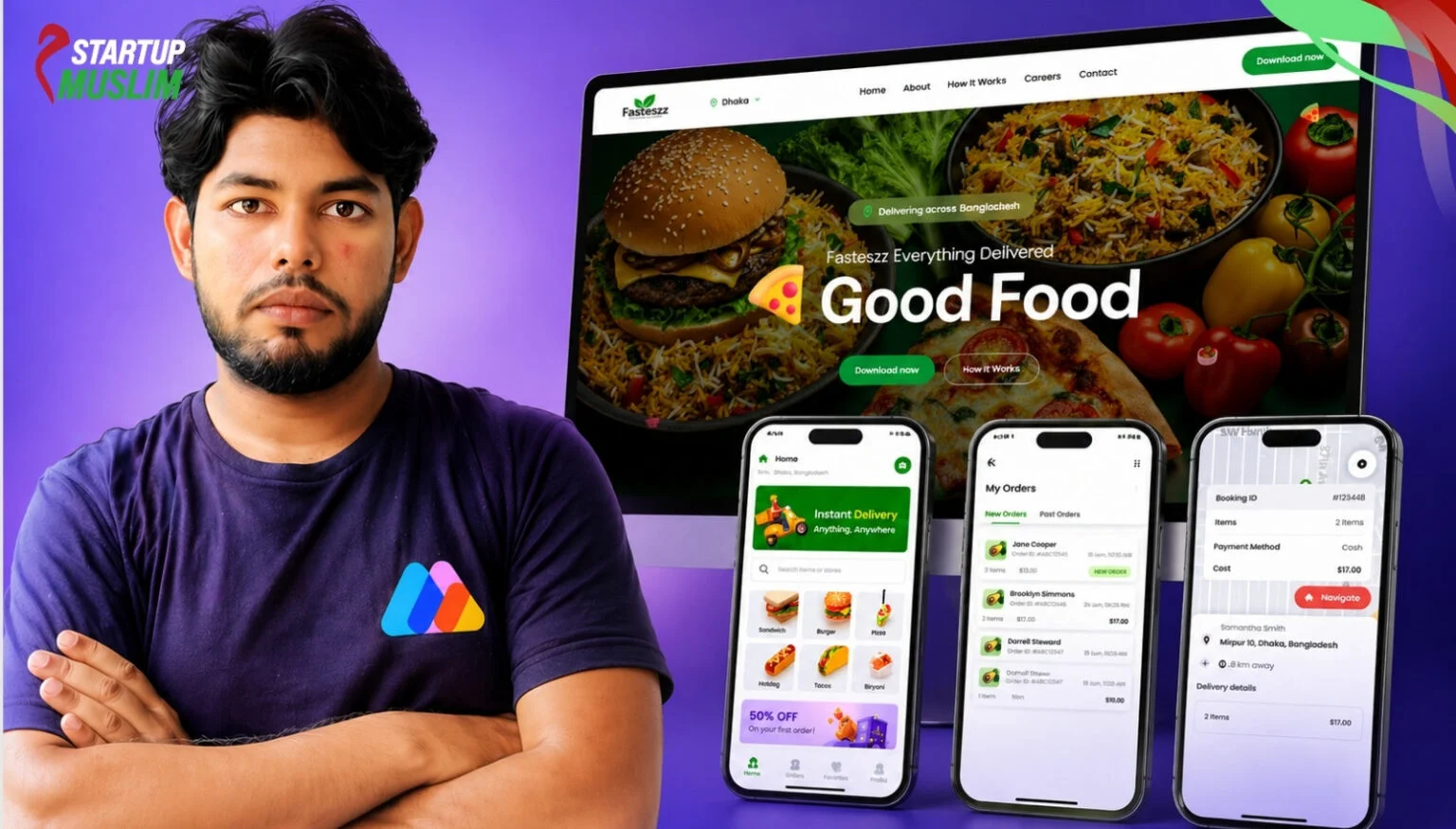
Choosing Impact Over Convention
At an age when most students are focused on education or early career choices, S K M Riad chose a different path. At just 19, he stepped away from the idea of a “safe” and predictable route to build Fasteszz, an all-in-one delivery platform designed to simplify how people access everyday services in Bangladesh.
For Riad, the decision was less about risk and more about timing. “Waiting for a safe path often means delaying impact,” he says. That mindset reflects a growing shift among young founders—one that prioritizes speed of learning and real-world problem solving over traditional progression.
Identifying a Fragmented System
The idea behind Fasteszz emerged from a problem that many people in Bangladesh encounter daily. Urban consumers rely on multiple platforms for different needs—food delivery, grocery orders, parcel services—each operating independently. This fragmentation creates inefficiencies, inconsistent service quality, and a disjointed user experience.
Riad saw an opportunity to unify these services. Fasteszz was built as a single platform where users can access multiple delivery needs in one place, with the goal of making the experience faster, more reliable, and more intuitive.
From Simple Prototype to Real Users
Like many early-stage startups, Fasteszz began with a minimal version of the product. Rather than aiming for a fully developed system, Riad focused on launching quickly with core functionality. The initial rollout was limited to a small geographic area, a handful of vendors, and a basic delivery network.
Early growth came through direct effort—personal outreach, leveraging existing networks, and word-of-mouth referrals. This hands-on approach allowed the platform to evolve based on real user feedback, shaping both product features and operational processes.
Building Trust at 19
One of the more difficult aspects of building Fasteszz was earning trust—particularly from vendors and partners who were accustomed to working with more established players.
Age, in this context, was both a challenge and a test of credibility. Riad approached this by focusing on consistency rather than persuasion.
Instead of making ambitious promises, he demonstrated reliability through execution—orders delivered on time, systems functioning as expected, and customers satisfied with the service. Over time, these small, repeatable outcomes established trust.
The Reality of Logistics
While technology plays a critical role in platforms like Fasteszz, the most complex challenges lie elsewhere. For Riad, operations and logistics have proven to be the most demanding aspects of the business.
Unlike software, which can be iterated and improved in controlled environments, delivery systems operate in real-world conditions. Traffic, rider availability, fluctuating demand, and inventory constraints introduce constant variability. Managing these factors requires coordination, adaptability, and continuous refinement—often in real time.
When Vision Meets Reality
One of the most ambitious ideas behind Fasteszz was the promise of ultra-fast delivery. The concept of fulfilling orders within 30 minutes is compelling, but maintaining that consistency across different conditions is significantly more complex than it appears.
Traffic congestion, demand spikes, and supply limitations all affect performance. What initially seemed like a straightforward goal revealed itself to be an infrastructure challenge—one that requires deeper systems, stronger networks, and more operational maturity.
Faith as a Guiding Framework
Beyond execution and strategy, Riad’s approach to building Fasteszz is shaped by his faith. He views business not just as a commercial activity, but as a responsibility grounded in values such as honesty, patience, and accountability. This perspective influences both decision-making and long-term thinking.
By focusing on integrity and sustainable impact rather than short-term gains, he aims to build a company that reflects both professional discipline and personal conviction.
Advice for Young Founders
For other young entrepreneurs, particularly those hesitant to begin, Riad’s advice is direct. “Start small, but start now,” he says. He emphasizes that perfect conditions are rarely present at the beginning. Progress comes from action—learning through experience, adapting to challenges, and remaining consistent over time. Fear, in his view, is a natural part of the process, but not a reason to delay it.
Building for the Long Term
As Fasteszz continues to evolve, its success will depend on its ability to scale operations while maintaining reliability—an ongoing challenge in the logistics space. But beyond growth metrics, Riad’s focus remains on solving a real problem: making delivery simpler, faster, and more efficient for everyday users.
In doing so, he represents a new generation of founders—those willing to start early, learn quickly, and build with purpose. In a market defined by complexity and fragmentation, Fasteszz is built on a simple idea: Bring everything into one place. And for its 19-year-old founder, that simplicity may prove to be its greatest advantage.
