


Consider a simple question: how many times have you ignored a call, or had someone ignore yours? Now consider what happens if that call was an emergency—not the kind where the police or an ambulance is the right answer, but the kind where you need your people around you, immediately.
It is the kind of question that tends to get overlooked precisely because existing systems make us feel covered. But for Naeem Noor Mahomed, returning to South Africa after more than a decade abroad, the gap between feeling safe and actually being safe was impossible to ignore.
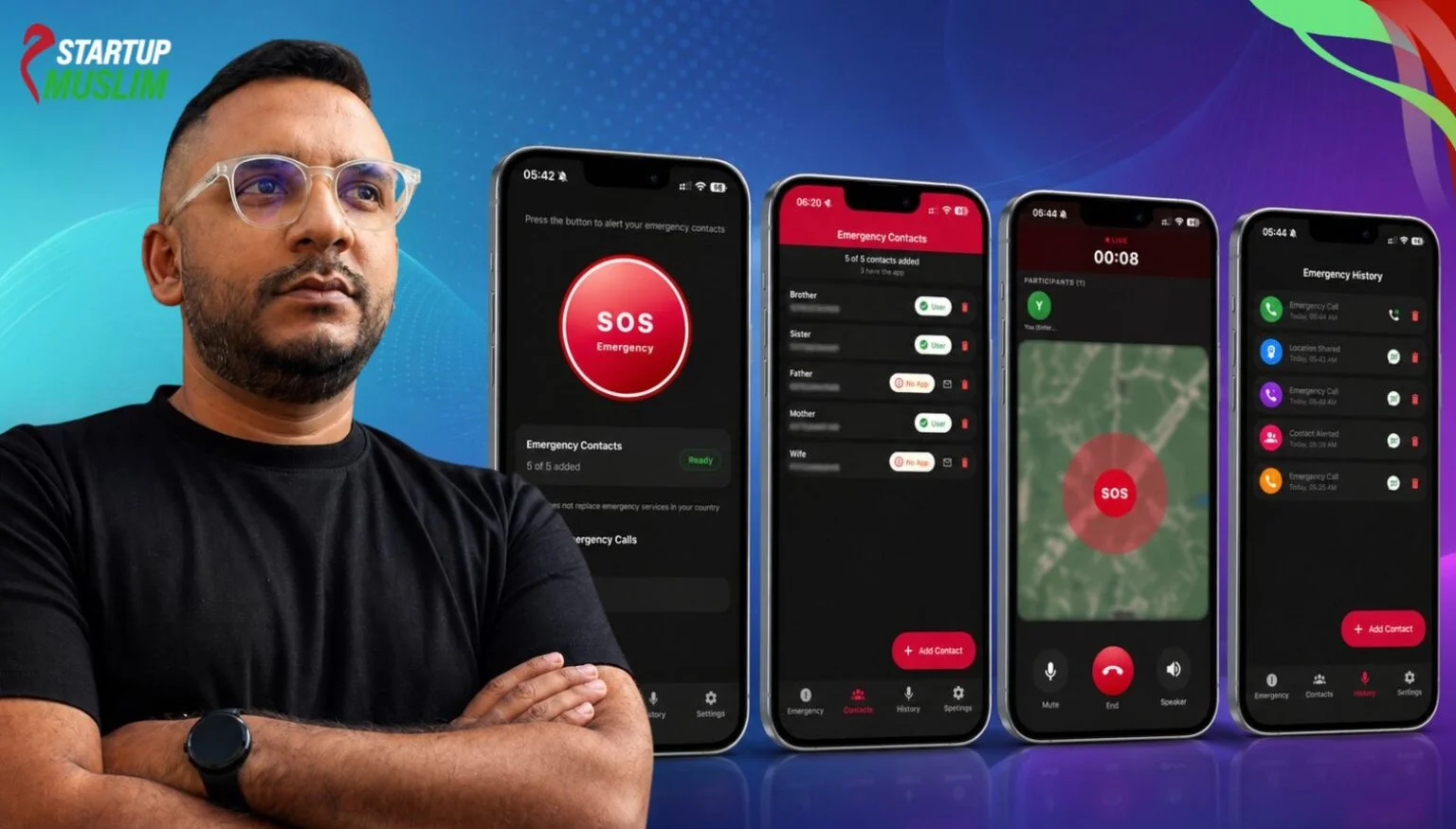
SOSSA was built from that observation. It is a personal safety app that connects users to five trusted contacts simultaneously—with a single tap from the home screen—launching a group call with live location sharing in real time. The premise is straightforward: reaching five people at once cuts response time and gives your network the information they need to act.
The personal safety app market was valued at approximately $860 million in 2024 and is projected to reach $2.74 billion by 2033, growing at a compound annual rate of around 13.7 percent. Demand for emergency alert features is cited as a primary driver by 55 percent of users in the segment. Mahomed is building SOSSA into that expanding space—with a specific focus on the kind of emergency that platforms oriented around police dispatch or ambulance services were never designed to address.
From Real Estate to Dell to Building His Own
Mahomed’s professional background is not that of a typical technology founder. His career began in 2012 as a commercial analyst at a real estate development company in Dubai, where his work centered on pricing and selling residential properties—including Princess Tower, which was the world’s tallest residential tower at the time.
After three years managing real estate assets, he joined Dell in Dubai as a category manager for retail and distribution. Over the following decade, he took on multiple roles spanning the Middle East, Africa, Turkey, and Central Eastern Europe—a breadth of exposure that gave him a particular way of thinking about problems.
“Throughout my career, I’ve always seen myself as a problem solver,” he says. “I built tools and processes to improve performance and get to the root of challenges rather than applying quick fixes.” It was that orientation, more than any specific technical background, that eventually led him toward entrepreneurship. When he eventually returned to South Africa, the environment he encountered sharpened that instinct into a specific problem worth solving.
The Gap That Official Systems Cannot Fill
Personal safety in South Africa is a deeply felt concern. The country consistently ranks among the most challenging environments globally for personal security, and the limitations of official emergency response infrastructure are well documented. But the problem Mahomed identified was not simply one of policing or emergency services—it was the layer of response that sits between an incident occurring and formal services arriving.
Existing safety apps, in his assessment, were largely built around the same model: alert the authorities, share a location, wait. What they did not address was the human network that, in practice, is often the fastest and most relevant first response—family members, close friends, neighbors who can physically reach someone, or coordinate on their behalf, in the critical minutes before any formal service can respond.
“Not the kind where police or an ambulance is the answer,” Mahomed explains, “but the kind where you need your people around you immediately.”
SOSSA is built around that distinction. By alerting five contacts simultaneously rather than routing through a dispatch center, the app is designed to mobilize the people most likely to respond fastest—and most personally.
Building the Product: Speed, Stability, and Iteration
Mahomed built SOSSA through his software development company, which he established with a single stated goal: to solve real-world problems at scale. The development process itself presented its own set of challenges. Mobile app development, particularly the debugging cycles required to ship reliable features, consumed significant time in the early stages.
Over time, he integrated AI tooling into the development workflow—a shift he credits with meaningfully accelerating the pace at which SOSSA can ship new features while maintaining cleaner, more stable codebases. The approach reflects a broader philosophy: embrace the tools that free up capacity for the work that matters, and iterate continuously rather than waiting for a perfect product.
“What excites me most is continuously adding features and value to our products so our customers have the best possible experience,” he says. “I’ve always been an early adopter of new technology, and I continue to embrace tools that add real value to my work.”
The Ongoing Challenge of Mass Adoption
SOSSA is currently offered as a paid service, priced at the lowest point Mahomed considers viable. His longer-term vision is for the app to become free—supported potentially through venture or investor funding—and adopted at the scale of millions of users. That ambition reflects both the size of the opportunity and the difficulty of the path toward it.
The personal safety app market is crowded with well-resourced incumbents. Platforms like Life360, Noonlight, and bSafe have spent years and significant capital building distribution. For an independent, early-stage product to break through requires not just a better feature set, but a marketing strategy capable of building genuine word-of-mouth in communities where personal safety is a lived, daily concern.
Mahomed acknowledges this directly. “Getting mass adoption remains an ongoing challenge,” he says. “But every day I focus on learning new marketing strategies, and the growth I’ve seen through trial and error gives me confidence. Not giving up has always been part of who I am.”
The user base is growing daily, and the product roadmap continues to expand—with the protection of children cited as one of the core use cases the team is actively developing toward.
A Growth Plan Rooted in Reinvestment
Mahomed’s growth strategy for SOSSA is deliberately grounded. Rather than pursuing external capital prematurely, the plan centers on reinvesting revenue into expanding market presence and building strategic partnerships and sponsorships that can extend the brand’s reach—both locally in South Africa and into broader global markets.
The logic is consistent with the product’s founding ethos: solve a real problem, build trust with real users, and grow from that foundation rather than outpacing it. The app’s addressable market is genuinely large—surveys indicate that around 60 percent of women and 40 percent of men report feeling unsafe when traveling alone at night, and more than 30 percent of respondents in global polls have experienced harassment or threats in public spaces at least once. The demand is structural, not manufactured.
Leading With Respect
Mahomed describes his leadership philosophy in terms that trace directly to his faith. The foundation, he says, is respect—unconditional, regardless of gender or background. In a product that exists to protect people in their most vulnerable moments, that principle is not incidental to the culture he is building. It is central to it.
“A team can only succeed when every member feels valued and heard,” he says. “I trust my team to deliver, and I encourage them to surface challenges early so we can work through them together.”
For younger Muslim entrepreneurs specifically, his guidance is blunt and practical. Start young. Fail often and early. Commit to daily learning. And accept from the outset that entrepreneurship, at least in the beginning, means doing everything yourself—not as a burden, but as how you build depth. “Trust that Allah is the best of planners,” he adds. “Failing a hundred times is better than never trying.”
A Legacy Built Around Service
SOSSA is still early. User numbers are growing but have not been publicly disclosed. The path to the mass adoption Mahomed envisions—free, globally distributed, reaching millions of users—remains ahead of him, contingent on the marketing traction and potential investor partnerships he is working to build.
But the legacy he is building toward extends beyond any single product. “I hope to be remembered as part of a community of people who genuinely changed lives—through hard work, generosity, and service,” he says. “I want to help alleviate poverty and build communities that lean on each other rather than waiting on systems beyond their control.”
In that framing, SOSSA is less a technology product than a reflection of a particular belief: that the most reliable safety net is not a system, but the people who already know you.
