


The MENA startup ecosystem raised a record $7.5 billion in 2025, a 225 percent increase on the previous year. Capital is moving. Investor interest is growing. And yet, for the majority of early-stage founders building outside of Dubai or Riyadh, the practical question remains unchanged: where do you actually go to find the tools, the co-founders, the mentors, and the investors you need to build a company from the ground up?
That question is one that Urooj Zia and Faizan Laghari have spent years watching founders fail to answer. Not because the founders lacked ability, but because the infrastructure to support them simply did not exist in one place. Qaflah is their attempt to change that.
Two Founders, Three Decades of the Founder Experience
Urooj Zia comes to Qaflah with nine years of experience spanning corporate environments, government projects, startups, and incubation centers. That range is not incidental—it gave her a ground-level view of how founders operate across very different institutional contexts. Most concretely, she has worked directly with more than 300 founders in a growth management capacity, close enough to see exactly where the systems around them were falling short.
Faizan Laghari brings a different but complementary lens. An entrepreneur for 22 years, he holds a degree in Business and IT from Curtin University, has successfully exited two ventures, and has personally coached more than 1,000 founders through their startup journeys.
Between them, the two co-founders have lived nearly every stage of the founder lifecycle—building, operating, advising, and scaling. “We are, quite simply, founders building for founders,” Zia says.
The Pattern They Kept Seeing
Across hundreds of founder interactions, a pattern emerged that was difficult to ignore. Founders in the MENAP region were cycling through incubation programs, absorbing curricula, accumulating frameworks—but walking away without the execution tools they actually needed. They were struggling to afford the software required to build their products, unable to find co-founders who shared their vision, and disconnected from the investors operating in their region.
The issue was not a shortage of ambition or talent. According to McKinsey, MENAP’s VC investment as a share of GDP sits at just 0.1 percent—compared to 0.8 percent in Southeast Asia and 0.4 percent in Latin America—suggesting four to eight times growth potential in the region over the coming years. The founders exist. The capital is beginning to follow. What has been missing is the connective infrastructure in between.
“They were accumulating knowledge but rarely receiving the actual execution tools they needed to build faster, scale efficiently, and gain visibility beyond their own country,” Zia explains. “That gap is what Qaflah was built to close.”
A Startup Operating System at $6 a Month
The name Qaflah is an Arabic word meaning a caravan—a group moving together through difficult terrain. It is an apt metaphor for what the platform is designed to be: not a single tool, but a unified system that moves with the founder from early-stage ideation through to fundraising.
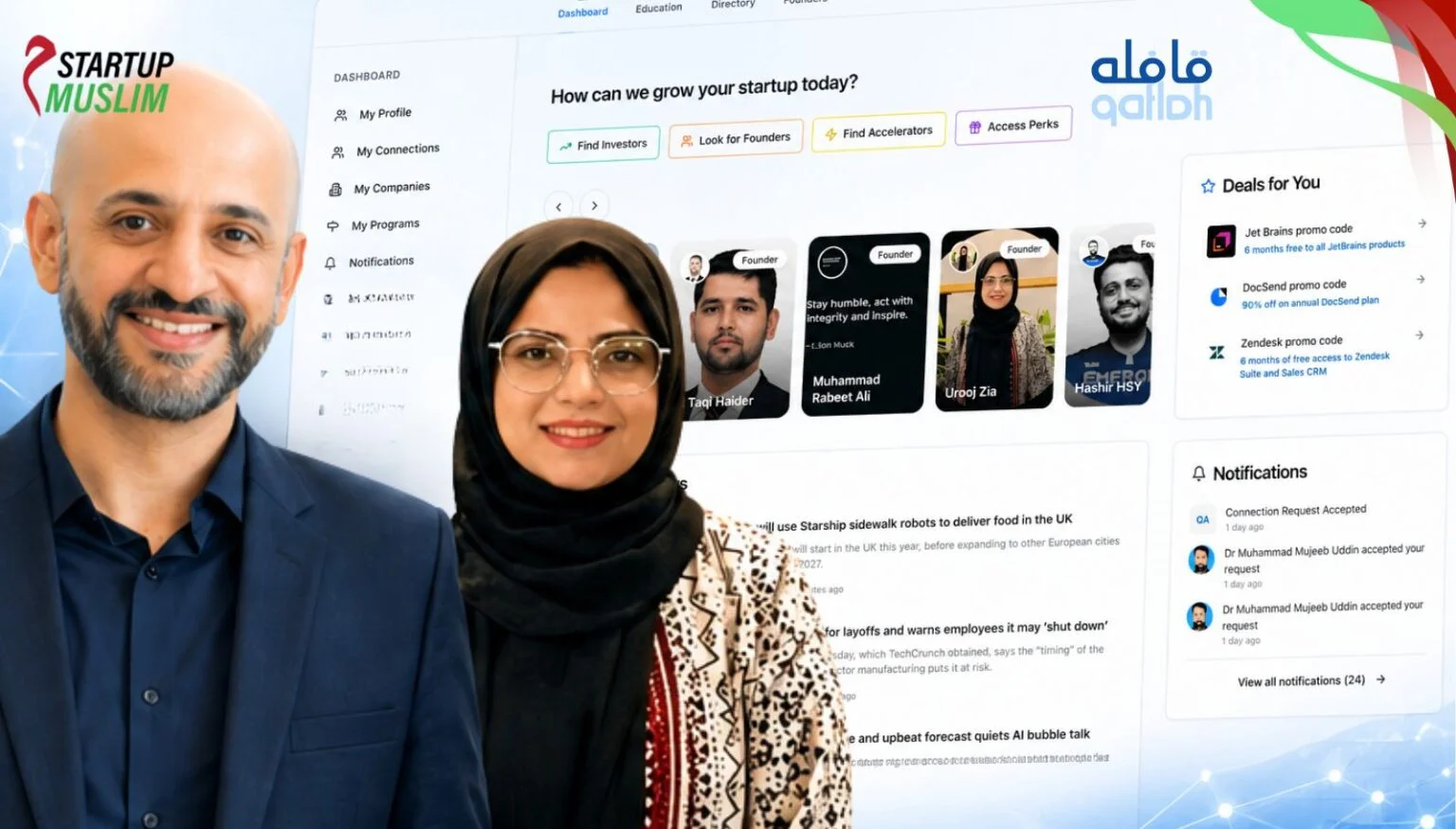
For a subscription of $6 per month, founders gain access to a community feed for sharing updates and requests, an AI-powered semantic co-founder matchmaking tool, and over $200,000 worth of perks and discounts on platforms including Webflow, HubSpot, JetBrains, Brevo, and Make. Beyond that, the platform provides built-in financial and accounting dashboards, investor filtering tools covering connections across more than 30 countries, and a centralized data room for tracking and managing investor conversations.
The pricing is deliberate. Accessibility, in Zia and Laghari’s view, is not a secondary consideration—it is the point. A platform designed to serve founders in emerging markets cannot be priced like one designed for Silicon Valley.
The Difficulty of Turning Experience Into a Product
For all the clarity of the problem they were solving, the hardest part of building Qaflah was not execution—it was articulation. Zia and Laghari came into the process with years of accumulated observations and an instinct for what founders needed. Translating that into a coherent, sequenced product was a slower process than either anticipated.
“Sitting down to decide what was truly essential, what to build first, what to leave for later—that was a slow, iterative process,” Zia acknowledges. “Even now, we are constantly adding and refining features based on real feedback from the founders using the platform.”
A second challenge was internal: the co-founder dynamic itself. With roughly 90 percent of the work handled between the two of them—heavily supported by AI tooling—learning to build genuine operational trust has been, by Zia’s account, as important as any product decision they have made. “You build that trust one decision at a time,” she says.
Early Traction and a Credible Network
Qaflah launched in January 2025. Within a few months, the platform had onboarded more than 400 founders—a meaningful early signal for a bootstrapped product operating without external funding. The company runs under Startup Syndicate, a parent entity owned and managed by Zia and Laghari.
Through Startup Syndicate, the team has built partnerships with a roster of international platforms including Gitex Global, Replit, She Loves Tech, the Entrepreneurship World Cup 2026, NextGeni, myco.io, and Accelerate Prosperity, an initiative of the Aga Khan Development Network. For an early-stage, bootstrapped product, that network provides Qaflah with both institutional credibility and distribution reach that would typically take years to develop.
Building Toward the Infrastructure Layer
Qaflah’s growth strategy is structured around three tracks. The first is product refinement—continuing to iterate based on direct founder feedback, ensuring that each feature on the platform is solving a problem someone is actively paying to address. The second is B2B partnerships with incubators and government organizations that want to extend Qaflah’s infrastructure to the founders already within their portfolios.
The third is investor relationships. As MENA early-stage deal activity continues to grow—with 486 early-stage deals completed in 2025 alone, according to Wamda—the demand for verified, credible deal flow from the broader MENAP region is increasing. Qaflah is positioning itself as the layer that connects founders to that capital in a structured way.
“By bringing all three sides together—founders, ecosystem enablers, and capital—we believe Qaflah can become the connective infrastructure the regional startup landscape has been waiting for,” Zia says.
Values at the Foundation
Zia and Laghari are deliberate about the values they have embedded into Qaflah—not as a branding exercise, but as a practical operating philosophy. Their “for founders, by founders” positioning is grounded in a simple premise: you cannot credibly build for a community you have not lived inside.
As Muslims, they frame the mission in terms of community enablement—removing the barriers of accessibility that have historically prevented founders in emerging markets from competing on equal footing. Integrity, in their view, is not separate from strategy. It is what makes a platform trustworthy enough to be genuinely useful.
Their advice to younger Muslim entrepreneurs reflects the same orientation. The first piece is practical: study what did not work for the founders who attempted to build what you are building. The market has a memory, and understanding prior failures produces more grounded plans.
The second is spiritual. “Do not get distressed by the hard work that comes with entrepreneurship,” Zia says. “Allah has placed great sustenance in hard work, and even greater sustenance in the work of someone who builds to solve another person’s problem and to bring them ease.”
The Bridge They Are Trying to Build
Qaflah is four months old. Its founders are bootstrapped, working largely as a two-person team, and still in the process of proving out the full scope of what they have built. The ambition, however, is clearly defined.
“My hope is that Qaflah becomes the strong bridge that connects the startup ecosystem across MENAP, and the foundation that uplifts the founders building within it,” Zia says. “If, years from now, founders across our region can point to Qaflah as part of why they were able to build at a global standard from where they stood, that is the legacy we want to leave behind.”
In a region where startup funding grew 225 percent in a single year but infrastructure for early-stage founders remains thin, that may be exactly the kind of unglamorous, structural work that matters most.
