


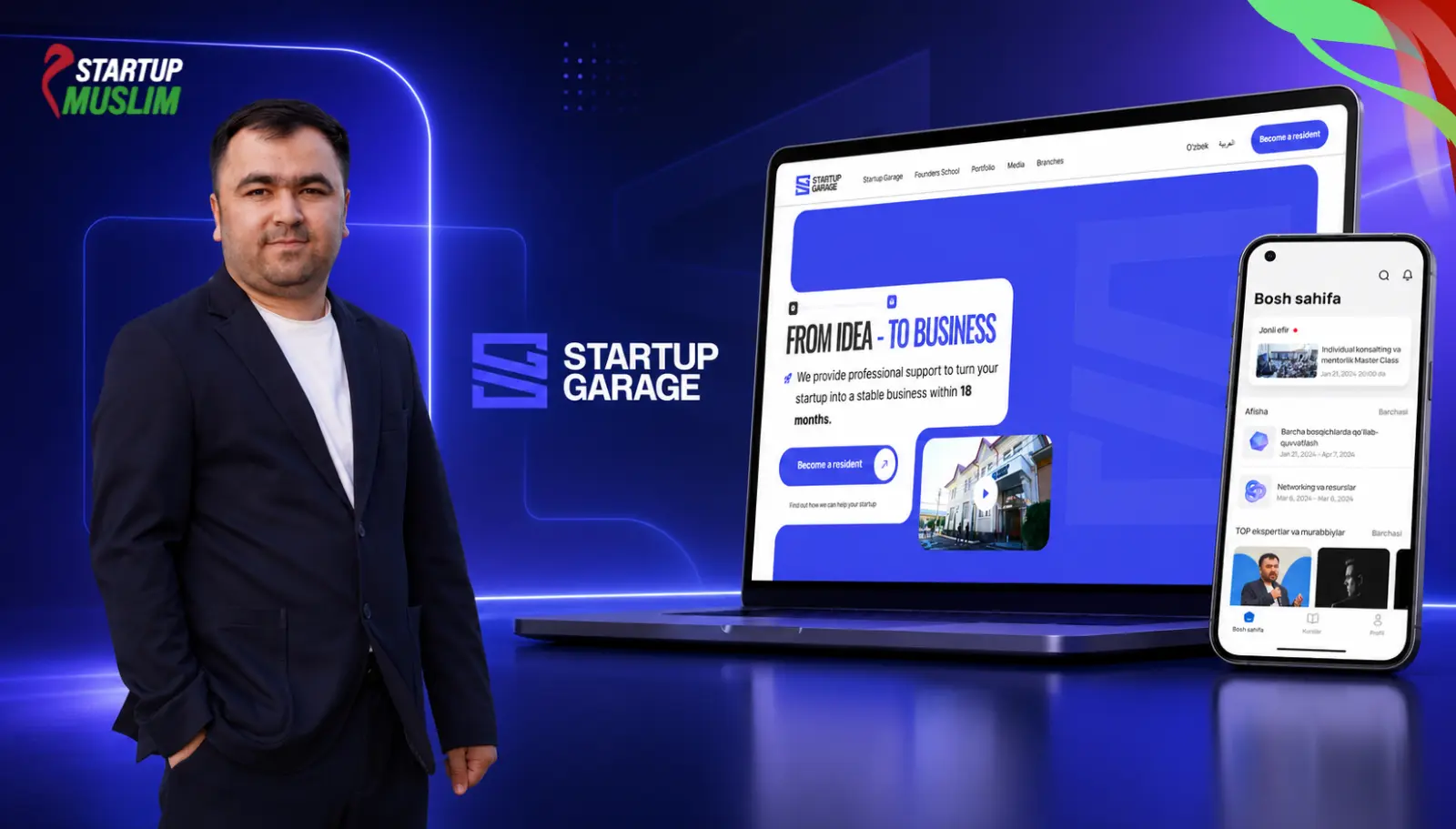
After helping educate thousands of software developers through MohirDev, Mukhammad Khalil realized that talent alone wasn’t enough. Today, through Startup Garage, he is building the entrepreneurial infrastructure that could transform Uzbekistan into one of the world’s next great startup ecosystems.
For decades, countries have been known for the natural resources they export. Saudi Arabia exports oil. Australia exports minerals. Brazil exports agricultural products. But what if a country could become known for exporting something far more valuable—entrepreneurs?
That is the vision driving Mukhammad Khalil, Founder of Startup Garage, a venture studio that is quietly reshaping the entrepreneurial landscape of Central Asia. While many organizations focus on helping individual startups succeed, Khalil is thinking on an entirely different scale. His ambition is to build an ecosystem where creating successful technology companies becomes a repeatable capability rather than an occasional success story.
It is an ambitious mission. Yet it is rooted in a simple observation. Great founders rarely emerge because of talent alone. They emerge when talented people are surrounded by mentors, investors, operators, customers, and institutions that help transform ideas into enduring businesses. In many emerging markets, that infrastructure simply doesn’t exist. Khalil believes building that missing layer may be one of the highest-leverage investments a nation can make.
When Education Was No Longer Enough
Long before Startup Garage was founded, Khalil was already investing in the future of Uzbekistan through MohirDev, one of the country’s leading technology education platforms. Thousands of young people acquired software engineering and digital skills through the platform, opening doors to careers that had previously seemed out of reach.
As MohirDev continued to grow, however, Khalil found himself asking a much bigger question. Education was producing highly skilled engineers, but what happened after graduation? Most students would join existing companies, contributing to someone else’s vision. Very few would build companies of their own.
That realization fundamentally changed his perspective. He began to understand that while education creates talent, entrepreneurship creates industries. A single engineer can build an outstanding career, but one successful entrepreneur can build an organization that creates hundreds—or even thousands—of careers for others. The long-term economic impact of company creation far exceeds that of individual employment.
“MohirDev taught me something very important: talent is everywhere, but opportunity infrastructure is not,” Khalil explains. “I became convinced that if we could build the infrastructure around entrepreneurs, the multiplier effect would be much greater.”
That conviction became the foundation upon which Startup Garage was built.
Why Startup Garage Isn’t Just Another Accelerator
The word accelerator has become one of the most overused terms in the startup ecosystem. Around the world, thousands of programs promise mentorship, networking opportunities, office space, and demo days. While many of these initiatives create value, Khalil believes they often address only a small portion of the entrepreneurial journey.
Startup Garage deliberately chose a different model.
“I often explain it very simply,” he says. “An accelerator advises founders. A venture studio gets into the kitchen and cooks with them.“
Rather than acting as external advisors, Khalil and his team become deeply involved in building companies alongside entrepreneurs. They help validate ideas, identify co-founders, refine business models, develop products, prepare fundraising strategies, and facilitate expansion into international markets. Their role extends far beyond mentorship—it resembles that of an institutional co-founder.
This model is particularly relevant in emerging ecosystems. In places like Silicon Valley, founders are surrounded by experienced operators, angel investors, venture capitalists, product leaders, and serial entrepreneurs. Knowledge flows naturally because the ecosystem has matured over decades. Emerging markets rarely enjoy that density of experience.
“You cannot simply give a young founder an office and tell them to build a billion-dollar company,” Khalil says. “You’re asking them to solve too many structural problems at the same time.”
Startup Garage exists to remove those structural barriers, allowing founders to focus on building exceptional companies instead of struggling to assemble the ecosystem around them.
A New Generation Is Emerging
Perhaps the most remarkable transformation Khalil has witnessed over the past five years has nothing to do with venture capital or government policy. It has everything to do with mindset.
“There has been a profound psychological shift,” he explains. “Five years ago, becoming a startup founder wasn’t viewed as a serious career path. Today, a new generation genuinely believes it can build globally relevant companies.”
That shift has been accompanied by increasing investor interest, stronger government support for innovation, growing pools of technical talent, and a startup ecosystem that is beginning to attract international attention. Yet Khalil believes Central Asia possesses another competitive advantage—one that outsiders frequently overlook.
Entrepreneurs in the region have learned to build under constraints. They know how to operate with limited capital, fragmented markets, and imperfect infrastructure. Those challenges, rather than becoming disadvantages, often produce founders who are exceptionally resourceful, resilient, and execution-focused.
Instead of trying to imitate Silicon Valley, Khalil believes Uzbekistan should embrace its own identity. Positioned between Central Asia, the Middle East, Türkiye, South Asia, and historic trade routes connecting East and West, the country has the opportunity to become a bridge linking some of the world’s fastest-growing entrepreneurial ecosystems.
“Our future is not becoming a smaller version of Silicon Valley,” he says. “Our opportunity is to develop our own model of entrepreneurship.”
Building Companies, Not Just Startups
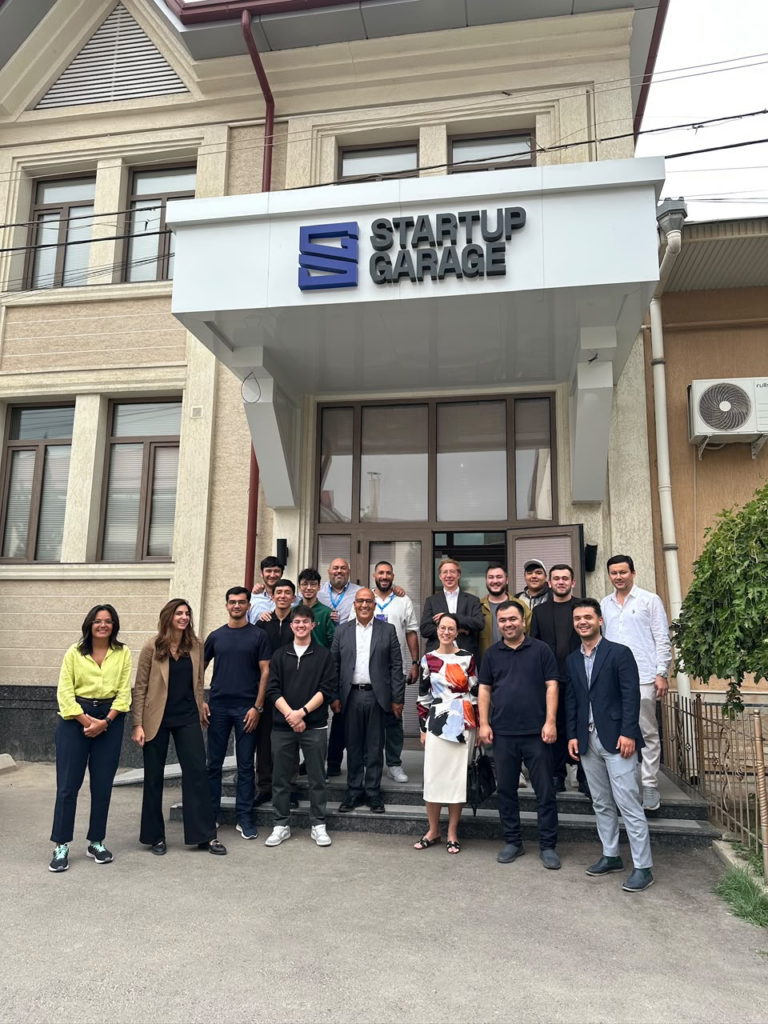
When Khalil speaks about Startup Garage, he rarely begins with funding, pitch competitions, or demo days. Instead, he talks about company building. That distinction may sound subtle, but it reflects an entirely different philosophy. While many startup programs are designed to accelerate existing businesses, Startup Garage is designed to help create businesses that otherwise may never have existed.
“I often explain it very simply,” Khalil says. “An accelerator advises founders. A venture studio gets into the kitchen and cooks with them.“
That philosophy shapes every aspect of Startup Garage’s work. Rather than limiting itself to mentorship sessions or networking events, the venture studio works alongside founders throughout the entire entrepreneurial journey. The team helps validate business ideas, refine business models, recruit co-founders, develop products, prepare fundraising strategies, and build go-to-market plans. In many cases, Startup Garage becomes an extension of the founding team itself, sharing both the challenges and the excitement of building a company from the ground up.
Khalil believes this hands-on approach is particularly important in emerging startup ecosystems. In mature innovation hubs such as Silicon Valley, entrepreneurs naturally benefit from decades of accumulated experience. Investors, experienced operators, mentors, product leaders, and serial founders are often only a few introductions away. Knowledge flows organically because the ecosystem has evolved over time.
Emerging ecosystems operate under very different conditions. Founders often possess exceptional technical ability and ambitious ideas, yet they must simultaneously solve problems related to hiring, fundraising, legal structures, product strategy, customer acquisition, and international expansion. Without experienced guidance, even the most promising startups can struggle long before they have the opportunity to prove their potential.
“You cannot simply hand a founder an office and expect them to build a billion-dollar company,” Khalil explains. “You’re asking them to solve too many structural problems at once.”
Startup Garage was created to remove those barriers. By surrounding founders with experienced operators and proven frameworks, the venture studio allows entrepreneurs to spend more time building products and serving customers instead of constantly reinventing processes that others have already solved.
The Human Behind Every Great Company
One of the most interesting aspects of Khalil’s investment philosophy is that he spends far more time evaluating people than evaluating ideas. Markets change. Products evolve. Business models pivot. Founders, however, remain at the center of every successful company.
“When I meet a founder, I don’t immediately think about the pitch deck,” he says. “I think about the person sitting across the table.”
He looks for qualities that cannot easily be taught: curiosity, resilience, humility, integrity, and the willingness to learn rapidly. More importantly, he looks for what he describes as agency—the ability to take ownership of problems instead of waiting for someone else to solve them.
In Khalil’s experience, successful entrepreneurs are rarely those with the most polished presentations. They are the individuals who consistently execute, adapt quickly when circumstances change, and remain committed even when progress is slow. These characteristics often matter far more than the initial business idea itself.
Startup Garage therefore invests heavily in founder development alongside venture development. The belief is simple: exceptional companies are built by exceptional people, and strengthening the founder ultimately strengthens the business.
Creating a Startup Production System
Although Startup Garage is still relatively young, Khalil believes its greatest achievement is not a single successful startup. Instead, he points to something much larger—the emergence of what he calls a startup production system.
Over the past year, Startup Garage and its broader ecosystem have helped launch more than 300 startups, with nearly half originating outside Uzbekistan’s capital city of Tashkent. Companies connected to the ecosystem have collectively attracted approximately $4 million in investment while the organization has expanded its activities across all fourteen regions of Uzbekistan.
These numbers represent far more than growth metrics. They demonstrate that entrepreneurship is no longer limited to a handful of major cities or elite networks. Young entrepreneurs from regions that previously had little exposure to venture capital or startup communities are now gaining access to mentorship, education, investors, and global opportunities.
For Khalil, regional inclusion is one of Startup Garage’s proudest accomplishments. He believes innovation should never be confined to capital cities.
“The next great founder may come from Samarkand, Bukhara, Fergana, or a small town that most investors have never visited,” he says. “Talent is distributed everywhere. Opportunity is not.”
By expanding beyond Tashkent, Startup Garage hopes to ensure that entrepreneurial opportunity reaches every part of the country. It is a strategy built on the conviction that world-class founders can emerge from anywhere when they are given access to the right ecosystem.
As the venture studio continues to grow, Khalil measures success not simply by the number of companies created, but by whether Uzbekistan develops the institutional capability to produce successful founders generation after generation. For him, the ultimate goal is not to build one unicorn. It is to build an ecosystem capable of producing many.
The Return of the Entrepreneurial Human
One of Khalil’s most compelling ideas is something he calls “the return of the entrepreneurial human.” He believes the world is entering a new economic era where entrepreneurship will become one of the most valuable skills a person can possess. For much of the industrial age, societies were built around producing employees for large organizations. Success often meant securing a stable job and climbing the corporate ladder. But artificial intelligence, automation, and rapid technological change are fundamentally reshaping that model.
“When intelligence becomes abundant, what becomes scarce is human initiative, creativity, judgment, and the courage to build something new,” Khalil says. Those are not skills that can be automated. They are entrepreneurial qualities, and he believes they will define the leaders of the next generation.
This philosophy shapes how Startup Garage develops founders. The goal is not simply to teach people how to raise venture capital or build software products. It is to cultivate individuals who can identify meaningful problems, assemble exceptional teams, adapt to uncertainty, and create value regardless of changing market conditions. In Khalil’s view, entrepreneurship is less about launching companies and more about developing a mindset capable of solving society’s biggest challenges.
Building Bridges Beyond Borders
Although Startup Garage was founded in Uzbekistan, Khalil has never viewed its mission as being limited to one country. From the beginning, his ambition has been to build a venture studio that connects entrepreneurs across Central Asia, the Middle East, Türkiye, Southeast Asia, and North Africa. These regions share enormous entrepreneurial potential, yet their startup ecosystems often operate independently with very little collaboration.
“We have brilliant founders across these regions,” Khalil explains. “But too often they are building in isolation. Investors know their local markets, founders know their local customers, but there are very few bridges connecting these ecosystems together.”
Startup Garage is working to become one of those bridges. Beyond helping founders launch companies, the organization actively connects entrepreneurs with international investors, mentors, venture studios, accelerators, and corporate partners. Khalil believes that the future belongs to startups capable of thinking globally from their earliest days rather than limiting themselves to domestic markets.
This vision is particularly relevant for Central Asia. Located at the crossroads of Europe, the Middle East, and Asia, Uzbekistan occupies a strategic position that historically connected civilizations through the Silk Road. Khalil believes entrepreneurship can create a modern version of those historic connections—where ideas, capital, talent, and innovation move freely across borders.
“The next generation of great companies won’t necessarily come from Silicon Valley,” he says. “They can emerge from Tashkent, Riyadh, Istanbul, Kuala Lumpur, or Cairo. What matters is creating ecosystems that help founders collaborate instead of compete in isolation.”
A Different Definition of Success
Unlike many venture investors who measure success primarily through valuations and exits, Khalil views entrepreneurship through a much broader lens. Building successful companies is certainly important, but he believes the greatest impact comes from creating an environment where entrepreneurship becomes self-sustaining.
For him, every successful founder becomes a future investor, mentor, employer, or ecosystem builder. Every startup that succeeds creates knowledge that benefits the next generation of entrepreneurs. Over time, these relationships compound, transforming isolated startup successes into an enduring innovation ecosystem.
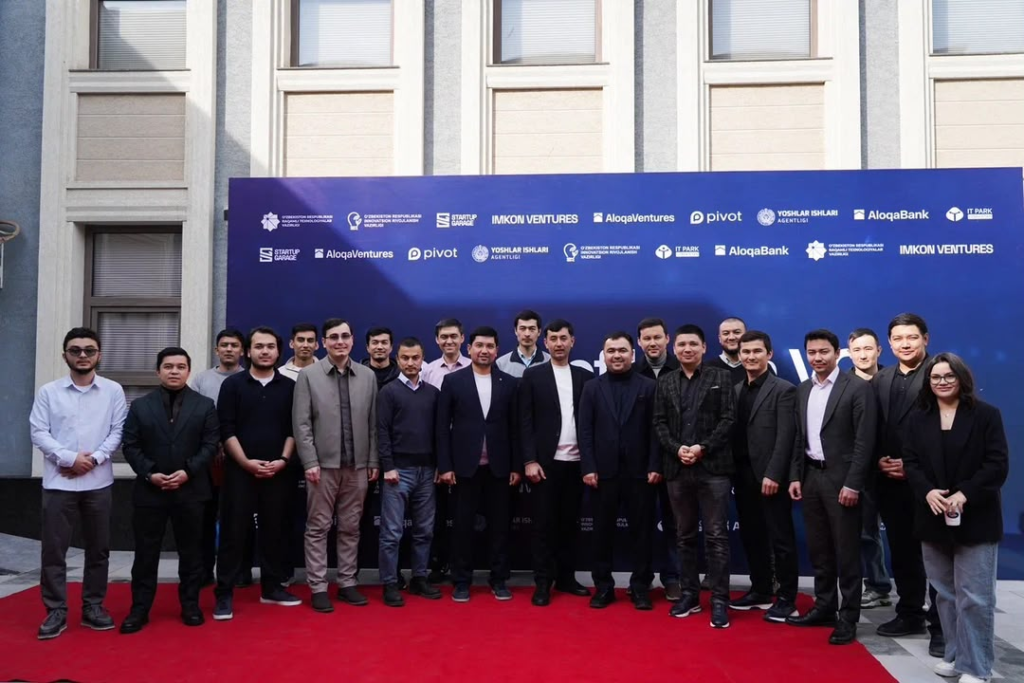
That is why Startup Garage invests heavily in community building alongside venture creation. Founders learn from one another, share experiences openly, and build relationships that often extend far beyond individual companies. Khalil believes these networks are among the most valuable assets an emerging ecosystem can develop because they create trust, accelerate learning, and reduce the barriers that future entrepreneurs will face.
Success, therefore, is not measured solely by the number of startups launched or the amount of capital raised. It is measured by whether entrepreneurship becomes embedded within the culture itself.
A Vision for the Next Decade
Looking ahead, Khalil’s vision is remarkably ambitious. He wants Startup Garage to become one of the world’s leading venture studios emerging from an emerging market, helping co-found globally significant technology companies while positioning Uzbekistan as one of the fastest-growing startup ecosystems in the world.
More importantly, he hopes to inspire a generation of entrepreneurs who believe they can build world-class companies without relocating to Silicon Valley or other established technology hubs. The future, he believes, belongs to founders who solve meaningful problems from wherever they are, leveraging local insight while competing on a global stage.
His message to young Muslim entrepreneurs is equally inspiring. Do not wait for the perfect ecosystem, perfect investor, or perfect opportunity. Great ecosystems are not inherited—they are built by ordinary people willing to take extraordinary risks. Every successful startup begins with a founder who chooses action over hesitation and execution over excuses.
“Our civilization has a rich history of trade, innovation, scholarship, and institution building,” Khalil reflects. “Entrepreneurship is not something foreign to us—it is part of who we are. The responsibility of our generation is to build again.”
That simple belief captures the essence of Startup Garage. It is not merely building startups; it is helping rebuild a culture of entrepreneurship across Central Asia—one founder, one company, and one generation at a time.
If Khalil succeeds, Uzbekistan may become known not only for its history along the Silk Road, but for something entirely new: a nation that exports entrepreneurs, creates globally competitive companies, and proves that the next great wave of innovation can emerge from places the world is only beginning to discover.
