





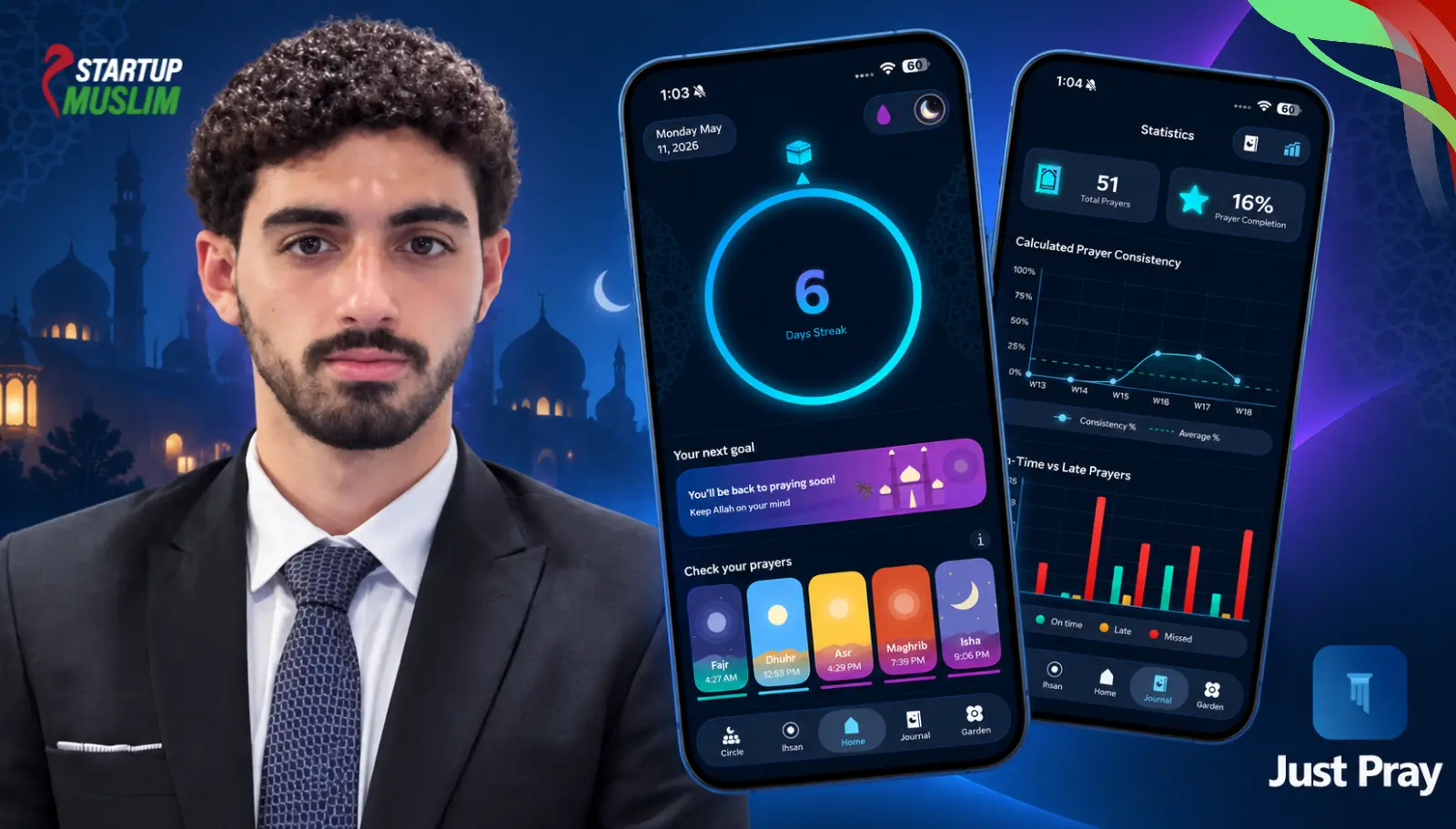
For Adam Moez Masoud, the problem with many prayer apps is not that they fail to tell Muslims when to pray. It is that knowing when to pray and actually making time for salah are two very different things.
That distinction inspired Just Pray, a mobile application designed to help Muslims build consistency in their five daily prayers. Rather than becoming another all-in-one Islamic platform, Masoud wants to solve one problem exceptionally well: helping people make prayer a regular part of their lives.
The idea came from personal observation. When Masoud began praying, he noticed how many people around him were not maintaining the same practice. As he paid closer attention, he found that being busy was often part of the explanation. He saw an opportunity to use software not simply to deliver reminders, but to help people overcome the distractions that prevent them from acting on those reminders.
The early numbers suggest the idea is resonating. Just Pray’s website reports more than 300,000 downloads, an average rating of 4.9 stars and over 30,000 five-star reviews. These are company-reported figures rather than independently audited user metrics, but they indicate the scale of attention the young product has attracted. <Cite refs={[“turn502977search9”]}/>
1. A Different Approach to a Familiar Problem
Prayer-time applications have been part of Muslim digital life for years. They calculate prayer times, provide the adhan, identify the Qibla and help users organise their daily worship. Yet Masoud believes that access to information is only one part of the challenge.
A person can receive an alert for Fajr, dismiss it and return to sleep. Someone can receive a notification for Dhuhr while working, acknowledge it and continue scrolling through social media. In both cases, the technology has delivered its message, but the intended behaviour has not necessarily followed.
Masoud wanted to build around that gap between intention and action. Just Pray tracks the five daily prayers and uses reminders, habit-building tools and features designed to reduce distractions. The objective is to make following through on salah easier, particularly for people who want to become more consistent but struggle to establish a routine.
The philosophy also shapes what the company chooses not to build. Masoud sees software moving towards focused products that perform a specific task well, rather than applications that attempt to cover every possible need. For Just Pray, that means resisting the temptation to expand into an everything app before mastering its central purpose.


2. Building a Technology Company Without a Tech Background
Masoud did not arrive at Just Pray through a conventional software career. He says he had no prior experience in technology or software development and had dropped out of high school before beginning work on the application. He credits Allah with making the journey possible, describing the experience with characteristic humility.
His path challenges the assumption that founders must follow a traditional educational route before attempting to build a technology product. It does not, however, remove the practical demands of product development. Creating an application that people can rely on requires continuous improvement, an understanding of user behaviour and the ability to respond to feedback.
Masoud’s approach is hands-on. He speaks with users regularly, asking what is helping them, what is getting in their way and whether they are becoming more consistent in their prayers. Rather than treating downloads or screen openings as definitive evidence of success, he looks for signs that the product is making a meaningful difference.
That focus gives Just Pray a different definition of traction. For Masoud, a large audience matters only if the application helps people achieve the purpose for which they downloaded it.
3. Designing for Behaviour, Not Just Notifications
Just Pray’s features reflect its emphasis on changing daily habits. Its Prayer Focus feature can block distracting applications, including social media, when a prayer is due, creating a barrier between users and the apps competing for their attention. The idea is to turn a reminder into a more deliberate opportunity to stop what they are doing and pray.
The app also takes a more direct approach to Fajr. Its alarm can require users to get out of bed and scan their prayer mat or a sink before it switches off. Instead of relying entirely on a tap on the screen, the feature introduces a physical action intended to help users move from waking up to preparing for prayer.
Other features address the longer process of building consistency. The Garden of Deeds gives users a visual representation of their prayer habits, while prayer history, statistics and a journal help them review their progress. Prayer Circles allow friends and family to follow one another’s progress and offer encouragement, bringing social accountability into an otherwise individual routine.
The application also includes Period Mode, a feature Masoud says grew from thinking about the people who might find consistent prayer habits hardest to establish. He initially imagined a female revert as the person he wanted to serve. That perspective encouraged him to consider how the experience should accommodate women’s needs rather than simply reflect his own.
4. Competing in a Market of Established Islamic Apps
Just Pray is entering a category with established products and very different approaches to serving Muslim users. Muslim Pro, for example, offers prayer times, adhan notifications, Qibla direction, Qur’an reading and recitation, translations, an Islamic calendar and other religious and lifestyle features. Its website reports more than 190 million downloads, illustrating the scale that an established, all-in-one Islamic platform can achieve.
Pillars takes a more focused approach. Alongside prayer times and Qibla direction, it offers prayer tracking, widgets, notifications and features such as a Fajr alarm. The company emphasises an ad-free experience and on-device location calculations, positioning privacy and simplicity as important parts of its proposition.
These products show that there is no single model for a successful Muslim prayer application. Some users want a broad set of Islamic tools in one place; others prefer a lightweight experience centred on prayer times, privacy or daily consistency.
Just Pray is betting that there is room for a product built around the behavioural side of salah. Its app-blocking feature, physical Fajr alarm, visual habit tracking and Prayer Circles make the experience about more than knowing when prayer begins. The distinction is not that competitors have ignored prayer tracking entirely, but that Just Pray places building a consistent prayer habit at the centre of its identity.
The challenge will be to maintain that differentiation as the market evolves. A focused product must deliver enough value to stand out without gradually accumulating features that dilute its original purpose.
5. Measuring Success Beyond Downloads
Masoud is cautious about the metrics that define progress. He pays attention to applications for free access, user reviews and direct conversations about prayer habits. Those signals help him understand whether people are finding the application useful, particularly when headline download figures cannot show whether someone is returning to the app or changing their routine.
This approach is particularly relevant for a product whose intended outcome is a personal religious practice. A download is an acquisition event, not proof of a lasting habit. Even frequent app usage may not, by itself, establish that a user is praying more consistently.
The company therefore needs to keep learning from the people it serves. Feedback can reveal whether reminders are useful, whether app blocking creates friction, whether users find the tracking experience motivating and where the product might unintentionally make a difficult routine harder. Over time, stronger retention and user research could help Just Pray distinguish initial curiosity from sustained engagement.
Affordability is another part of the mission. Just Pray is free to download, with premium features available through a subscription. Its website also allows people who genuinely cannot afford a subscription to request free access.
Masoud describes this as a deliberate choice to put purpose before monetisation. Those able to pay can help support continued development and access for people who cannot afford the product. The long-term challenge is making that model financially sustainable without allowing revenue targets to displace the mission that brought the company into existence.
6. Faith, Intention and the Limits of Artificial Intelligence
For Masoud, building a product connected to religious practice creates a responsibility that extends beyond software quality. He describes the hardest part of the journey as an ongoing struggle with intention: making sure his reasons for building Just Pray remain aligned with its purpose. It is not a question he believes can be answered once and then forgotten.
That concern also shapes his view of artificial intelligence. While AI may help people locate sources and organise information, Masoud does not believe it should replace human teachers in learning Islam. Religious knowledge involves interpretation, context and trusted relationships, and he argues that people should continue learning from qualified humans rather than treating an AI system as a religious authority.
His position offers a useful contrast with the broader technology industry’s enthusiasm for adding AI to almost every product. Just Pray’s defining ambition is not to demonstrate the newest technology. It is to help people establish a meaningful practice, using tools only where they serve that outcome.
7. The Ambition to Become the Best Prayer App
Masoud’s long-term vision is deliberately narrow. He does not want Just Pray to become an all-purpose Islamic application filled with features that compete for attention. He wants it to become the best prayer app in the world, insha’Allah, by concentrating on helping Muslims pray consistently.
That ambition places the company’s future success on a different measure from that of many consumer technology startups. Growth matters, but the deeper test is whether the product continues to help people after the novelty wears off. The company must keep improving its user experience, build trust, support people who cannot afford premium access and establish a sustainable business around the mission.
The opportunity is to make technology serve a purpose that extends beyond the screen. If Just Pray can help turn good intentions into lasting habits, its impact may be measured not only in downloads or ratings, but in the daily routines of the people who use it.
The mission is in the name. Just Pray.


