





On a work trip to Austin, Zakir H. was looking for something simple: a way to meet other Muslims and discover community events. He searched through Eventbrite, hoping to find gatherings that would help him connect with people in a new city. Later that night, however, an email recommendation arrived with a very different suggestion: “Nightlife in Austin.”
For Zakir, the experience was more than an irrelevant recommendation. It raised a much deeper question about what happens when people searching for meaningful community experiences are placed inside digital platforms whose discovery engines are designed around entirely different assumptions. His immediate reaction, he recalls, was concern about what his own children might one day be exposed to through similar recommendations.
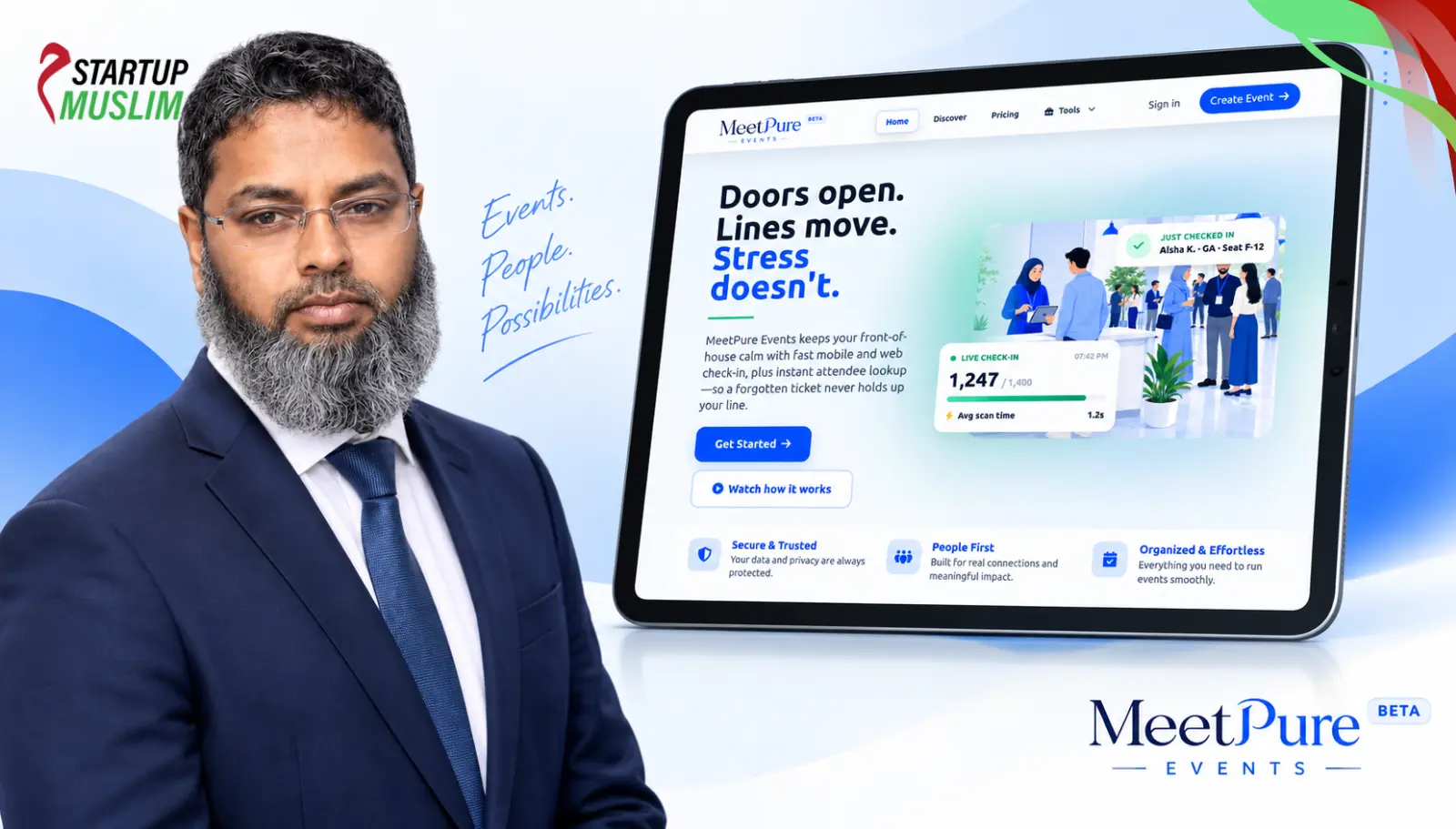
That moment in Austin became the trigger for MeetPure Events, a platform designed to help people organize and discover events without forcing faith-based communities, families and nonprofits to navigate an ecosystem that may not reflect their values. Founded by Zakir alongside his work on Prayers Connect, MeetPure is now evolving into something considerably broader than a ticketing alternative. The company wants to build an operating system for the entire event lifecycle.
When a Search for Community Became a Startup Idea
Before MeetPure Events, Zakir was already working on Prayers Connect, a platform helping people discover mosques and mosque-centered events. That experience gave him a close view of how fragmented community discovery could be, particularly for people looking for gatherings that aligned with their faith and values.
The Austin experience made him realize that the problem extended beyond finding mosques. Communities needed a broader infrastructure for conferences, fundraisers, family events, nonprofit gatherings and other meaningful experiences. He saw an opportunity to create a modern platform where discovering events did not mean accepting recommendations that conflicted with the user’s expectations or values.
The idea was therefore not simply to build a “Muslim Eventbrite.” The more ambitious question was whether a technology platform could embed values such as family safety, privacy, respectful content and transparency into its architecture while still delivering a competitive product experience. That distinction has shaped MeetPure’s development from the beginning.
Building an Event Operating System, One Problem at a Time
MeetPure did not begin by attempting to build every feature its founders envisioned. Zakir says the company started with an MVP, reached out to organizations within its network and hosted events itself. New capabilities were added gradually, often because the team encountered operational problems firsthand or because organizers repeatedly asked for them.
The result is a platform that now extends far beyond ticket sales. MeetPure includes AI-powered event creation, fundraising, email campaigns, project planning, QR check-in, attendee analytics and granular team permissions. An event organizer can, for example, give a volunteer permission to check in attendees without giving that person access to financial information—a particularly relevant feature for community events run by distributed volunteer teams.
Fundraising is also integrated directly into events, while optional project boards allow teams to manage tasks and ownership within the same environment. Rather than forcing an organization to combine separate tools for ticketing, donations, communication and project management, MeetPure is attempting to centralize those workflows around the event itself. For Zakir, there was also a product principle behind this expansion: choosing a values-aligned platform should not require accepting inferior technology. After more than a year of active development, he believes MeetPure has reached parity with mainstream platforms on core fundamentals while advancing further in selected areas.
Turning a Flyer Into an Event in Minutes
One of MeetPure’s most interesting uses of AI came from observing something deceptively simple: organizers often create a flyer before they create anything else. A community organization may design a poster containing the event title, date, time, venue and speaker information, then distribute it through WhatsApp and social media. Traditional event platforms frequently require the organizer to repeat that work by manually entering the same information into a series of fields, uploading the image separately and formatting the listing.
MeetPure takes a different approach. An organizer can upload the flyer, and the platform’s AI extracts details such as the title, date, time, venue and speakers into a structured event draft. The organizer can then review and enhance the information, while the original flyer becomes the event cover image. What could traditionally require filling out more than a dozen fields and spending 10 to 30 minutes on setup can often be reduced to a single upload and a review pass taking only a few minutes. The feature reflects a broader philosophy: technology should adapt to how organizers already work rather than demanding that they change their behavior to accommodate software.
MeetPure is now extending that idea across the event lifecycle. Its AI can help generate descriptions, FAQs, ticket details, emails, invitations, agendas, speaker profiles and event images, while future capabilities are intended to make AI increasingly operational rather than merely generative.
The Bold Business Model: Zero Platform Fees
Perhaps the most unconventional decision in MeetPure’s business model is its commitment to charging organizers zero platform fees. Zakir initially expected the company to take a percentage from each transaction, following the model used by many ticketing businesses. But he kept returning to two principles: organizers should retain as much of their revenue as possible, and attendees should pay as little as possible. Although MeetPure had the technical capability to introduce transaction fees early, the company deliberately chose not to activate them.
The challenge, of course, was sustainability. Zakir describes wrestling with how to reconcile those principles with the need to build a viable business, before arriving at an alternative: allowing attendees to make an optional contribution rather than imposing a mandatory platform fee.
The model has performed better than he expected. According to Zakir, the average voluntary contribution has been comparable to the fee the company originally considered charging, except users are not forced to pay it. Nobody is required to pay the fee, yet many people choose to support the platform anyway. It is an experiment in whether trust and perceived value can sometimes produce an alternative to the traditional transaction-fee model—particularly within communities where organizers often operate with limited budgets and events may be closely connected to charitable or social missions.
Building Technology Around Values Rather Than Adding Them Later
MeetPure is primarily designed with Muslim communities in mind, but Zakir does not see that focus as a constraint on the company’s potential market. He argues that family safety, privacy, transparency and respectful content are concerns shared by schools, charities, nonprofits, families and other faith communities.
Those principles are also reflected in the product’s AI and discovery systems. MeetPure says its AI operates behind safety layers designed for family-friendly event content, while events undergo human and AI-assisted review before becoming available on the platform’s discovery pages. The company can identify events that fall outside its values and prevent them from being surfaced through discovery or recommendations.
That philosophy takes MeetPure back to the original problem Zakir encountered in Austin. Recommendation systems are never entirely neutral; they reflect decisions about what should be promoted, surfaced and optimized. MeetPure is attempting to make a different set of decisions from the architectural level upward. The company’s goal is not simply to filter inappropriate content after it appears. It is to create an environment where people searching for meaningful events can have greater confidence in what the platform may put in front of them.
Early Traction and the Difficult Currency of Trust
MeetPure’s early metrics suggest that the platform has moved beyond concept. More than 45,000 tickets have been sold through the platform, representing approximately $1.9 million in gross merchandise value, achieved by a team of just six people. The company also indexes roughly 44,000 events for discovery, although that figure includes both MeetPure-managed events and external events surfaced through the platform.
Its most recent in-product survey generated an NPS of 83 from 210 responses, with 88% classified as promoters and fewer than 5% as detractors. On the organizer side, Zakir points to repeat usage as another important signal, with organizations returning to use MeetPure for subsequent events rather than treating it as a one-time solution.
But growth in event technology comes with a challenge that cannot easily be solved through a feature comparison. Organizers are trusting a platform with attendees, payments and, in many cases, one of their most important events of the year. If something goes wrong with ticketing, refunds or check-in on the day of an event, the consequences are immediate.
Zakir says the company has learned that trust is earned one event at a time. Payments, payouts, refunds, disputes, compliance and sales tax must work reliably, particularly across jurisdictions. The technology matters, but organizers remember whether the company was dependable when the event itself depended on it.
From the United States to a Global Discovery Platform
The United States remains MeetPure’s primary market, with Canada representing its nearest opportunity for deeper expansion. The company is already seeing organic activity there, while the United Kingdom, GCC and Europe are also markets of significant interest. Yet Zakir is clear that international expansion cannot simply mean switching on a new country inside the software. Payments, currencies, sales tax, regulations, refunds, payouts and local event practices vary considerably from market to market, making local relationships almost as important as the underlying technology.
MeetPure therefore hopes to expand with entrepreneurs and operators who understand their local markets and already have relationships within their communities. Rather than attempting to manage every country remotely from the United States, the company sees partnerships as a more sustainable path to international growth. Over the next 12 to 24 months, MeetPure plans to make its conversational AI assistant generally available, strengthen payments and sales tax compliance, improve local event discovery and expand internationally with the right partners. The longer-term ambition is even broader: a platform capable of supporting everything from a simple RSVP or wedding invitation to a major fundraiser or conference with thousands of attendees.
For Zakir, the ultimate vision has two sides. Organizers should naturally think of MeetPure when they need to create and manage an event. Attendees should think of it when asking a simple question: What is happening around me? And perhaps the most personal measure of success remains the one that inspired the company in the first place. Zakir wants his children to one day open MeetPure without him having to worry about what the platform will put in front of them.


