





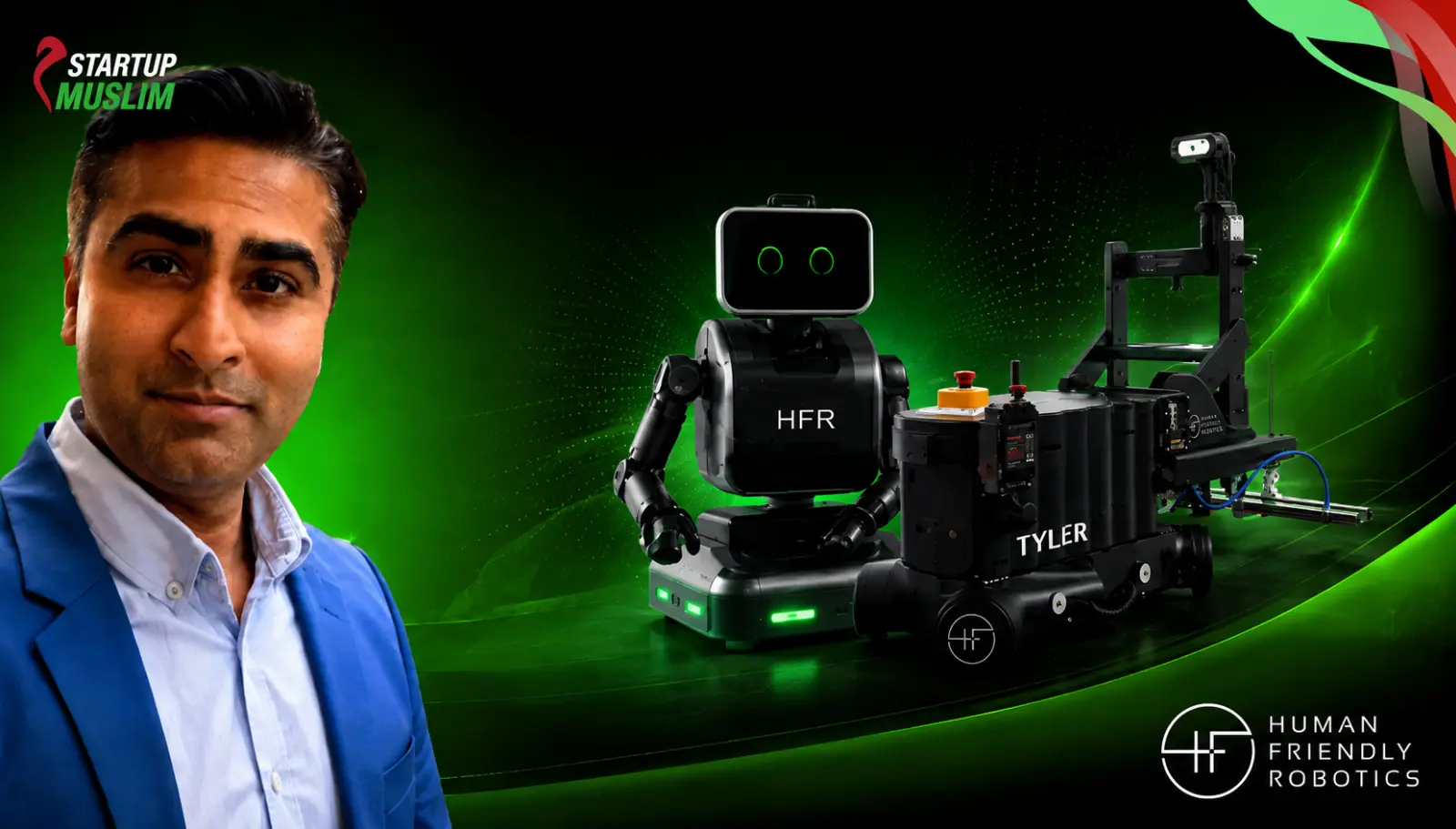
From Software to the Physical World
For nearly two decades, Shamoon Siddiqui built software companies. He founded and worked across ventures including BookSwim, CryptoStreet and Trilogy Education, spending much of his career in a world where products could be designed, tested and shipped primarily through code. But as artificial intelligence accelerated software development, Siddiqui began to question where the next durable opportunities would exist. If a small team could now build software in weeks that once required years and large engineering organizations, he became increasingly convinced that the harder problems would be found somewhere else: in the physical world.
Construction became the answer. It is one of the world’s largest industries, yet many of its most important workflows remain remarkably manual. Moving tiles, pulling heavy electrical cable and operating inside unfinished buildings require physical strength, precision and judgment that cannot be solved with another dashboard or AI chatbot. At the same time, contractors are facing a fundamental labor problem: demand for construction work remains strong, but there are not enough skilled workers to complete the projects already underway. For Siddiqui, that combination created an opportunity worth spending another decade pursuing. Rather than competing to build increasingly interchangeable software, he decided to work on machines capable of doing difficult physical work alongside human beings. That decision led to Human Friendly Robotics (HFR) and its central philosophy: give America’s tradespeople superpowers.

Robots Designed Around Workers, Not Against Them
The name Human Friendly Robotics reflects more than branding. Siddiqui’s fundamental belief is that construction sites are fundamentally different from controlled manufacturing environments. A factory can be designed around a machine, with predictable floors, repeatable processes and tightly controlled inputs. A construction site changes constantly. Materials arrive late, floors are uneven, plans collide with reality and experienced workers make hundreds of small decisions that are difficult to capture in software.
That makes replacing workers with autonomous machines an unnecessarily difficult proposition. HFR is instead pursuing a collaborative model in which humans remain responsible for judgment, adaptation, sequencing and exceptions, while robots take on repetitive motion, lifting, precision and consistency. The company’s products are therefore designed to fit existing workflows rather than forcing construction crews to reorganize their jobs around machines.
There is an important economic argument behind the philosophy. The construction labor shortage is often framed as a recruiting problem, but Siddiqui believes it is increasingly a productivity problem. If the industry cannot immediately produce more skilled workers, one solution is to make each skilled worker more productive without asking them to work harder or endure greater physical strain. That idea is now being tested through HFR’s first generation of specialized construction robots.
Building Robots for the Jobs Construction Workers Don’t Need to Do Alone
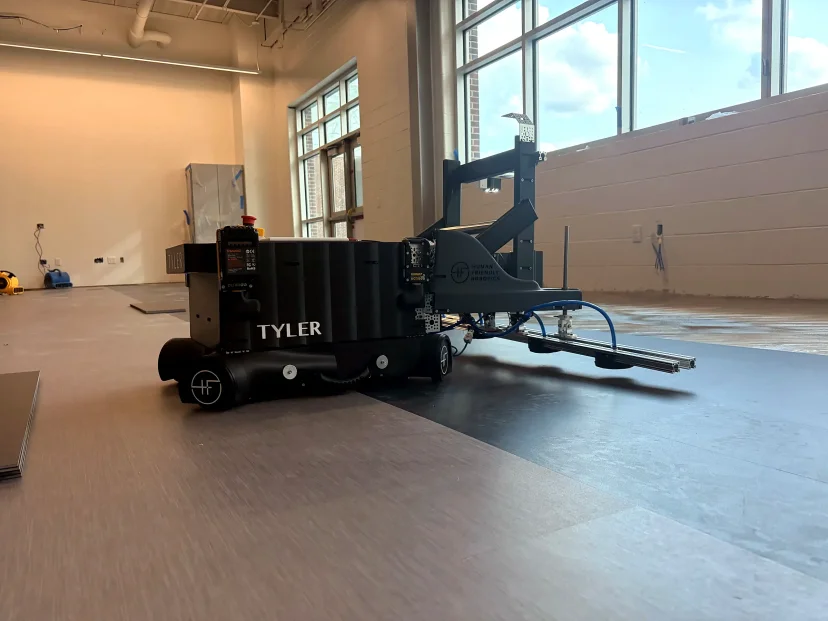
The clearest expression of Human Friendly Robotics’ philosophy is Tyler, the company’s flooring robot. Rather than attempting to replace an entire flooring crew, Tyler takes on one of the most repetitive and physically demanding parts of the job: placing tiles accurately and consistently. The installer remains responsible for the decisions that require experience and judgment, while the robot handles the repetitive motion. In practice, an installer spreads mortar across a row and Tyler picks and places tiles with consistent spacing and alignment. The human worker continues to handle leveling clips, cuts, edges, material decisions and quality checks. It is a deliberately collaborative workflow, with the robot effectively functioning as another member of the crew rather than an autonomous replacement for it.
That approach has already produced measurable results. During a recent deployment at Plaza Las Américas in Puerto Rico, Tyler achieved a measured placement rate of 1.79 square feet per minute, equivalent to approximately 107 square feet per hour during active placement. Siddiqui is careful to distinguish active placement from total finished-floor productivity, noting that the figure does not include cuts, borders, staging, setup, cleanup or waiting for other trades.
That transparency is important. Construction robotics cannot be evaluated through laboratory demonstrations alone. A machine that looks impressive in a controlled test but fails to account for the messy realities of a construction site has little commercial value. HFR’s objective is therefore to make Tyler reliable enough that contractors can eventually plan actual jobs around the robot.
Wattson and the Data Center Boom
HFR’s second major product, Wattson, tackles a very different construction bottleneck: pulling electrical wire. The timing is significant. Artificial intelligence is driving enormous demand for new data centers, but those facilities cannot be built with software alone. Behind every AI data center are vast quantities of conduit, cable, switchgear, cooling systems, concrete and skilled electrical labor. As data-center construction accelerates, the physical infrastructure required to support computing becomes an increasingly important constraint.
Wire pulling is particularly demanding. Large feeder pulls can require substantial crews working with significant physical tension, while also creating safety and coordination challenges. Wattson is being designed to assist electrical crews by coordinating the feeding and pulling sides of the operation, reducing the brute-force labor required without eliminating the electrician.
HFR is preparing for field validation with Mortenson and electrical contractors, with a target of completing 100 commercial wire pulls using Wattson over the next 12 months. But Siddiqui is resisting the temptation to build around the excitement surrounding AI infrastructure. For him, Wattson will only matter if it reliably works inside an electrician’s existing workflow and produces measurable improvements in time, labor or risk.
The Hardest Part Is Not Building the Robot
The deeper engineering challenge is reliability. Construction sites are unpredictable, and a sophisticated autonomous system that fails unexpectedly can be less valuable than a simpler machine that works consistently. Siddiqui’s view is straightforward: customers do not buy technical elegance; they buy completed work and schedule certainty. That changes how HFR approaches robotics. The company pays close attention not only to what the machine can do, but to setup time, manual controls, operator visibility, recovery procedures, component accessibility and the speed at which a technician can diagnose a failure. A robot may perform its core task perfectly and still make a project slower if materials are poorly staged or workers do not know how to recover from an interruption.
For Siddiqui, that is why autonomy percentages can be misleading. The best construction robot is not necessarily the one that operates independently for the longest period. It is the one that a construction crew is willing to use on Monday morning.
From Specialized Robots to a New Construction Technology Platform
Human Friendly Robotics is now moving from technical development toward early commercial validation. Tyler has already operated in live commercial environments, including Plaza Las Américas in Puerto Rico, while HFR has also conducted field work at the Union County Municipal Building and Edison Magnet High School. Those deployments expose the machines to the conditions that matter most: real staging constraints, different surfaces, active crews and actual construction schedules.
On the electrical side, Wattson is preparing for field validation with Mortenson. HFR is also developing relationships with industry organizations and contractor networks, including Starnet and NECA. The company remains deliberately small, with a multidisciplinary team spanning software, robotics, mechanical systems, electrical engineering and field operations.
The company has also been supported by outside investors, including early supporters from the Muslim community. But Siddiqui is clear about what he considers the real evidence of progress i.e. deployments, not fundraising. HFR’s next major operating targets—100,000 square feet of robotically installed flooring and 100 completed commercial wire pulls over the next 12 months—are deliberately physical measures of progress.
Why HFR Is Starting With Specialized Machines
Siddiqui does not see HFR eventually building one humanoid robot capable of performing every construction task. Instead, the company is developing specialized robots on top of shared construction technology. Tyler is purpose-built for flooring; Wattson is purpose-built for wire pulling because the physical requirements of the two jobs are fundamentally different.
What can eventually be shared is the technology underneath: navigation, perception, safety systems, operator interfaces, remote diagnostics, fleet management and jobsite data. That creates the possibility of a broader robotics platform without requiring every individual machine to use identical mechanical systems. Siddiqui is skeptical that humanoid robots represent the ideal answer for most construction tasks. The human body is a general-purpose compromise; a machine designed specifically to place tiles or pull heavy cable can be optimized around that particular job. His argument is that construction does not need machines that imitate workers—it needs purpose-built machines that solve expensive problems well.
The platform, in his view, comes after the products. A technology platform without a commercially valuable robot is simply an architecture diagram. Specialized robots create the customer value first; shared infrastructure can then emerge around them.
Earning the Right to Go Global
The Middle East represents an intriguing future market for HFR, particularly given the scale of construction and data-center investment in countries such as Saudi Arabia and the UAE. But Siddiqui is deliberately resisting the pressure to announce global expansion before the company has established repeatable commercial deployments in North America. When HFR eventually expands internationally, the company expects to work through strong local contractors, distributors and operating partners rather than immediately building its own regional infrastructure. That approach could allow HFR to enter markets with large construction pipelines while keeping service and support manageable.
It is a philosophy that extends to fundraising. Robotics requires patient capital because hardware iteration is slower and field testing is expensive. Siddiqui wants investors who understand that reliability is built through repeated operation, failure analysis and redesign—not through the rapid deployment cycles associated with software. The company’s earliest support from members of the Muslim community is particularly meaningful to him because those investors believed in HFR before the evidence was obvious. For a deep-tech company, that kind of conviction can matter during the period when the vision is still ahead of the proof.
The Next 12 Months Will Be About Proof
Siddiqui’s advice to other deep-tech founders is remarkably direct: sell before you scale. Too many robotics companies can spend years perfecting technology before discovering whether customers will actually pay for the result. HFR is taking the opposite approach—identify a narrow, expensive problem, understand what it costs the customer, put the machine into the field, and let real-world performance determine what comes next. That philosophy makes HFR’s immediate milestones unusually tangible. Over the next 12 months, the company wants Tyler to robotically install 100,000 square feet of flooring and Wattson to complete 100 commercial wire pulls. These are not vanity metrics; they are tests of whether the machines can reliably perform valuable work outside the laboratory.
And perhaps that is the most compelling part of Siddiqui’s vision. The future of construction robotics may not be defined by the robot that looks the most futuristic. It may be defined by the machines that quietly show up every morning, work alongside skilled people, reduce physical strain, improve productivity and simply get the job done. Human Friendly Robotics is betting that the future of construction is not humans versus machines. It is humans with machines—and the goal is to give every skilled worker a little more power.


