





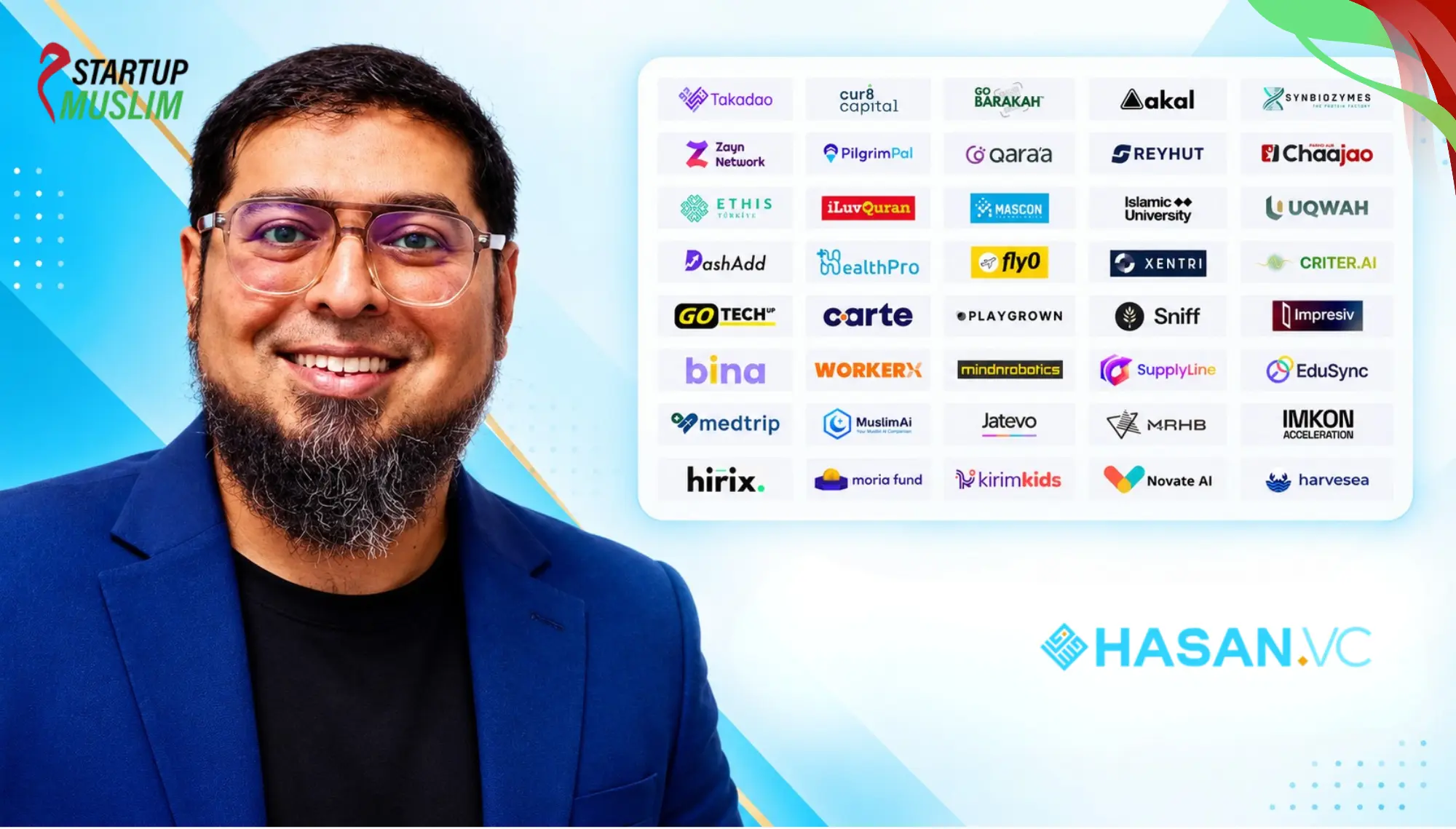
For Umar Munshi, the future of Muslim entrepreneurship will not be determined by how many startups chase billion-dollar valuations. It will depend on how many build businesses that survive difficult markets, solve meaningful problems and create lasting value for their communities.
That conviction sits at the heart of HASAN.VC, the venture capital firm he co-founded to connect Muslim entrepreneurs with investors who understand both their markets and their values. Today, a network of 70 angel investors backs 40 portfolio companies across 10 countries, offering founders more than capital. The network also brings customers, mentors, operating experience, and relationships that can be difficult to access in underserved startup ecosystems.
Munshi is trying to build something larger than a conventional investment fund. His ambition is to create a connected entrepreneurial ecosystem where Muslim founders can build ethical businesses in Jakarta, Karachi or Riyadh with access to the kind of support that has helped startup hubs elsewhere flourish.
Building Ahead of the Market
Munshi began building businesses at 18, developing an early appreciation for the challenges of introducing new products and business models before markets are ready for them. In 2014, he co-founded an Islamic fintech venture builder with Ronald Wijaya, launching regulated, ethical fintech platforms in five countries. One of its early initiatives focused on real estate crowdfunding for social housing in Indonesia, helping fund thousands of homes.
This experience taught Munshi a lesson that would shape his approach to entrepreneurship and investing. Building a product is only one part of building a company, particularly when the business operates in regulated financial markets. Securing licences as a first mover meant earning the confidence of regulators, shareholders and tens of thousands of crowdfunders, each of whom needed a reason to trust a relatively unfamiliar model.
Trust, he learned, develops more slowly than technology. Yet it can become one of a company’s most valuable assets when market conditions deteriorate. His work on GlobalSadaqah, a platform for zakat, sadaqah and waqf giving, reinforced another conviction. Financial technology could make established Islamic practices more accessible by removing the friction between people’s intentions and their ability to act on them. The challenge was not necessarily to invent new behaviour, but to build better systems around needs that already existed. That insight would eventually lead him to HASAN.VC.
Why HASAN.VC Is Betting on the Community
Munshi saw two problems in the Muslim entrepreneurial ecosystem. Founders were building promising halal businesses but often struggled to find investors who understood their industries, geographies and values. At the same time, individuals in his wider network wanted to invest in early-stage companies but lacked the time, expertise or structure to assemble and manage a diversified startup portfolio themselves.
HASAN.VC was designed to connect those two groups. The underlying opportunity is substantial. The Islamic economy spans industries including food, finance, healthcare, travel and lifestyle, yet relatively little of its economic activity translates into early-stage investment for companies developing new products and infrastructure. Munshi’s response was to build a fund powered by a community whose members could contribute more than money.
The result is a model in which investors can help portfolio companies find customers, recruit talent, secure partnerships and establish credibility. A founder raising capital in an unfamiliar market may need an introduction to a potential enterprise customer just as urgently as another cheque. A network of investors and experienced operators can help provide both. Today, 70 angels support 40 portfolio companies across 10 countries. For Munshi, the significance lies not only in the number of companies funded, but in the relationships that connect them. Capital may open the door. The community can help a founder keep moving once inside.
The Case for Building Camels, Not Unicorns
Munshi’s investment philosophy is captured in the image of a camel. The animal can survive difficult conditions, carry heavy loads and continue moving when resources are scarce. It is also the inspiration behind HASAN.VC’s podcast, Camels vs Unicorns, which reflects his preference for companies designed to endure rather than businesses built around growth at any cost. This distinction matters in Southeast Asia, the Middle East and North Africa, and South Asia, where entrepreneurs may face limited capital, demanding customers and complex regulatory environments. A company cannot assume that another funding round will always be available to compensate for weak fundamentals. It must learn to make disciplined decisions with the resources it has.
Munshi contrasts this approach with the power-law model associated with Silicon Valley, where abundant venture capital can support aggressive growth in the expectation that a small number of enormous outcomes will compensate for the rest of a portfolio. HASAN.VC welcomes ambitious outcomes, but its community-backed structure creates a different set of incentives. The firm favours durable businesses with credible paths to profitability. That emphasis also reflects its approach to Islamic finance, with its focus on real economic activity and shared risk and reward rather than interest-based returns or excessive speculation. The philosophy does not mean founders should think small. It means they should build businesses capable of surviving long enough to realise their ambitions.
What HASAN.VC Looks for in a Founder
For Munshi, halal compliance is the first investment filter. A business must be halal in substance, not merely in its branding. Once that requirement is met, he evaluates founder quality, business fundamentals and market size, in that order. The founder’s character matters because early-stage investing involves considerable uncertainty. Financial projections can change, customer behaviour can surprise even experienced operators, and products often need to be refined after entering the market. Munshi looks for resilience, honesty about what is not working and a detailed understanding of the company’s numbers.
A polished pitch is not a substitute for strong unit economics. Founders should understand customer acquisition cost, retention and the margins as clearly as they understand their vision for the market. Investors need to know whether the business can turn demand into sustainable revenue, not simply whether its addressable market looks impressive in a presentation.
He also sees a connection between a founder’s values and the way the business operates. A sincere commitment to halal principles should influence relationships with employees, customers and partners. In that sense, ethical conduct is not a separate box to tick after financial analysis; it should be visible in the decisions that shape the company.
Munshi’s advice to founders is straightforward. Build for the market in front of you, acknowledge problems openly and make every dollar work. Trying to copy a Silicon Valley growth story without accounting for local capital constraints or regulation can be as damaging as treating halal as a marketing label.
Five Companies Reflecting a Broader Opportunity
HASAN.VC’s portfolio illustrates the range of problems Muslim entrepreneurs are addressing, from social finance and healthcare to recruitment, education and agriculture. GoBarakah, a Malaysian platform that began with corporate giving software, has expanded into what the company describes as Malaysia’s first regulated Social Exchange. It has won competitions run by the central bank and the Securities Commission and secured backing from venture capital firms. Its evolution reflects an effort to build financial infrastructure around social impact.
In Indonesia, HealthPro is addressing healthcare workforce operations. By adding scheduling, payroll and credentialing to its platform, the company grew monthly revenue eightfold over 18 months and is now raising a seed round. Its progress highlights the potential in solving operational problems inside essential industries rather than focusing exclusively on consumer-facing applications.
Hirix, an AI-native recruitment platform, serves enterprise clients in Malaysia, Japan, the United States and Canada. Its acceptance into a leading AI chipmaker’s startup programme is another sign of its progress. Qara’a, meanwhile, is bringing artificial intelligence into Qur’an learning and has surpassed two million downloads in Indonesia, alongside a distribution partnership with the country’s largest mobile operator for the recent Hajj season.
MindNRobotics applies robotics and the Internet of Things to Malaysian palm oil plantations, with backing from a Malaysian government agency. Together, these companies demonstrate Munshi’s interest in businesses grounded in specific market needs. They are not united by a single technology or industry, but by founders who understand the problems they are trying to solve and have begun demonstrating traction.
A Connected Network for the Muslim World
Munshi’s long-term ambition is to build what he describes as a “Y Combinator for the Muslim world,” connecting founders, capital and customers across markets that too often operate in isolation. He believes the foundations are already emerging, with companies operating across 10 countries and a meaningful portion of the portfolio already profitable, even at an early stage. The next phase requires two developments. First, founders need deeper follow-on capital so that the investors who back them early can continue supporting them as their businesses grow. Second, the model must expand further into MENA and South Asia, where entrepreneurial activity is rising but access to startup capital remains uneven.
The goal is a network where relationships between Jakarta, Karachi, Riyadh and Istanbul become as useful and accessible as those between established startup hubs. That means capital moving across borders, experienced operators mentoring new founders and portfolio companies becoming customers and partners for one another.
Community is central to that vision. A cheque may arrive once, Munshi argues, but a useful network can support a founder every week through introductions, hiring assistance, fundraising advice and commercial partnerships. HASAN.VC works directly with founders on strategy, hiring, fundraising and partnerships, while planning for potential exits from the beginning. Its investment priorities also reflect the scale of unmet needs. Munshi points to agritech, healthcare workforce infrastructure and social-finance systems serving Islamic banks and regulators. Artificial intelligence accounts for roughly a quarter of the portfolio, but he is particularly interested in applications that reduce operating costs. He expects some of the first billion-dollar Muslim-led companies to emerge from infrastructure businesses underpinning finance, healthcare and trade.
Building a Legacy Beyond the Exit
Munshi’s approach to investing is inseparable from his understanding of faith. He sees Islam’s emphasis on doing good, solving problems and leaving a legacy as a practical guide to choosing businesses. Companies such as Takadao and MRHB, which offer Shariah-compliant alternatives in insurance and finance, reflect the effort to widen access to products aligned with Muslim customers’ needs.
For him, legacy is measured in jobs created, skills developed, problems solved and trust that survives the founders who established a business. He would rather back ten founders who build lasting companies over 15 years than one founder who pursues a quick exit. The same principle informs his emphasis on barakah, or blessing, and the belief that the means through which a business creates value matter alongside its eventual results.
This vision also broadens the responsibility beyond investors. Angels can provide capital and experience; professionals can mentor and help recruit; customers and partners can offer early contracts and distribution. Others can contribute through introductions, amplification and the willingness to believe in a founder before the wider market does. The opportunity, Munshi believes, is for the ummah to act as a connected economic network rather than a collection of isolated entrepreneurs and investors.
The next generation of Muslim founders does not need capital alone. It needs a community prepared to help them build businesses that last. Founders and community members interested in this model can learn more at hasan.vc.


