


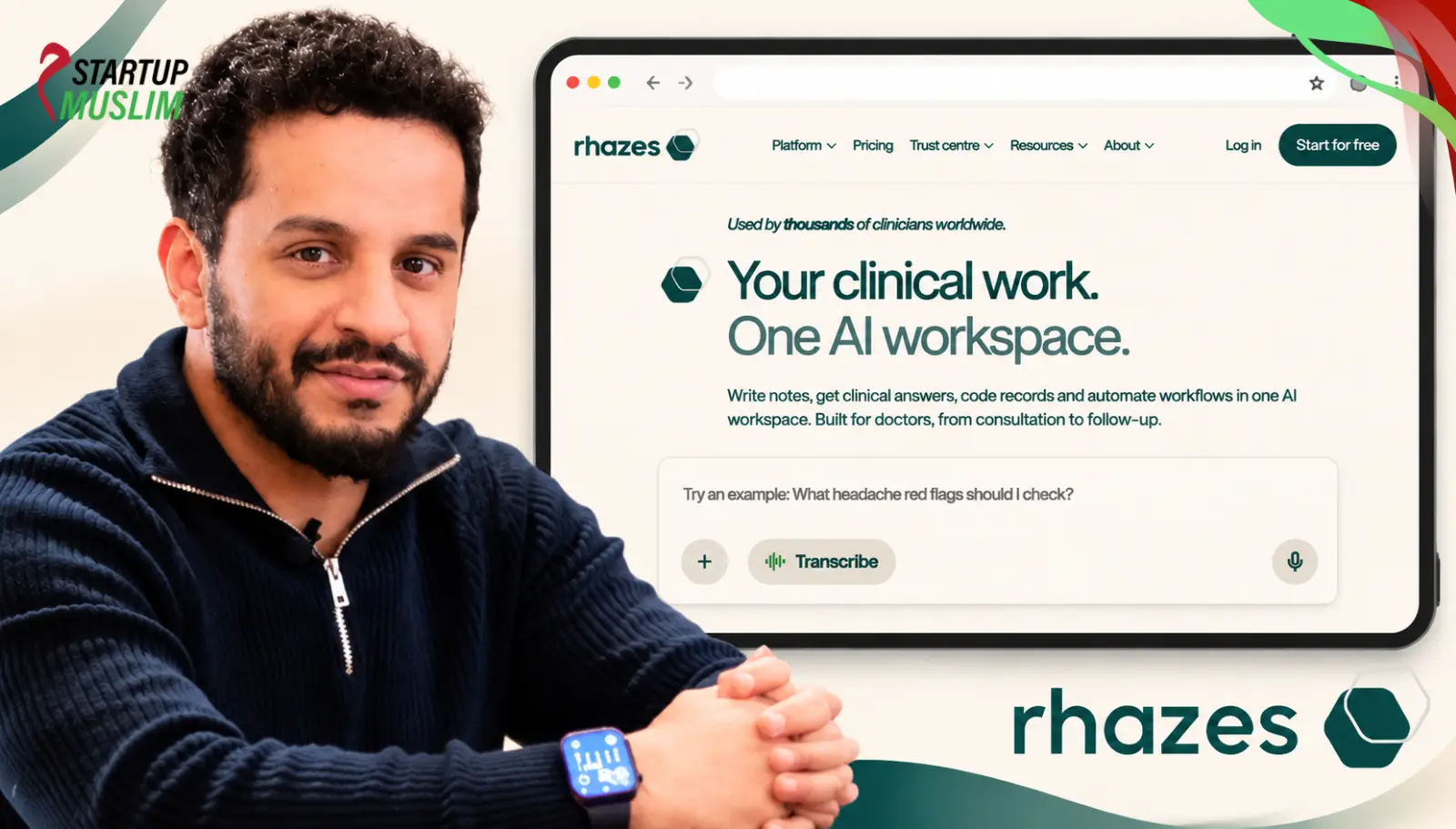
A doctor’s work does not end when a patient leaves the consultation room. There are medical records to review, clinical notes to complete, research to conduct, prescriptions to prepare and letters to write. For many healthcare professionals, these responsibilities take up hours that could otherwise be spent with patients. Dr Zaid Al-Fagih experienced this reality firsthand while working as a doctor in the UK’s National Health Service (NHS). Today, he is using that experience to build Rhazes, a clinical artificial intelligence platform designed to help doctors manage more of their daily work.
His journey into healthcare technology was shaped by two very different environments. One was the highly developed British healthcare system, where he trained and practised medicine. The other was his humanitarian work during the Syrian conflict, where he volunteered as a first responder and first-aid trainer in settings with limited resources and access to medical expertise.
Together, these experiences led him to a question that would eventually become the foundation of Rhazes: how much more could a doctor achieve with the right support?
From the NHS to Humanitarian Work in Syria
Al-Fagih trained in medicine at Imperial College London and went on to work as an NHS doctor. During his clinical experience, he saw how much time healthcare professionals spent managing information rather than directly caring for patients. A patient’s medical history might be spread across several records, while relevant research papers and treatment guidelines were stored elsewhere. Bringing everything together before making a clinical decision could take considerable time.
His interest in solving these problems extended beyond medicine. He pursued a management degree at Imperial and studied public policy at the University of Oxford, gaining a wider understanding of how healthcare systems operate and where improvements could be made.
His humanitarian experience in Syria added another dimension to that understanding. Working as a first responder and first-aid trainer exposed him to the difficulties faced by medical professionals when resources, specialist support and access to knowledge are limited. He saw how much responsibility individual clinicians carry, particularly when they have little support around them.
For him, the problem was not simply that doctors needed better software. They needed practical tools that could help them make informed decisions while reducing the workload that came with treating patients.
How Rhazes Started and Found Its Direction
Rhazes was founded in 2023, at a time when advances in large language models were creating new possibilities for applying artificial intelligence to medicine. Having experienced the challenges of clinical work himself, Al-Fagih saw an opportunity to use these developments to address problems he understood personally.
The company initially concentrated on diagnostic support and medical documentation. Preparing a discharge summary, for example, requires a doctor to bring together a patient’s admission details, investigations, treatment and follow-up instructions into a clear document for the next stage of care. AI offered a way to process much of this information and help doctors explore possible diagnoses and treatment options.
However, conversations with clinicians revealed that the opportunity was much larger. Doctors needed to access patient information repeatedly throughout their working day, not just when preparing a diagnosis or writing a discharge summary. Rather than creating separate tools for individual tasks, Rhazes could connect these activities in one clinical platform.
In April 2025, the team made the decision to rebuild the product around this broader vision. The new platform entered beta in June and launched more widely in September 2025, bringing patient record analysis, clinical questions, research, documentation and other everyday tasks into a single experience.
It was a major decision that required the team to reconsider much of the work it had already completed. But Al-Fagih believed the larger opportunity justified starting again.
More Than 10,000 Doctors and a Growing International Platform
The rebuilt platform has gained considerable traction since its launch. Rhazes now has more than 10,000 doctors on its platform, alongside paying individual customers and hospital pilots. For a company that introduced its unified clinical platform in September 2025, reaching this community represents an important stage in its growth.
Its business operates through two main routes. Individual doctors can discover the platform and subscribe directly, giving Rhazes an international user base and allowing the company to receive feedback from the clinicians using its technology. Healthcare organisations can also arrange tailored deployments that connect Rhazes with their existing patient records and clinical guidance.
The company’s commercial model includes individual subscriptions, organisational contracts and software development services. Its investors include Plug and Play, Qatar Development Bank and Hatcher+, alongside private investors. The funding has supported the development of a platform designed to serve both individual clinicians and larger healthcare providers.
For Al-Fagih, reaching more than 10,000 doctors is only the beginning. The next challenge is turning that growing community and the experience gained through hospital pilots into wider adoption across healthcare systems internationally.
What Makes Rhazes Different From Other Clinical AI Tools?
Many AI tools can answer medical questions, summarise information or help prepare documents. Rhazes aims to bring these capabilities together so that doctors can use one platform throughout different stages of a consultation and the work that follows.
Consider a doctor treating a patient with several long-term conditions and a complicated medical history. Understanding the patient’s previous treatments, reviewing relevant medical evidence and considering management options can require significant time. Rhazes helps bring this information together, allowing clinicians to explore relevant research and prepare clinical documents based on the guidance used by their organisation.
Its capabilities also extend beyond individual consultations. Hospitals can connect the platform to existing patient record systems and use it to review records against clinical standards. The company also supports medical coding, which translates diagnoses and procedures into recognised codes used in healthcare records and billing.
Language is another important part of its approach. Rhazes supports Arabic and other languages, helping it serve healthcare environments where patients, doctors and medical records may use different languages. This is particularly relevant in the Gulf, where local communication and clinical practices must be considered when introducing new technology.
The idea is to support both the clinical thinking and the administrative work involved in patient care.
Research, Accuracy and the Importance of Clinical Trust
In healthcare, saving time is valuable, but an inaccurate medical answer can create serious risks. Al-Fagih’s background as a doctor has influenced how Rhazes approaches reliability, with an emphasis on connecting clinical answers to supporting evidence that doctors can inspect.
The company’s research includes methods for grounding treatment recommendations in medical guidelines, translating clinical information into recognised medical codes and evaluating how AI models identify multiple conditions in a patient. These methods have informed the technology behind its platform.
There is also published research supporting some of its practical benefits. A comparative study of Rhazes using recorded consultations, published as an abstract in the BMJ’s Emergency Medicine Journal, reported a reduction of more than 60% in transcription time compared with manual transcription. While this measures a specific task rather than the full clinical workload, it offers a measurable indication of the time that AI-assisted documentation can save.
Rhazes also holds Class I medical device status and ISO/IEC 27001:2022 certification for information security management. Its safeguards include encryption, access permissions, activity logs and security testing. Customer data is excluded from foundation-model training, and healthcare organisations can configure deployments according to their hosting and data-location requirements.
Doctors can review supporting sources, edit generated documents and approve them before they are used in patient care. The technology is designed to assist clinical professionals, not take responsibility away from them.
Bringing Clinical AI to Underserved Communities
Al-Fagih’s humanitarian experience continues to shape the company’s ambitions, particularly when it comes to healthcare access in underserved communities. In smaller clinics and resource-limited settings, doctors may not have immediate access to specialist colleagues, administrative support or extensive medical resources. A platform that helps them review patient histories, find relevant guidance and prepare clinical documents could make a meaningful difference.
His connection to Arabic-speaking communities makes this area particularly important to him. A patient might describe symptoms in a local dialect, while the doctor uses English medical terminology and needs to prepare documents in another language. Rhazes aims to make these transitions easier while supporting the clinical guidance relevant to each healthcare setting.
His experience in the UK and Gulf has also shown him that successful adoption requires more than introducing advanced technology. The NHS offers a strong environment for clinical research and medical innovation, while Gulf healthcare markets have shown significant ambition in investing in new technology and expanding healthcare capabilities. Bringing these strengths together creates opportunities for companies developing clinical AI for international markets.
For Al-Fagih, access should not be limited to well-funded hospitals. A doctor in a small, under-resourced clinic should also be able to benefit from the same advances available to clinicians in major medical centres.
The Vision: A Clinical Team Available Around the Clock
Over the next three to five years, Al-Fagih wants Rhazes to develop into a platform capable of supporting increasingly complex clinical work under a doctor’s direction. He envisions a system that can prepare for consultations using a patient’s medical history, investigate difficult clinical questions and coordinate the work that follows a treatment decision.
One area he is particularly interested in is proactive care. Rather than waiting for a patient to return with a problem, an AI system could monitor changes in medical records, alert healthcare teams to emerging concerns and help track overdue investigations. Such capabilities could help doctors identify issues earlier and maintain a clearer picture of a patient’s health between appointments.
The company has designed Rhazes to incorporate advances from different AI providers, allowing it to build on improvements in language, speech, image understanding and the ability to complete complex tasks. Its longer-term ambitions include personalised treatment, supported by a deeper understanding of each patient’s medical history and available research.
Ultimately, Al-Fagih wants Rhazes to become a widely used clinical platform across countries and medical specialties, with measurable improvements in doctors’ capacity and the care patients receive.
His journey began with a doctor recognising how much time was being lost to tasks that took him away from patients. Today, that experience is shaping a company working towards a different kind of healthcare environment, one where technology takes on more of the workload and doctors have more time to do what they trained for.
The ambition is not to replace the doctor. It is to give the doctor a better team.
