


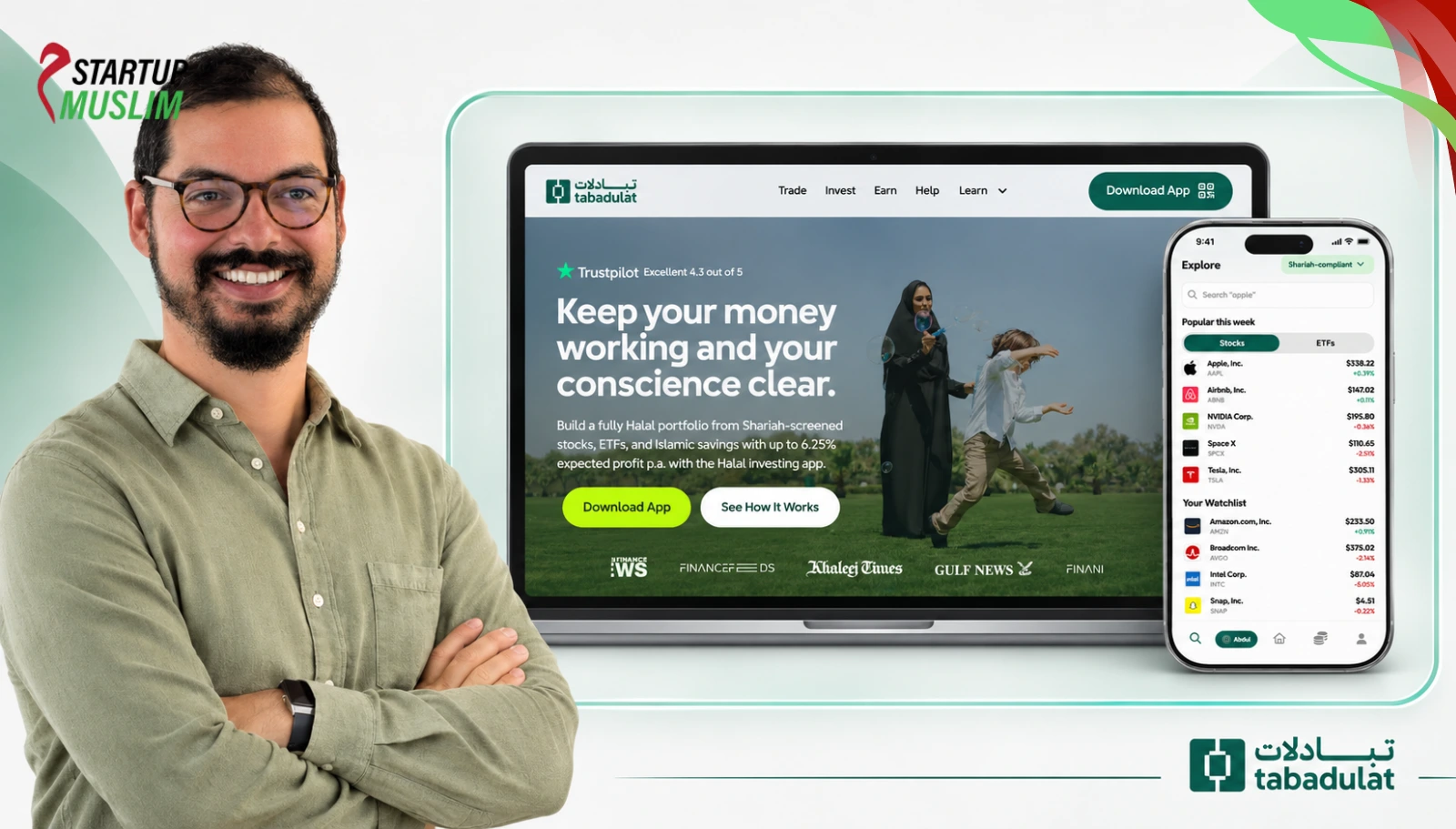
For many Muslim investors, putting money into the stock market has never been as simple as opening a brokerage account and buying shares. A stock may look attractive, but is the company Shariah-compliant? Does the broker lend shares or pay interest on idle cash? How should investors calculate zakat and purify income that does not meet Islamic requirements? These questions can turn what should be a straightforward investment decision into a complicated exercise.
For Samy Mohamad, this was not just a market gap he had spotted from a distance. It was a problem he had faced himself. After more than a decade in global financial markets, experience at Morgan Stanley and professional trading in London, he found that the tools available to Muslim investors did not meet his own requirements. Rather than accept the compromises, he decided to build something different.
That decision led to Tabadulat, a financial technology company building a regulated brokerage designed around Islamic principles from the ground up.
From Morgan Stanley to Building a Brokerage
Samy’s journey into entrepreneurship began with a career at the intersection of finance and technology. He spent more than a decade in global capital markets, including at Morgan Stanley, where he advised senior leadership on emerging technologies that could shape the future of banking. His work covered areas such as quantum computing, post-quantum encryption, cryptocurrency, tokenisation, central bank digital currencies and stablecoins. He was also exposed to OpenAI before ChatGPT entered the mainstream.
But technology strategy was only one part of his professional life. Trading was his passion. After leaving Morgan Stanley, he became a professional futures trader in London, an experience that shaped how he approaches decisions and risk. Trading, he explains, leaves little room for excuses. Every decision has a consequence, and the results are visible in the trading balance. His academic experience at London Business School added another dimension. He completed a Master’s in Analytics and Management, where he learned to apply engineering and analytical thinking to financial markets. The combination of technical knowledge, financial experience and a trader’s discipline would later become central to building Tabadulat.
A Personal Problem That Became a Business
The idea for Tabadulat emerged when Samy began looking more closely at the relationship between his investments and his faith. His professional trading career had given him access to financial markets, but learning more about riba made him question whether futures trading aligned with Islamic principles. He decided he wanted his money to reflect his values as a Muslim. The decision came at a cost. Moving towards Shariah-compliant investing exposed how difficult and expensive it was to find reliable services. Samy found asset management fees as high as 2%, screening services he considered unreliable, and a fragmented system in which investors had to use different providers to check compliance, execute trades and calculate purification and zakat.
The problem was not simply a lack of halal investment options. It was the absence of an integrated system that could bring compliance and execution together. An investor might screen a stock on one platform, buy it through a conventional broker with features such as stock lending, and then manually check whether the holding remained compliant. Calculating zakat across a large portfolio could become a separate task involving spreadsheets and company financial statements. Samy believed Muslim investors should not have to choose between the quality of their investment experience and their religious principles.
He built the platform he could not find.
Building Islamic Finance Into the Platform
Tabadulat’s central idea is that Shariah compliance should not be an additional feature placed on top of a conventional brokerage. It should shape how the entire platform operates. The company has built its own infrastructure around screening, trading, custody and ongoing compliance, with the aim of making the experience straightforward for investors.
Its regulatory and governance structure is a major part of that approach. In December 2025, the Abu Dhabi Global Market’s Financial Services Regulatory Authority granted Tabadulat its full Financial Services Permission as a Category 3A firm. The company also received authorisation for Islamic Financial Business. According to Samy, this makes Shariah compliance part of its regulated operating framework rather than simply a marketing claim.
Tabadulat is also an AAOIFI member and has an independent Shariah Supervisory Board made up of three scholars specialising in the rules governing trade and investment. The company’s fatwa is publicly available, allowing users to examine the basis of its Shariah framework. It also says its operations, execution systems and handling of client money and assets are covered by Shariah compliance audits.
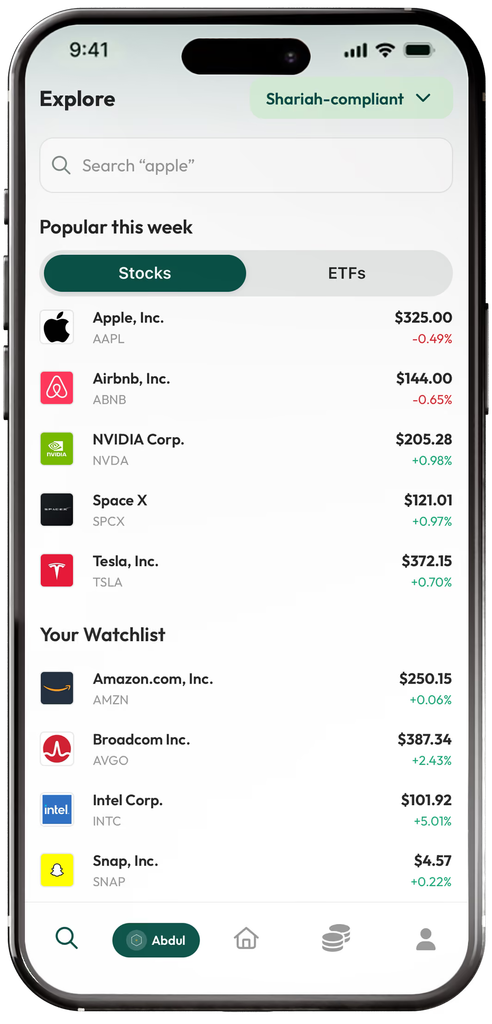
Screening is another important part of the model. Tabadulat says it partners with the only AAOIFI-approved Shariah screener in the world and makes its screening data available to users for free. The platform monitors company activities and financial ratios, including interest-bearing debt, interest-bearing investments and non-permissible income. Since a stock’s status can change when a company reports new financial results, screening is repeated as new filings become available. In practical terms, users can see the compliance status of stocks in the app. They cannot purchase an asset that is classified as non-compliant, although the platform does not automatically force them to sell an existing holding if its status changes.
The Challenge of Building the Infrastructure
Securing regulatory approval was only one part of the work. Samy says the greater challenge was building an operating model that could meet the standards expected of a regulated financial institution while also satisfying its Shariah requirements. That meant developing governance, anti-money laundering controls, technology, risk management, custody arrangements and counterparty relationships together. The company also found that many conventional financial technology providers could not support what it wanted to build. Third-party brokerage systems and back-office vendors did not offer the functionality needed for Shariah monitoring, purification or zakat calculations. Tabadulat therefore had to develop much of its own infrastructure.
Working with Islamic banks created further challenges. Samy says that parts of the Islamic financial infrastructure remain behind conventional banking systems, particularly when it comes to custody and keeping client funds in non-interest-bearing accounts. Building the right arrangements required significant work with banking partners, some of whom now approach Tabadulat for guidance on improving their own infrastructure.
The company’s white-label business model adds another layer of responsibility. Through a business-to-business-to-consumer approach, institutions can use Tabadulat’s technology and infrastructure to serve their own customers. This requires institutional-grade security, access controls and technology standards, not just a functional consumer app. For Mohamad, these constraints have also shaped the company’s approach to product development. Rather than launch quickly and fix compliance issues later, Tabadulat aims to ensure the regulatory and Shariah frameworks are in place before introducing new services.
Funding Growth Without Venture Capital
Tabadulat has secured close to US$4.5 million in committed capital, according to Samy. The funding is intended to support three priorities: strengthening its position in the UAE, expanding the product range and entering additional markets when the required regulatory approvals and infrastructure are in place. The company currently offers access to halal US stocks and ETFs, alongside Murabaha savings. It is also preparing to expand access to almost 80 global capital markets. Its planned product roadmap includes precious metals, real estate investment trusts, sukuk, multi-currency IBANs, debit cards and payment services.
Samy believes the opportunity extends well beyond the United States. He points to the limited availability of Islamic banking services in Europe as an example of the gap between Muslim demand and the financial infrastructure available to serve it. However, he is careful not to announce expansion plans before licensing and local arrangements are sufficiently advanced. The company is also taking a deliberate approach to its sources of capital. Samy says Tabadulat has not taken venture capital funding and does not intend to do so. He wants to avoid pressure from shareholders to introduce services that may be commercially attractive but do not align with the company’s principles. The committed capital gives the business room to build its team and focus on long-term product decisions.
Although Tabadulat does not yet publish detailed figures for registered users, assets under management, trading volume or revenue, Samy says active users and client assets are both growing at double-digit rates month on month. He adds that the company is still at an early stage of scaling customer acquisition and is using user feedback to improve the product.
Making Halal Investing Simple and Affordable
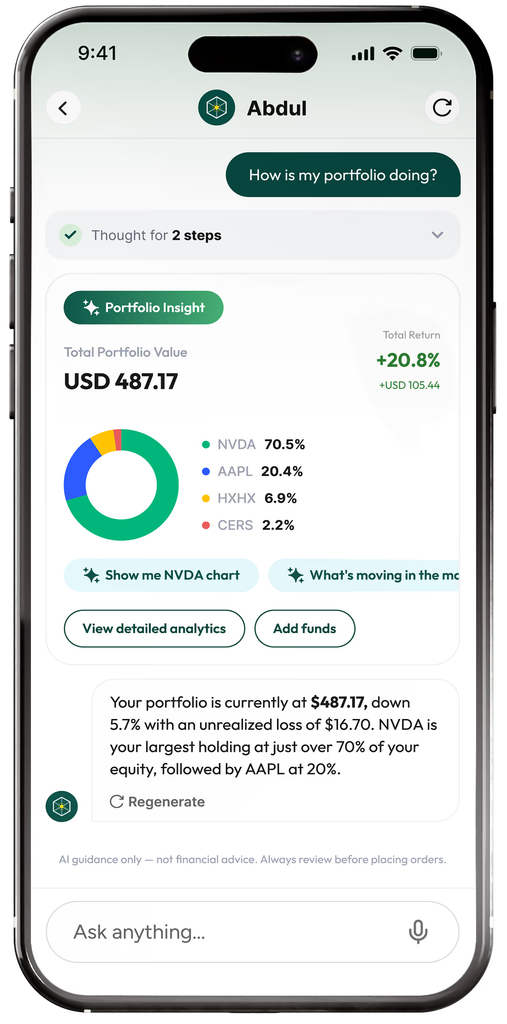
One of Tabadulat’s ambitions is to reduce what Samy `calls the “Halal Tax”: the additional cost Muslim investors can face when using financial products designed for Shariah compliance. He argues that conventional financial institutions have often added halal screening to existing products rather than building a complete alternative. The extra layers can lead to higher fees for customers. Tabadulat’s pricing is designed to challenge that model. The company offers zero-commission trading on US stocks and ETFs, with fractional trading available for a $1 charge. Users can access screening, financial data, charting tools and AI-powered analysis, while its Murabaha savings product offers up to 6.25% expected annual profit. Other markets may involve applicable exchange charges.
Samy also sees the opportunity to bring real assets and broader financial services to everyday Muslim investors. Precious metals, REITs and sukuk are among the products he is interested in introducing, alongside tools that make zakat and purification easier to manage. His view of tokenisation and cryptocurrency, however, is more cautious. He argues that Muslim investors should focus on real assets and the real economy rather than speculative products. For him, the more meaningful opportunity is to build financial infrastructure that connects Shariah governance, execution, custody and cash management in a single system.
A Global Financial Platform Built Around Faith
Samy’s long-term ambition is to make it possible for Muslims anywhere in the world to invest, save and manage their money without compromising their faith or accepting an inferior financial experience. He believes Islamic financial products should compete on quality, convenience and value, not rely on religious identity alone to attract customers. His advice to Muslim entrepreneurs reflects that belief. Founders should start by proving that a real problem exists, understanding what customers currently pay and building a better solution. Shariah compliance, he argues, should be the foundation of the business, not the only reason people choose it. A halal product still needs to be a good product.
He also stresses patience, careful hiring and honest leadership. Building in financial services requires founders to understand their limitations and bring in people who can cover their weaknesses. At Tabadulat, he credits co-founders Ali Abdulkadir Ali and Ahmed Said, alongside the wider team, for helping turn the company’s vision into an operating business. The larger opportunity is not limited to building another investment app. It is about giving Muslim investors access to the same level of financial infrastructure that conventional customers have long taken for granted. If Tabadulat succeeds, its impact could extend beyond its own customers and help shape how Islamic financial services are built and delivered.
Samy ends with a message that captures the scale of the ambition: “Muslims can do the maths. We built the rails for the banks. Now we have to build them for the people.”
